
Throughout 2025, work continued on Recreational Craft Directive (RCD), Recreational Craft Regulations (RCR) and Post Construction Assessment (PCA) research, with a newly drafted paper by Tom Keeling – known as PCA 2 – receiving an encouraging response from Graham Russell MBE, Chief Executive of OPSS (Office for Product Safety & Standards). The paper is due for wider release in early 2026.
Since the release of the PCA 1 paper in 2024, IIMS has remained engaged with members and sector colleagues, in the hope that keeping the topic in focus will help drive an industry response, leading to clarification. Additionally, the IMarEST Exec has agreed to provide whatever support it can to help.
Following receipt of the PCA 2 paper, OPSS has agreed there is:
“confusion across the industry in relation to the Post Construction Assessment requirements. OPSS recognises the matters raised and we will be in contact with other stakeholders in the sector on this issue”.
Continuing, they confirmed they are:
“reviewing the information published on gov.uk and by other organisations regarding the PCA requirement in the regulations, to determine whether a revision to OPSS’ regulatory guidance for the RCR would provide clarity for businesses and professionals operating in this market”.
This is good news for the sector, which has struggled to understand how to apply PCA, following a difficult few years of varying interpretations. OPSS also confirmed that Trading Standards are actively engaged in reviewing industry guidance; this dual approach can only be positive for the recreational small craft industry and provide much needed clarity.
One large problem area is amateur-fitted professionally built hulls, commonly known as “sailaways”. Throughout the late 1990s and into the 2020s, thousands of DIY enthusiasts bought part-completed vessels from manufacturers, fitting them out and putting them to use, many as liveaboard homes.
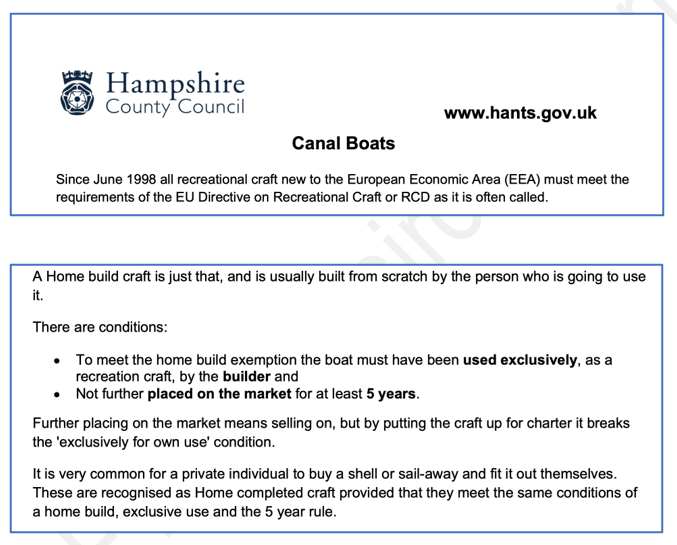
The inland waterways industry happily endorsed and supported the practice, understanding that such vessels could be considered as home-built boats. As a result they qualified for an exemption to the RCD as long as they were not sold on for a period of 5-years from the date of completion (the so-called 5-year rule).
Recently attitudes in some quarters have changed, with some brokers telling boaters their long-completed sailaway vessels are illegitimate, having been incorrectly entered into service by not being CE marked. They are told they have in fact modified a ‘product’, and as such, a PCA by an Approved Body is required, and that this is a legal requirement in order to sell the vessel. Some boaters follow this instruction, and costs incurred are reported to rise to around £10,000 in some cases.
In 2023, an informally arranged brokers’ group was formed to challenge this emerging view on the basis that they believed all they were doing in the past – and in fact all boaters were doing – was following industry guidance. Contemporary letters and printed guides from high-ranking and respected organisations like the Boat Safety Scheme, Royal Yachting Association and the Canal Boatbuilders Association were produced that supported this view; that a sailaway vessel is a home-built vessel and as long as it is not sold within 5 years of completion, is exempt from the regulations thereafter. However, still some disagreed that the 5-year rule was ever a “thing”.
During this 25 year period of prolific amateur fit-out of professionally-built hulls, Hampshire Trading Standards were the lead authority in the UK regarding the RCD. Their role in providing top-level compliance guidance to the industry, trade organisations, as well as Trading Standards offices across the country was well known and documented. In fact, in 2010 to provide absolute clarity, Hampshire Trading Standards published a set of guidance factsheets about the RCD, including one entitled “Canal Boats”. Re-released in early November 2025 through a Freedom of Information (FOI) request, the factsheet makes clear what the UK national position was regarding sailaways.
The guidance is unambiguous and it is clear the concept of amateur fit sailaways was endorsed at the highest levels.
Marine professionals are now optimistic that the ongoing review by OPSS and Trading Standards will at last provide authoritative guidance and clarification, reassuring owners and sellers of such vessels what is required of them in order to sell their used vessels, ending a period of considerable unease in the sector.