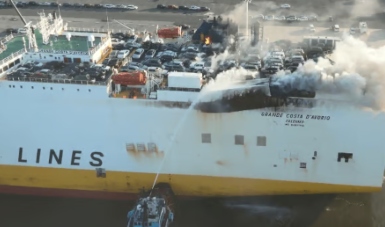
Operator modifications blamed by shipbuilder for Dali blackout

Operator modifications blamed by shipbuilder for Dali blackout . Phoot credit: USACE
Operator modifications blamed by shipbuilder for Dali blackout . Photo credit: USACE

The fallout following the M/V Dali accident which caused the collapse of the Francis Scott Key bridge in Baltimore in March 2024 continues to make the news headlines and is likely to do so for many months to come. Now the vessel’s builder, HD Hyundai, has weighed in to respond. It says changes made after delivery bypassed critical redundancies, triggering the second Dali blackout that left the ship without propulsion or steering in the critical moments before the bridge strike.

HD Hyundai Heavy Industries has issued a detailed and robust defence of the vessel’s original design following the National Transportation Safety Board’s (NTSB) investigation into the ship’s collision with Baltimore’s Francis Scott Key Bridge. Continue reading “Operator modifications blamed by shipbuilder for Dali blackout”

How a tragic pilot ladder accident led to regulation changes

How a tragic pilot ladder accident led to regulation changes

In a milestone for maritime pilots’ safety, on June 26 2025, the International Maritime Organization(IMO) significantly improved Pilot Transfer Arrangement (PTA) requirements by adopting amendments to International Convention for the Safety of Life at Sea (SOLAS) regulation V/23, as well as new mandatory PTA Performance Standards. The Performance Standards are incorporated into SOLAS, giving them the full force of international law. The path to this achievement began on a tragic day more than five years ago. On December 30, 2019, Captain Dennis Sherwood, a New York State- licensed pilot, was killed in a tragic pilot ladder accident. He fell while embarking a container ship using a combination arrangement with a trapdoor. This arrangement did not comply with either V/23 or IMO Assembly Resolution A.1045(27) (“Recommendation on Pilot Transfer Arrangements”), the relevant international standards. While advocating for pilot safety has always been a key role for the American Pilots’ Association (APA), Captain Sherwood’s death was an impetus for APA to immediately redouble its domestic and international efforts in this area. APA’s domestic strategy included communications with shipping companies, reaching out to state pilot oversight authorities, and working with the U.S. Coast Guard (USCG). Continue reading “How a tragic pilot ladder accident led to regulation changes”

RMI investigation into enclosed space death in tanker

The Republic of the Marshall Islands Maritime Administrator has released an investigation report into the death of a crewmember from tanker TRF Kashima after the sailor and two other crewmembers had entered an enclosed space and fell unconscious.

What happened

On 14 July 2024, the Republic of the Marshall Islands-registered oil/chemical tanker TRF Kashima, managed by Anglo Eastern Shipmanagement (Singapore) PTE. LTD., was underway in the South China Sea en route to the Republic of Singapore, where the ship was due to arrive on the morning of 16 July 2024. Work being done on board included cleaning of the ship’s cargo tanks. Continue reading “RMI investigation into enclosed space death in tanker”

Italian marine industry forecast reveals positive outlook for 2026

Italian marine industry forecast reveals positive outlook for 2026

At the annual members’ assembly in December, Confindustria Nautica shared its latest sector forecast based on the research department’s data-based outlook for the industry. This analysis, drawn from a survey of member companies in early December, points to a cautiously optimistic forecast for Italian marine industry especially the recreational boating and superyacht sectors.

The superyacht segment ended 2025 in a strong position. Half of surveyed companies saw their turnover grow compared to last year, and another 25 per cent reported steady results. Order books show growth rates are returning to normal, with half of yards keeping order levels steady and a quarter seeing more orders than last year. Continue reading “Italian marine industry forecast reveals positive outlook for 2026”

When can an insurer deny a claim

When can an insurer deny a claim

An insurer deny a claim is a refusal by an insurer to indemnify an insured under the terms of an insurance contract.

Firstly, what forms an insurance contract? It is formed from three types of documents:

  • The Insurance Schedule
  • The Insurance Policy Wording
  • Any Endorsement

So, all of these must be read together to understand the terms of an insurance contract. Therefore, there are many terms in a contract of insurance that may be applied by an insurer for the purpose of refusing to indemnify an insured. Against popular belief of many insureds, this does not mean that insurers claim departments spend their time scrawling through insurance contracts to find a reason not to indemnify a client! Just to be clear for readers of this article, by indemnify we mean not to defend an insured and/or not to pay out on a claim. Continue reading “When can an insurer deny a claim”

13 fire protection equipment items to check manually

13 fire protection equipment items to check annually

The Isle of Man Ship Registry has issued anew shipping notice earlier this year that sets out the minimum level of maintenance and inspection for 13 fire protection equipment items onboard, as required by SOLAS regulation II-2/14.

Overall, all fire protection systems and appliances must be in good order at all times and be readily available for immediate use while the ship is in service. If a fire protection system is undergoing maintenance, testing or repair, then suitable arrangements must be made to ensure safety is not diminished through the provision of alternate fixed or portable fire protection equipment or other measures. The onboard maintenance plan should include provisions for this purpose. Continue reading “13 fire protection equipment items to check manually”

Ageing fleet driving increase in incidents

Detentions casualties losses and world fleet

A clear uptick in casualties in 2024, driven by machinery damage/failure and an ageing fleet, stands out in the latest analysis of Lloyd’s List Intelligence casualty data.

The number of maritime casualties rose by 15% in 2024. Coupled with a 7% rise in casualties in 2023, this represents a concerning development for the maritime industry, particularly with the global fleet growing at a considerably slower rate. This trend has now been established for several years. While the overall number of incidents declined by 5% be tween 2014 and 2018, the figure has increased every year since. Between 2018 and 2024, the number of incidents increased by 42%. Over the same period, the number of vessels in the global fleet increased by 10%. Continue reading “Ageing fleet driving increase in incidents”

Best practices on sampling procedures

Best practices on sampling procedures

West P&I Club has published a loss prevention bulletin addressing the issue of cargo contamination claims and highlights best practices on sampling procedures.

According to West, cargo contamination claims are a major risk for tanker operators, often resulting in expensive disputes. Properly taken, sealed, and stored samples are essential to prove cargo quality at the time of loading. As tanker cargoes are loaded through closed systems, pre-loading inspection is not possible. Samples are the shipowner’s main defence in off-spec claims as they provide critical evidence to identify when and where contamination occurred, reducing claim costs and response time. Continue reading “Best practices on sampling procedures”

Dewatering system valves found in closed position

Dewatering system valves found in closed position

This notice, issued by ABS, summarizes recent observations on bulk carriers where non-compliance with the requirements of SOLAS Chapter XII, Regulation 13.1 was identified in the forecastle space dewatering system manually operated suction valves.

On bulk carriers and in accordance with SOLAS Regulation XII/13.1, MSC/Circ.1069 and IACS UI SC179, the arrangements for draining and pumping ballast tanks located forward of the collision bulkhead and the bilges of any dry space Continue reading “Dewatering system valves found in closed position”

CINS issues guidance on shipping lithium-ion cells in containers

CINS issues guidance on shipping lithium-ion cells in containers

CINS – the Cargo Incident Network System – has published its CINS Lithium- ion Cells Guidelines. Published in conjunction with the International Group of P&I Clubs and the TT Club, the document has been produced by Members of the CINS Lithium-ion Cells Work Group and offers guidance on shipping lithium-ion cells.

Lithium-ion cells are primary elements of a battery and can exist in various forms. Commonly used in portable electronics and electric vehicles, their defining characteristic is the ability to accumulate, store and release electrical energy through the movement of lithium-ions between a positive and a negative electrode. Continue reading “CINS issues guidance on shipping lithium-ion cells in containers”

Enhanced safety regulations could advance maritime electrification

Enhanced safety regulations could advance maritime electrification

The maritime industry is having to contend with an increasingly complex regulatory landscape. The introduction of FuelEU Maritime at the beginning of the year has, for the first time, established comprehensive regulations for phasing out the use of fossil fuels by vessels sailing in Europe and the start of maritime electrification. Additionally, the recent outcomes from MEPC 83 suggest a likely introduction of a new global carbon pricing mechanism for international shipping. Continue reading “Enhanced safety regulations could advance maritime electrification”

Navigating the Risks: Lithium-Ion Batteries, Electric Vehicles, and Fire Safety in the Maritime Industry

Navigating the Risks: Lithium-Ion Batteries, Electric Vehicles, and Fire Safety in the Maritime Industry

INTRODUCTION

Lithium-ion (Li-ion) batteries are an everyday essential item embedded in everyday life, found throughout the world and in almost every household or workplace in one form or another. We can find them in portable devices such as mobile phones, laptops, tablets, power banks and cordless vacuums, all the way through to electric vehicles (EVs) – scooters, buses, cars and bikes. However, their widespread use has led to a surge in fire incidents, particularly involving EVs. Recent media reports and insurance data highlight a 17% increase in Li-ion battery-related fires in New Zealand alone1. As the maritime industry embraces the global shift toward electrification, the integration of Li-ion batteries and EVs onboard vessels presents both opportunities and significant fire safety challenges. This article explores the science behind Li-ion batteries, the risks they pose, and the implications for maritime operations, drawing on recent incidents and emerging mitigation strategies. Continue reading “Navigating the Risks: Lithium-Ion Batteries, Electric Vehicles, and Fire Safety in the Maritime Industry”

Instagram Posts from the IIMS @iimsmarine

Privacy Overview

This website uses cookies so that we can provide you with the best user experience possible. Cookie information is stored in your browser and performs functions such as recognising you when you return to our website and helping our team to understand which sections of the website you find most interesting and useful.

Strictly Necessary Cookies

Strictly Necessary Cookie should be enabled at all times so that we can save your preferences for cookie settings.

Show details Hide details
Performance & Marketing Cookies

This website uses Google Analytics to collect anonymous information such as the number of visitors to the site, and the most popular pages. This also helps us optimise our marketing campaigns. User data sent to Google Analytics may be used for ad personalization and measurement of our ad campaigns. Keeping this cookie enabled helps us to improve our website.

Show details Hide details