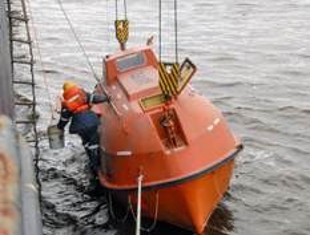
Lifeboat Incidents: Key Observations & Lessons Learned

Lifeboat Incidents: Key Observations & Lessons Learned

Since  lifesaving  appliances  became  mandator y  onboard  vessels,  significant changes have been observed in the design of lifeboats and their launching systems. These changes have largely been driven by the need for larger lifeboat capacity, enhanced protection, easier operation, and improved overall safety.

Traditional open wooden boats have been replaced by fully enclosed lifeboats and free-fall boats, while modern rescue boat designs now support a wide range of maritime rescue operations. Despite these advancements, accidents during lifeboat operations – launching, running, or recovery – continue to occur, resulting in fatalities and injuries. Many of these incidents are linked to increased reliance on technology, despite improvements in design, equipment, and maintenance standards. Continue reading “Lifeboat Incidents: Key Observations & Lessons Learned”

Global agreement on fishing vessel safety to enter into force in 2027

Global agreement on fishing vessel safety to enter into force in 2027

Argentina has become the latest country to accede to the 2012 Cape Town Agreement, triggering its entry into force in 12 months.

The Agreement has met the requirements for entry into force and will enter into force in February 2027, closing a longstanding gap in the global maritime safety framework.

It sets out mandatory safety standards for more than 45,000 fishing vessels of 24 metres in length and over, according to FAO data, helping to prevent casualties, improve working conditions for fishers, enhance competitiveness and protect the marine environment.

Welcoming the milestone, IMO Secretary-General Mr. Arsenio Dominguez said, “Thousands of fishers lose their lives every year while working to supply the world’s growing appetite for fish and fish products. The 2012 Cape Town Agreement will help protect fishing crews, while safeguarding vessels.” Continue reading “Global agreement on fishing vessel safety to enter into force in 2027”

Bureau Veritas summary of IMO SDC 12

Bureau Veritas has shared a summary on the twelfth session of IMO Sub-Committee on Ship Design and Construction (SDC 12), which was held earlier this year.

SDC 12 agreed on:

– draft amendments to the 2011 ESP Code, with a view to approval in principle by MSC 111, formal approval by MSC 113 and adoption by MSC 114, as appropriate;
– draft guidelines on the use of Remote Inspection Techniques (RIT) with a view to adoption by MSC 111, in conjunction with the adoption of the draft amendments to the 2011 ESP Code to allow the use of RIT in ESP Code surveys; Continue reading “Bureau Veritas summary of IMO SDC 12”

Updated IAMSAR manual to be carried onboard from January 2026

The IAMSAR Manual edition III must be carried onboard vessels from 1 January 2026

Lloyd’s Register (LR) has advised about upcoming amendments to the IAMSAR (International Aeronautical and Maritime Search and Rescue) Manual, which operators must have onboard their vessels in hard copy by 1 January 2026 to comply with SOLAS regulations.

According to LR, under SOLAS regulation V/21, all ships are required to carry an up-to-date copy of the IAMSAR Manual Volume III. As stated in MSC-MEPC.2/Circ.2, the IAMSAR Manual Volume III must always be available in hard Continue reading “Updated IAMSAR manual to be carried onboard from January 2026”

IMO Sub-Committee on Ship Systems and Equipment (SSE11)

Maritime life-saving equipment and ship’s fire safety systems have been the focus of the eleventh session of the IMO’s Sub-Committee on Ship Systems and Equipment.

The Nautical Institute provided a summary of the meeting saying one topic under consideration related to dealing with electric vehicle (EV) fires in Ro-Ro passenger ships.

It was noted that EVs have a lower fire rate of just 25 fires per 100,000 vehicles sold, compared to 1,530 fires per 100,000 sold for petrol cars. Continue reading “IMO Sub-Committee on Ship Systems and Equipment (SSE11)”

IMO issues amendments to lifeboat maintenance and inspection requirements

IMO issues amendments to lifeboat maintenance and inspection requirements

The International Maritime Organization (IMO) has issued resolution MSC.559(108) amending the requirements for the maintenance, thorough examination, operational testing, overhaul, and repair of lifeboats, rescue boats, launching appliances, and release gear.

The amendments aim to keep safety protocols current, particularly concerning ventilation systems for totally enclosed lifeboats. This is in response to advancements in safety practices and lessons learned from past incidents.

The resolution recalls previous decisions, notably Resolution MSC.402(96), which set forth the initial requirements for the maintenance and examination of lifesaving equipment. Continue reading “IMO issues amendments to lifeboat maintenance and inspection requirements”

Impact Tier III Regulation on yachts rejected by IMO

Impact Tier III Regulation on yachts rejected by IMO

The International Maritime Organisation (IMO) has rejected a proposal submitted by Turkey and the International Council of Marine Industry Associations (ICOMIA) that sought to mitigate the impact on the yachting industry caused by Tier III regulation.

Turkey and ICOMIA proposed an alternative standard for vessels currently covered under a delay provision which expires in 2021. Meeting this standard results in reduced guest cabin space as gas exhaust treatment systems have to be installed.

The consequence of this could render yachts just above the 24m threshold commercially unattractive, a segment that ICOMIA considers crucial for the marine industry. Continue reading “Impact Tier III Regulation on yachts rejected by IMO”

Future IMO and ILO legislation planned changes

IMO logo
IMO logo

There are some upcoming planned changes to mandatory statutory IMO and ILO legislation, regulations and instruments, including:

– Adopted amendments that are in a transitional period towards full implementation;
– Adopted amendments entering into force on or after 1 April 2019;
– Significant topics which are currently under discussion and development, including meetings up to Maritime Safety Committee 100 (MSC) in December 2018.

This 64 page document will help you make sense of what is happening: Future_IMO_and_ILO_Legislation___April_2019

Several IMO amendments have entered into force from 1st January 2019

The data collection system is one of the measures taken which will support the implementation of IMO’s Initial IMO Strategy on Reduction of GHG Emissions from Ships, adopted in 2018.

As of 1st January 2019, IMO amendments have entered into force related to bunker delivery, relating to the supply of marine fuel oil to ships, which have fitted alternative mechanisms to comply with the IMO’s 2020 sulphur cap. Other amendments that have come into force this year include the IMSBC Code 2017 amendment and the amendments to designate North Sea and Baltic Sea as ECAs, while the data collection on fuel oil consumption has also commenced.

Bunker delivery note

Bunker delivery note amendments enter into force only a year before the limit for sulphur in fuel oil will be reduced to 0.50% m/m outside emission control areas (ECAs), from 3.5% currently. In ECAs, the limit will remain at 0.10% m/m.

The amendments to Appendix V of MARPOL Annex VI are intended to address situations where the fuel oil supplied does not meet low sulphur requirements, but has been supplied to Continue reading “Several IMO amendments have entered into force from 1st January 2019”

Instagram Posts from the IIMS @iimsmarine

Privacy Overview

This website uses cookies so that we can provide you with the best user experience possible. Cookie information is stored in your browser and performs functions such as recognising you when you return to our website and helping our team to understand which sections of the website you find most interesting and useful.

Strictly Necessary Cookies

Strictly Necessary Cookie should be enabled at all times so that we can save your preferences for cookie settings.

Show details Hide details
Performance & Marketing Cookies

This website uses Google Analytics to collect anonymous information such as the number of visitors to the site, and the most popular pages. This also helps us optimise our marketing campaigns. User data sent to Google Analytics may be used for ad personalization and measurement of our ad campaigns. Keeping this cookie enabled helps us to improve our website.

Show details Hide details