Liberia Maritime Authority reinforces mandatory engine room fire prevention requirements

Liberia Maritime Authority reinforces mandatory engine room fire prevention requirements

The Liberia Maritime Authority has sent out a marine advisory to reinforce the mandatory compliance requirements that govern engine room fire prevention, fire protection readiness, and safe machinery-space operations on Liberian-flagged vessels.

The authority added recent engine room fire incidents indicated that non-compliance with established regulations, marine notices, and safety requirements remained a significant causal factor. Continue reading “Liberia Maritime Authority reinforces mandatory engine room fire prevention requirements”

Sanlorenzo report shows order intake up 16% with €943.1m in 2025

 Sanlorenzo report
Sanlorenzo report

Sanlorenzo has published its 2025 financial report highlighting an order intake of €943.1million—a 16% year-in-year increase.

The Italian shipyard explained the €130 million uplift compared to the previous year was driven by the success of extraordinary new model launches and enduring brand desirability and strengthened distribution in MED, APAC and US.

Its preliminary consolidated results also said the company’s group net profit also rose by 4.2% to €107.4 million. Continue reading “Sanlorenzo report shows order intake up 16% with €943.1m in 2025”

Japan completes first ship-to-ship methanol bunkering at anchorage

Kohzan Maru VII (in the background) alongside Eika Maru (foreground). Credit: MOL
Kohzan Maru VII (in the background) alongside Eika Maru (foreground). Source: MOL

Mitsui O.S.K. Lines announced Japan’s first ship-to-ship bunkering of methanol vessel fuel at anchorage.

The company teamed up with the City of Yokohama, Kokuka Sangyo Co, Idemitsu Kosan Co, and Mitsubishi Gas Chemical Company – collectively known as the “Five Parties” – to successfully complete the endeavour.

Methanol fuel was transferred from the Eika Maru to the Kohzan Maru VII in the Yokohama District of Keihin Port. The Eika Maru is a coastal methanol transport vessel operated by Kokuka Sangyo and the Kohzan Maru VII is a dual-fuel, ocean-going, methanol-transport vessel operated by MOL, and both are chartered by MGC. Continue reading “Japan completes first ship-to-ship methanol bunkering at anchorage”

Korean working group to develop safety management and marine discharge standards

Credit: Korean Register

The Korean Register is collaborating with the Korean government, five major Korean shipbuilders and the Korea Testing & Research Institute to launch a working group to develop safety management and marine discharge standards for ammonia effluent.

As the maritime industry accelerates its transition to zero-carbon fuels in line with the International Maritime Organization (IMO)’s 2050 net-zero target, ammonia-fueled ships are emerging as a promising next-generation solution. Continue reading “Korean working group to develop safety management and marine discharge standards”

Japan emerges as an early adopter of advanced fire detection on RoRo vessels

Japan emerges as an early adopter of advanced fire detection on RoRo vessels

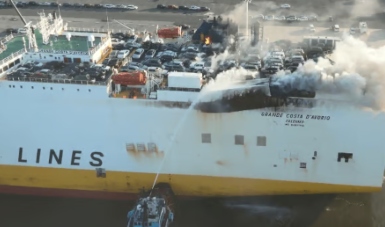
Japan is emerging as an early adopter of advanced fire detection systems on RoRo vessels, according to inspection data from Idwal, the global vessel condition specialist.

While fire safety on RoRo vessels has come under increasing scrutiny, particularly as electric vehicles enter the cargo mix in greater numbers, Idwal’s inspections show that adoption of advanced fire detection technology across the global fleet remains uneven. Japanese owned and operated tonnage is increasingly standing out as an early mover, often installing more advanced detection systems ahead of regulatory requirements. Continue reading “Japan emerges as an early adopter of advanced fire detection on RoRo vessels”

Bureau Veritas summary of IMO SDC 12

Bureau Veritas has shared a summary on the twelfth session of IMO Sub-Committee on Ship Design and Construction (SDC 12), which was held earlier this year.

SDC 12 agreed on:

– draft amendments to the 2011 ESP Code, with a view to approval in principle by MSC 111, formal approval by MSC 113 and adoption by MSC 114, as appropriate;
– draft guidelines on the use of Remote Inspection Techniques (RIT) with a view to adoption by MSC 111, in conjunction with the adoption of the draft amendments to the 2011 ESP Code to allow the use of RIT in ESP Code surveys; Continue reading “Bureau Veritas summary of IMO SDC 12”

Interferry demands pause on EU ETS implementation

Interferry demands pause on EU ETS implementation

Interferry, the global trade association for the ferry industry, has called for an immediate pause on EU ETS implementation  for the maritime sector.

The demand follows the recent decision to continue exempting road transport from a parallel ETS mechanism and the lack of clear regulations on the distribution of the funds collected. Continue reading “Interferry demands pause on EU ETS implementation”

India DGS launches Safety Video Series

India DGS launches Safety Video Series

In a first of its kind, the Directorate General of Shipping (DGS) has developed a comprehensive Safety Video Series to improve safety awareness across the maritime workforce.

The DGS has observed recurring safety lapses and incidents attributable to deficiencies in safety awareness by shipping companies, seafarers and trainees as evidenced by casualty investigations conducted by the Directorate. Continue reading “India DGS launches Safety Video Series”

An Australian National Marine Hull Claims Register: Is now the time?

An Australian National Marine Hull Claims Register: Is now the time?

The Australian Marine Insurance sector still relies on fragmented state registries and siloed Insurer records. A national hull claims register could transform underwriting, fraud detection, and buyer confidence – but lessons from New Zealand show the benefits come with real challenges.

Australia’s boating community is one of the largest per capita in the world. There are 905,000 registered pleasure craft vessels in Australia, (including over 95,000 PWCs), excluding Northern Territory where there is no mandatory vessel registration required. Continue reading “An Australian National Marine Hull Claims Register: Is now the time?”

New EU ETS rules take effect from January 2026

New EU ETS rules take effect from January 2026

This year marks a turning point for the EU Emissions Trading System. After a two-year phase-in, maritime transport will face full compliance under the EU ETS, alongside an expanded scope covering additional greenhouse gases and a tighter emissions cap.

These changes reinforce the EU’s climate ambition while significantly raising the stakes for affected sectors. Continue reading “New EU ETS rules take effect from January 2026”

Safety recall of flares issued due to spontaneous combustion

Safety recall of flares issued due to spontaneous combustion
Safety recall of flares issued due to spontaneous combustion. Source: USCG

The United States Coast Guard (USCG) has sent out a warning following a manufacturer recall of nearly 50,000 affected signal flares.

The USCG Office of Design and Engineering Standards was notified of a manufacturer recall of the Orion Skyblazer II Red XLT Aerial Signal (also called Orion XLT Skyblazer self-contained red meteor flare) due to three incidents of spontaneous combustion. There were no reported injuries. Continue reading “Safety recall of flares issued due to spontaneous combustion”

Review of Maritime Transport 2025 Report published by UNCTAD

Rebeca Grynspan, UNCTAD secretary-general

In her foreword to this year’s Review of Maritime Transport 2025 report, UNCTAD secretary-general writes as follows:

“Global maritime transport has entered uncharted waters.

Not since the closure of the Suez Canal in 1967 have we witnessed such sustained disruption to the arteries of global commerce. Ships that once transited the Red Sea in days now sail for weeks around the Cape of Good Hope. Freight rates that were relatively stable for years now swing wildly from month to month. Supply chains we thought were resilient have proven fragile. Continue reading “Review of Maritime Transport 2025 Report published by UNCTAD”

Instagram Posts from the IIMS @iimsmarine

Privacy Overview

This website uses cookies so that we can provide you with the best user experience possible. Cookie information is stored in your browser and performs functions such as recognising you when you return to our website and helping our team to understand which sections of the website you find most interesting and useful.

Strictly Necessary Cookies

Strictly Necessary Cookie should be enabled at all times so that we can save your preferences for cookie settings.

Show details Hide details
Performance & Marketing Cookies

This website uses Google Analytics to collect anonymous information such as the number of visitors to the site, and the most popular pages. This also helps us optimise our marketing campaigns. User data sent to Google Analytics may be used for ad personalization and measurement of our ad campaigns. Keeping this cookie enabled helps us to improve our website.

Show details Hide details