Introduction
Referring to the ISM Code, one might think that the responsibility of the shipmaster would be limited to the application of the Company’s Safety Management System (SMS), whereas the spirit of the ISM Code lies elsewhere, particularly in its objectives, which can be recalled here:
Objectives of the ISM Code:
To ensure safety of the vessel through an internal organization with a view to providing safe operating practices and a safe working environment by ensuring compliance with the mandatory rules and regulations concerning it and by taking into consideration industry recommendations relevant to its activities.
However, the ISM Code was created nearly 30 years ago with a desire for not only universal compliance, but also for continuous improvement, which is important to the International Maritime Organization (IMO). We must therefore find this improvement objective through intelligent application of the Code.
Furthermore, given that the ISM Code was deliberately designed to be concise, it is important not to rush through the requirements. The original text is often intentionally more specific than you might think and has given the shipmaster another hidden responsibility: verifying compliance with the Safety Management System (SMS).
Process
For an SMS in operation and mandatorily “declared” compliant by a flag, this should theoretically be simple. Indeed, if the flag itself commits to complying with the Code while considering it as an acceptable minimum and certifying it as compliant with an official Document of Compliance, it is committing to safety at sea at an international level. So, assuming that all flags are reliable, even when they delegate to ROs, we could assume that all ships operating around the world comply with the ISM Code.
Then, after regularly verifying that each of the company’s ships strictly enforces its SMS, the flag company commits and issues a Safety Management Certificate (SMC) to each ship “managed” under the same SMS. These two certificates are the key to operating internationally.
Then, if the flag state is reliable, it will ensure that the ship complies with European regulations, if applicable, and that the port regulations of the ports it visits are known and followed.
After five years – at the IMO, we’re very much on a five-year basis – it’s time to review the SMS. Everything evolves so quickly today, including our safety culture, so we’ll take the opportunity to improve it if necessary. In this process of maintaining compliance and continuous improvement, between two visits from its flag administration, it is up to the company to ensure the operation of its SMS as specified with particular regard to the ISM Code where a DPA (Designated Person Ashore) has been chosen, which will ensure this compliant operation in complete theoretical independence from the management.
However, a major player seems to have been somewhat overlooked in this operational chain via the SMS: the ship’s Master. This person is the key to effective on-board implementation, in cooperation with the DPA, and liaises with the shipowner and their company regarding this implementation. This key is essential to all ship operations, whether technical, safety, human, or commercial, and, of course, as a “profit centre” for the shipowner.
Since the SMS is the main instrument for ensuring the safety of the ship and its passengers, as well as environmental protection, it is logical that this SMS should be the Master’s bedside book.
While their ultimate responsibility remains tied to their discretionary power (SOLAS V rule 34-1), which is also logically included in the SMS.
So, with all this clearly defined, what does the ship’s Master do?
The captain incurs liability, i.e., sometimes their personal freedom, via the company’s SMS, which they are specifically responsible for implementing on board. Upon arriving on board, they may encounter:
- A text message declaring compliant by a flag administration that is sometimes lacking in competence and, moreover, sometimes subject to “pressure” from the shipowner.
- A huge and poorly perfoming, almost generic SMS, often,
- A copied SMS, but porly coped, poorly pasted… from another similar SMS
- A virtual SMS, exsisitng only ‘off shelf’ of a model provided by an RO.
- A simple paper excersise disguised as a virtual operation, a ‘smoke factory’ as the Anglo-Saxons would say!
- A chaotic SMS operation without any real self-analysis or verifcation by a company DPA, a person virtually ‘unkown’ to the crew.
- A text applied more or less by their predecessor captains, where there is no internal operational analysis.
- There are internal audits sometimes carried out by the DPA themselves, without the necessary independence, and therefore few anomalies and no major nonconformities are revealed, with the added bonus of repeated “self-satisfaction”!
- External audits are a little more incisive, but not too much, especially for the shipowner’s wallet.
- The crew is not consulted in any way by the captain who authored the annual review… as long as things are running smoothly, we leave it at that. Remember the terrible “no waves syndrome”. Besides, it’s rare that SMS is discussed during the monthly Ship Safety Committee (SSC).
- There are a few incidents in the ship’s daily life, but all of them are minor, and sharing with company feedback records was not deemed necessary.
- The annual external flag audit is always a key moment; however, the objective remains to “not make waves”, and under no circumstances is the right to criticise or even raise an alert… especially not.
- The Master’s annual review simply lists safety operations carried out and looks like statistics more than a true analysis.
- This captain’s review simply analyses the operation of the SMS without any consideration of a compliance analysis, much less a proposal for improvement.
- The management review of the SMS may exist, but it remains confidential and is certainly not distributed to shipmasters, and so on. In short, “it’s just running smoothly,” but far from the spirit of the Code!
So, what should be done, considering the following:
- With respect to the Shipowner, the ship’s Master remains responsible for the entire vessel and therefore for the operation of the SMS on board their vessel.
- With respect to the flag, the Master must fulfil the responsibilities listed in the ISM Code, with personal checks related to obtaining the SMS, correcting non-conformities, and taking into account recommendations.
- With respect to the PSC (Port State Control), the Maritime Administration of the host port may consider that the SMS is not functioning properly and requires immediate corrective action to avoid detention, which is the nightmare of its owner or charterer. The Master of the vessel must therefore decide or transmit corrective actions to lift or avoid detention. Any defects noted are also reported to the flag. (NB: until recently, the PSCs never emphasised the critical points of the SMS because the reliance on the DOC apparently was still existing).
- Regarding the SMS created by the company, the Master must regularly (annually) conduct a review on board and report any deficiencies to the company: a functional review, certainly, but… not a compliance review?
To ensure all this, the Master should lead SSC meetings, considering the opinions of their crew members, especially regarding the operation of the SMS at the level of each person on board… to use this in their personal assessment (captain’s review).
All this is theory!
But aren’t the shipmaster’s responsibilities ultimately more important than that?
The compliance of this SMS has been verified by an Administration, any Administration, or its representative (class or other RO) which has issued a DOC. Therefore, the Shipowner can theoretically use their vessel anywhere. Notwithstanding the annual verification of the operation of their SMS, and apart from the random PSC, they have virtually every opportunity to use their supposedly compliant vessel as they see fit complying with international regulations for the safety of persons, property and environmental protection.
However, the ship’s captain may have a different idea of the application of the ISM Code. Perhaps acquired through personal knowledge or through previous contracts with a Shipowner who opted for more than the minimum. Maybe even if they come from the oil or gas transport sector, where, thanks to the TMSA (Tanker Management & Self- Assessment), the SMS minimum has been forgotten for long.
The Master may be a special employee due to their status as a collaborator of the Shipowner, but they are nonetheless obliged to report any problems to management. Especially when they affect the safety of the vessel, the people on board, and the protection of the marine environment. As stipulated by the ISM Code, the operator must report to the company “gaps” in the SMS, the implementation of which they are supposed to monitor aboard. Indeed, “to review something” implies both examination and criticism for some improvement… otherwise, it makes no sense!
This may be an opportunity to link the ISM Code to this modern notion of contradiction. Indeed, the Code never specified that the company’s SMS, declared compliant, was something set in stone… on the contrary, we might say!
Let’s recall here what the ISM Code itself says:
Captains Responsibilities and Authority:
- The company should clearly define and establish in writing the captain’s responsibilities with regard to:
- implementing the company’s safety and environmental protection policy;
- encouraging crew members to apply this policy;
- issuing appropriate orders and instructions in a clear and simple manner;
- verifying that specifications are being met, and
- periodically reviewing the safety management system and reporting any deficiencies to shore- based management.
Let’s break down each requirement:
- Implement the company policy
It is obvious that the Master, representing the Company, cannot do anything other than apply the policy decided by management in the form of an SMS to be implemented, and also to apply the company’s procedures and follow any instructions. To ensure this implementation, the Master must have advanced knowledge of the ISM Code and the Company’s SMS, as they will also have to assess the SMS’s compliance as well as its application on board their vessel.
2. Motivating the crew members to implement this policy
IMO somehow intended to involve the Master in motivating the crew to implement the Company’s policy… which is what ensures the “pay” at the end of the month, after all. We could have said: “oblige and assist the crew to implement the Company policy via the SMS as part of their duties”… that would have been clearer for our sailors. In “motivating,” there’s more than just simple application; there’s also the encouragement to apply… an additional notion of participation! This participation today could be distinguished in the Master’s periodical review when, for example, they describe the safety committee results as something other than a “crying office”. The management, in its instructions, and the DPA during their visits, will encourage the Master to motivate their crew through a simple description of the benefits of giving their opinion, including in a critical manner.
3. Give appropriate orders and instructions
Nothing new under the sun: The Master’s orders and instructions have been part of our culture for ages. Their introduction as a code requirement solves the previous problem: the Master’s orders must include the application of Company policy, and in particular, compliance with the procedures and instructions contained in the SMS. This normally also includes the crew’s participation in improving the system through an internal organisation like the safety committee today.
Notice: A relatively recent method will help us: nothing prevents the shipowner from including a paragraph on the application of the SMS on board in the seafarer’s employment contract, specifying the mandatory knowledge of the SMS and its consequences, as well as its continuous improvement. If this is not done at the company level, it can also be done via the Master’s standing orders if necessary… while, fortunately, SMS is still improving, little by little every day.
It is specified that the orders must be simple and clear. We will use existing material, even if only the parts of the STCW Code on watchkeeping, for example. If the job descriptions are already well developed, this will simplify the standing orders. A reference to well-established texts (IMO, for example) will avoid repetition… and these texts have the advantage of being clear and precise! Ultimately, the Master will be left with specific orders concerning their vessel and ts operations, as well as ad hoc orders depending on circumstances, including weather conditions (order book, which includes a daily section, for example).
When we talk about orders…
We must also talk about the language in which these orders or instructions are given. Multilingualism comes back to haunt us here again. Orders must be given in the crew’s working language. When there are multiple languages, orders in English are therefore necessary!
While I have no doubt about is the Master’s English, the crew’s level of English is often insufficient. Therefore, don’t hesitate to translate orders into certain languages spoken on board (Tagalog, Ukrainian, Russian, Spanish, Arabic).
Warning: The English comprehension test is increasingly common in Flag State and Port State Controls at all crew levels.
4. Verify that the specifications are met
A little ambiguous, but still fantastic! This involves verifying that what was specified in the SMS is being applied. The Master in charge of the vessel ensures the vessel’s operations follow the company’s procedures and instructions. They, in a way, provides on-site oversight assigned to the DPA, who remains on land. This link between the DPA and the Ship’s Master is obvious… but apparently not to everyone!
5. Reviewing the SMS
Here, then, there is a possibility of interpretation: Reviewing the SMS is one thing, while reviewing the application of the SMS on board, as many have understood it, is another!
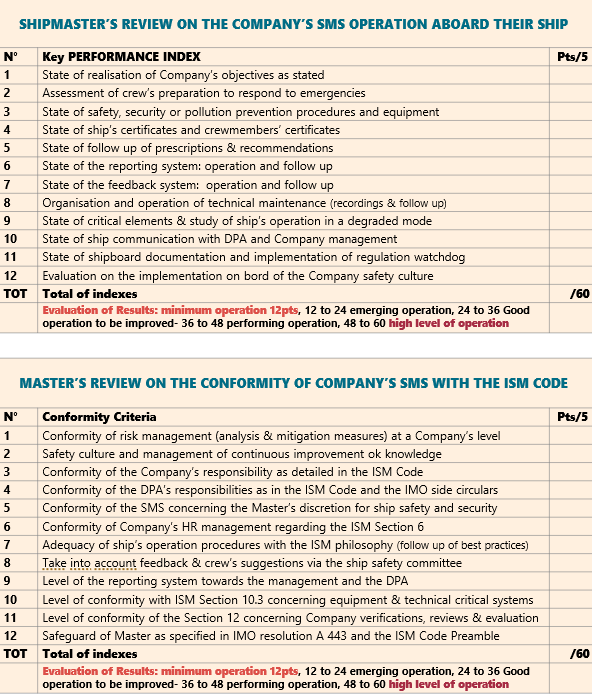
By analysing the “safety and environmental protection” situation on board during the period in question, the Master can, using performance indicators for example (see below), measure the application of the SMS on board. This is still quite simple and will, in theory, be of great use to the DPA in their preparation of the management review (as understood by a correct SMS) on the one hand. And on the other hand, they will take the opportunity to give their opinion as the person ultimately responsible for the compliance of the SMS with the ISM Code as they understood it. For the modern Master in a serious company, this is in some way a new task which is added to the other commercial or technical reports or is a part of them.
Proposed contents of a Master’s review concerning the implementation of the Company’s SMS
- Introduction: Evolution of SMS implementation compared to the last review – Status of achievement of the captain’s objectives
- Analysis of SMS operation on board: Summary of analyses: Suitability of the vessel with the SMS and possible proposals, crew readiness to respond to emergency situations, status of the vessel’s certificates, analysis of the operation of the vessel’s maintenance system, status of vessel compliance, operational status of the vessel from a safety perspective, status of critical components and systems, status of safety equipment
- Overall analysis of internal and external audits: With copies of internal audits and external audits.
- Results of internal accident investigation analysis
- Overall analysis: Requirements for periodic or special flag and/or PSC inspections and analysis of the follow-up to any requirements or recommendations
- Analysis of feedback from the vessel
- Evaluation of the application of the SMS on board
- Personal assessment by the Master of the compliance of the Company’s SMS with the ISM Code, with a list of questions regarding the regulations that concern us, including local regulations in the ports visited
- Suggestions for improvements, with their degree of urgency
- Conclusion and new objectives of captain UNTEL

Tools related to the captains responsibility:
The Safety Committee (Rule 4.3 of the MLC 2006)
Ship Safety Committee (SSC)
Created by the MLC 2006 and therefore applied on board vessels with more than five crew, the Safety Committee is a mandatory tool that assists the Master in the management of the vessel. For crews of fewer than five, the captain replaces the safety committee (this is generally already done in the SMS). Beyond this, a committee is formed to address all aspects of safety, health, and risk prevention on board. This involves implementing the Company’s safety/health policy and program (e.g., the ship’s operator holding the DOC).
Note: Any additional “environment and safety” issues can be conveniently grouped together via the SMS.
Specific responsibilities of the safety committee
Ensure flag and Company health and safety requirements are met and collaborate with the Captain and the Company to implement the corresponding SOHSP policy and program (see MSC-MEPC.2/ Circ.3 of 2006):
- Participate in the Health/Safety/ Working Conditions program
- Review crew questions and opinions on this subject- Assess the condition of relevant equipment
- Monitor compliance with established procedures
- Review incidents, accident/nearmiss reports (Flag, Company, or occupation) and any resulting preventive measures
- Provide opinions and/or recommendations
- Contribute to the principles relating to training/familiarisation and instructions on working conditions (consultation when procedures are amended, for example)
Composition of the Safety Committee
- Captain (or representative): Committee Chair
- A designated competent crew member by the Company, responsible for risk prevention
- Possible safety delegates per department (depending on the number of crew members): officers, crew, others (passenger ships)
NB: appointed or elected delegates who may acquire the necessary knowledge through the Company (internal training during working hours, for example)
Operation of the Safety/Security promotion Committee
Under the responsibility of an officer in charge of promoting Safety/ Security, generally the Chief Mate, traditionally responsible for all aspects of safety on board:
- Monthly or more frequent committee meetings (exceptionally when two committee members request it)
- Mandatory meetings following accidents, incidents, or near misses
- Mandatory reports to be communicated to everyone on board, with a copy to the DPA (Departmental Safety Officer) and followed up by the captain
Practical application
Opinions of the crew member(s) during internal audits and Captain’s reviews and participation in the annual DUP review (individual opinions of members taken into account)
… Last but not least, the captain’s objectives
As a Captain, it seems normal to me to have my own objectives related to the application of the ISM Code. Unless I remain at the minimum required level of service, as a matter of ethics. A ship’s Captain should be able to set their own objectives once the Company has appointed them as permanent Master for a minimum period. Limiting themselves to safety, a Master aware of the common weaknesses of seafarers could express upon arrival on board a targeted improvement objective, for example, along the following lines:
- Part of the emergency plan requires improvement, and during this time on board, I propose during the present period to improve the crew’s preparedness to respond to emergencies. …by developing a drill & exercise plan based on communication during emergencies. All exercises will emphasise this “communication” aspect, whether within the onboard team (response team, crisis unit, Master), or with potential emergency services or the Company directly.
- Another paper exercise could be devoted to brainstorming on the real risks compared to an already old and somewhat generic Risk Assessment Study or even conducting an evacuation drill in a hard-to-access compartment to evaluate and, if possible, improve our already acquired methods, etc.
- Just as simulating a gathering of thousands of passengers in preparation for an evacuation of the ship in a situation other than good weather and during the day, would raise awareness among the hotel crew of this problem, which is known to be “virtually insoluble.” This kind of attitude is certainly in keeping with the spirit of the ISM Code, linked to continuous improvement and the new safety culture of our time, which, without abandoning a well-established practice, is moving more easily than 30 years ago toward smarter safety management.
NB: The topic is broad enough to challenge your thinking.
Finally, the Master must review the SMS compliance
As part of their responsibilities, the Master, by delegation from the shipowner, ensures that their vessel complies with the SMS, but not only that!
Indeed, the ISM Code specifies that the SMS itself must be reviewed periodically (Section 5.5) by the Master, and not only its onboard application, as most of members of our industry have understood. Notwithstanding the copy of the DOC posted at the entrance to the captain’s office, this compliance of the Company SMS must also be verified by the Master during their annual review. In theory, nothing is more effective than the advice of those who apply it day to day… rather than waiting for an internal audit conducted by auditors who are often somewhat lacking in knowledge of the ISM Code and almost never truly independent. Difficulties: It is true that except in small companies where senior management participated in the creation or evolution of the SMS, large companies long ago switched to an SMS “developed” by a team of “landlubbers,” sometimes with minimal knowledge of work at sea, and which hasn’t evolved much since its creation.
Then again, due to a certain atavism, our industry has never really known how to practice differently and cannot tolerate the current trend of whistleblowers!
Few Masters finally dare to suggest improvements to the SMS. Why? It’s worth remembering here that French law, as in the US (SPA), allows employees to express their criticism of their boss’s safety options… as long as they present them “with restraint” (French Court of Cassation, September 28, 2022).
Conclusion
Today, the shipmaster assumes their duties in the following theoretical circumstances: the vessel’s certificates are up to date, particularly the SMC (Safety Management Certificate), which is theoretically official proof that the onboard safety and environmental protection management complies with the Company’s SMS, itself recognised as compliant with the ISM Code by a named DOC (Document of Compliance).
However, the current general weakness of Flag State Control is undermining the confidence that the profession has cultivated within the framework of the IMO, a loss of confidence largely due to flags of convenience, if not “flags of complacency”.
Traditionally, the PSC was created largely to counter this phenomenon. Through targeted inspections and by sanctioning lax behaviour, the PSC has begun to instil fear, being seen as “the armed wing of the IMO.”
Theoretical sanctions can scare shipowners who fail to comply with international regulations because detention is theoretically a terrible instrument that directly attacks the shipowner’s wallet… more than ever in our industry, time is money, and any delay today is counted… in dollars lost on chartering.
This PSC system, supposed to solve the problem of substandard vessels, even though it scares shipowners and continues to improve, is far from perfect. Sometimes the vessel doesn’t need to call at a port for a transfer, for example, beyond territorial waters… thus, the dark fleet under the command of “Dark Masters” that continues to grow, avoids calling and therefore… we have no legal right to hope to block it. The Law of the Sea did not provide for this (except in cases of violations or pollution only)… should it not be reviewed and a Coastal State Control (CSC) created, extended to all vessels where control would be possible without being a clear initial violation… an amendment to the UNCLOS maritime conventions to clarify this (via MONTEGO BAY), for example.
Cdt Bertrand APPERRY CLC AFEXMAR,
FMIIMS bertrand.apperry@afcan.org
The views presented above are solely those of the author and do not necessarily reflect those of AFCAN. They are intended for information exchange and discussion purposes.
PS 1. The transition from English, the working language of the IMO, to another language often poses interpretation problems. This is generally not too serious, but it still often takes us a little further away from the desired result of the initial text.
PS 2. The Italian government and the RINA (the Italian RO) have had a difficult time following the official investigation into the Costa Concordia disaster. Our colleague Francesco Schettino recently requested release halfway through his prison sentence (already 8 years in the Rebibbia prison in Rom) … which was refused! Perhaps it’s still too early for him to tell us the story from his perspective. Are the Italian administration and RINA a little afraid that Schettino will point out the impressive laxity of the Company’s ISM certification, and more specifically on board their ship?
PS 3. The English version of the Code refers to “deficiencies,” which the French have simply translated as “gaps,” whereas in English, this word is broader, meaning “lack/insufficiency/imperfection or weakness/deficiency, while retaining a nuance of insufficient level.”
PS 4. The phenomenon of the dark fleet (strangely called the “ghost fleet” in French) is poisoning our industry today, with nearly 1,000 ships affected, and therefore at least 1,000 captains more “like pirates than privateers”. Personally, as a former Master, I am ashamed!
PS 5. Port regulations are often somewhat forgotten by Masters, yet in the event of an incident in the port, this is the first check that will be used by local investigators.