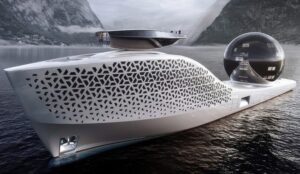
For decades, diesel has powered almost every large vessel on the water. It is reliable, energy-dense, and supported by a global refuelling network. But as the marine industry looks toward lower-emission alternatives, new ideas are starting to surface. Hydrogen has already entered the conversation for superyachts. Now, an even more ambitious concept is being explored; nuclear power.
Could boats run on nuclear power?
It sounds extreme, but nuclear propulsion is not new. Submarines and aircraft carriers have used it for decades. The real question is whether the technology can be scaled down for civilian vessels.
Why the industry is even considering nuclear
Boats require large amounts of continuous power. Unlike cars, they push through water, which creates constant resistance. At the same time, emissions regulations are tightening, especially for large yachts and commercial vessels. This has pushed designers to explore alternatives like hybrid systems and hydrogen fuel cells. Hydrogen is promising, but it faces a major limitation. The infrastructure to produce, store, and refuel hydrogen at scale is still limited. That has led some designers to look further ahead and ask a more radical question. If hydrogen is difficult to deploy, could nuclear energy solve the problem entirely?
Nuclear power at sea is already proven
Nuclear propulsion is already used in military vessels because of its unique advantages.
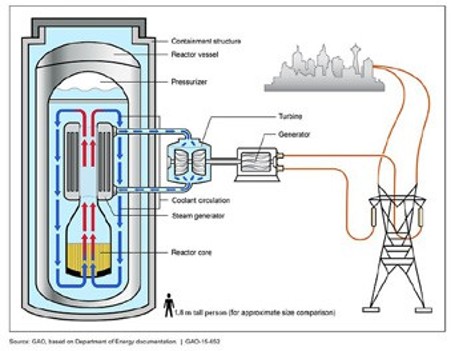
Instead of burning fuel, a nuclear reactor generates heat through controlled reactions. That heat produces steam, which drives turbines and powers the vessel.
The benefits are clear:
- Extremely long operating range without refuelling
- Consistent power output over long periods
- No direct carbon emissions
This is why submarines can remain underwater for months and aircraft carriers can operate for years without refuelling. So, the concept works. The challenge is scaling it for civilian use.
The rise of small modular reactors (SMRs)
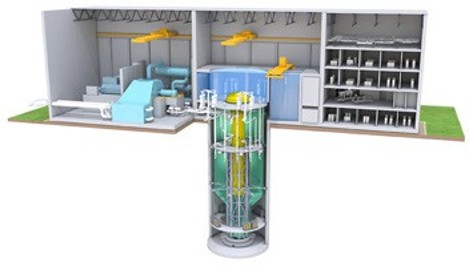
Recent developments in nuclear technology have introduced Small Modular Reactors, or SMRs. These reactors are designed to be:
- Smaller than traditional nuclear plants
- Factory-built and modular
- Easier to transport and install
Organizations like the IAEA and governments such as Canada are actively developing SMRs, typically in the 50 to 300 megawatt range. On paper, this sounds like a breakthrough. Smaller reactors suggest the possibility of new applications, including marine propulsion.
But this is where reality sets in. “Smaller” in the context of nuclear power is still very large.
Could nuclear actually work on a yacht?
Some of the world’s top yacht builders are already exploring the idea.
Feadship, for example, has studied nuclear-powered superyacht concepts that could operate for years without refuelling. These designs are aimed at the very top end of the market, where yachts exceed 100 meters in length. The appeal is obvious:
- Near unlimited range
- No reliance on fuel infrastructure
- Reduced emissions over long voyages
For ultra-large yachts, nuclear propulsion starts to look technically possible. But even at that scale, major challenges remain.
The real constraints: Size, weight and safety
The biggest obstacle is not generating power. It is safely containing it. Nuclear reactors require heavy shielding to protect passengers from radiation. This shielding adds significant weight and volume. Even small modular reactors are still far too large for most vessels under superyacht size.
Then there is safety. A nuclear system must be designed to withstand collisions, grounding, and flooding. That level of protection adds even more complexity and cost. Regulation is another major barrier. Ports, governments, and international waters would all require strict oversight before nuclear-powered civilian vessels could operate.
And finally, there is public perception. Even if the technology is safe, many people may hesitate before stepping onto a nuclear-powered yacht.
How it compares to diesel
To understand the challenge, it helps to compare nuclear energy with diesel.
Diesel fuel is extremely energy-dense and easy to store. A relatively small tank can power a boat for long distances. Nuclear energy, on the other hand, produces far more power, but requires:
- Reactor containment
- Radiation shielding
- Cooling systems
- Safety redundancies
In simple terms, nuclear power is efficient in output, but inefficient in size and complexity when scaled down. This is why it works well on massive vessels but struggles to translate to smaller platforms.
Where it could work first
If nuclear propulsion ever reaches civilian boating, it will likely start with:
- Ultra-large superyachts
- Commercial vessels operating long distances
- Specialized research or expedition vessels
These platforms have the space, budget, and use cases to justify the technology. For boats under 40 or even 60 feet, nuclear power is not realistic with current technology.
The more likely path forward
Before nuclear becomes viable, the industry is more likely to adopt intermediate solutions.
Hydrogen fuel systems and hybrid propulsion are already being tested and deployed. These systems reduce emissions while maintaining familiar engine designs. In many ways, hydrogen may act as a stepping stone toward more advanced energy systems.
Nuclear remains further out on the horizon.
Final thoughts
Nuclear-powered boats are not science fiction. The technology already exists and has been proven at sea. But scaling that technology down for civilian use is a different challenge entirely. Small modular reactors represent progress, but they are still too large, too complex, and too heavily regulated for widespread marine use. For now, nuclear propulsion is only realistic for the largest vessels on the water. That said, the idea is no longer impossible.
As energy technology continues to evolve, it is not unreasonable to ask whether the boats of the future might one day leave the dock without ever needing to refuel. The real question is not just whether nuclear power can work on boats.
It is how small, safe, and practical it can become.
By Koushik Paul