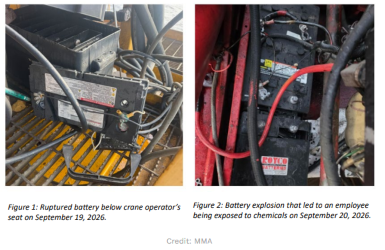
Two battery ruptures involving offshore cranes in the Gulf of Mexico (also designated in U.S. federal policy as the Gulf of America) have prompted the US Marine Minerals Administration (MMA) to highlight the importance of battery inspections, charging-system checks and safe maintenance practices as battery hazards do not disappear when equipment is idle. One battery ruptured beneath an operator’s seat despite having been unused for approximately two years, while another exploded during electrical troubleshooting, exposing personnel to hazardous contents. The incidents demonstrate how batteries can remain dangerous even when equipment appears inactive or maintenance work is considered routine.
What happened
According to MMA Safety Alert No. 526, issued on 30 October 2026, the two incidents occurred on 19 and 20 September 2026. In the first incident, a crane battery ruptured while an operator was seated directly above it. The battery was housed in a small compartment beneath the seat and had neither been used nor serviced for approximately two years.
Despite this prolonged inactivity, it remained connected to a solar panel through a regulator intended to prevent charging once the battery reached full capacity. The rupture affected equipment and prompted precautionary measures, although the operator reported no direct contact with battery acid.
The second incident occurred during electrical troubleshooting following a recent battery replacement. A sensor wire that had been disconnected during the replacement was trapped beneath the edge of a battery inside its compartment.
As a worker lifted the battery to release the trapped wire, its tops blew off, exposing nearby personnel to hazardous battery contents. Those affected immediately flushed their skin and clothing with water.
Although the incidents occurred under different circumstances, both involved batteries that presented hazards during conditions not necessarily associated with normal crane operation.
What went wrong
The MMA alert identifies several potential battery-failure mechanisms, including physical damage, inadequate maintenance, incorrect installation, overcharging, short circuits and unsuitable operating conditions.
In the first incident, the battery’s prolonged lack of use did not eliminate the potential hazard. Its continued connection to a solar charging system meant that charging arrangements remained relevant to its safety, regardless of how frequently the crane was operated.
Importantly, the presence of a regulator designed to prevent overcharging does not, by itself, establish that the charging system was functioning correctly. The alert does not identify a regulator failure as the cause.
The second incident illustrates the risks associated with physically handling batteries during troubleshooting. Although the trapped sensor wire explains why the worker needed to lift the battery, the alert does not establish that the wire caused the explosion. Both cases reinforce the importance of assessing electrical, chemical and stored-energy hazards before maintenance or troubleshooting begins, rather than treating battery handling as a minor mechanical task.
The big picture
The wider safety concern extends beyond offshore crane operations. Batteries are used throughout ships and offshore installations, including emergency equipment, backup power arrangements and machinery systems that may remain inactive for extended periods. Equipment inactivity should not be confused with electrical isolation or safe battery condition. Batteries can remain connected to charging sources, deteriorate during storage or develop defects that are not immediately apparent.
These cases involve different battery technologies and circumstances, but collectively highlight the importance of inspection, competent maintenance and effective control of battery-related hazards.
They also raise a practical question for vessel operators: whether batteries associated with rarely used equipment receive the same attention as those supporting critical systems.
What could reduce the risk?
The MMA recommends that operators and contractors adopt a systematic approach to identifying battery hazards, including equipment that is infrequently used.
A central consideration is ensuring that batteries are included in maintenance inventories and inspected by qualified personnel. Checks should cover visible deterioration, including swelling, cracks, leakage, corrosion, overheating and damaged connections. Battery inspections should also extend beyond the battery itself. Charging arrangements, including solar panels, regulators, associated wiring and charger compatibility, need to be verified against manufacturers’ instructions.
Before batteries are moved or electrical faults investigated, personnel should assess the potential for electrical discharge, chemical exposure and ignition. Work areas should be appropriately controlled, with electrical isolation undertaken when safe to do so. Where batteries show signs of damage or abnormal conditions, further handling should be deferred until qualified personnel have assessed the risks. Suspect batteries should be secured and managed according to approved procedures, and affected equipment should not return to service before evaluation.
Finally, maintenance records and routine safety inspections should capture battery condition, charging arrangements and corrective actions. Battery enclosures must also remain clean, dry, adequately ventilated and protected from physical damage.
Ask your team the following:
- How do we identify and inspect batteries installed in equipment that has not been operated or serviced for an extended period?
- What checks confirm that chargers, regulators and associated wiring are functioning correctly after installation or maintenance?
- Before lifting or disconnecting a battery, how do we assess and control stored-energy, chemical and ignition hazards?
- How would our crew respond if a battery ruptured during maintenance and personnel were exposed to hazardous contents?
Key takeaways
- Unused does not mean safe: Batteries may remain hazardous even after prolonged inactivity, particularly when connected to charging equipment.
- Charging arrangements require verification: The presence of a protective regulator does not replace inspections and functional checks.
- Battery handling is hazardous work: Routine troubleshooting can expose personnel to stored electrical energy, corrosive substances and ignition risks.
- Maintenance must cover overlooked equipment: Batteries in rarely used systems should remain within planned inspection and hazard-assessment arrangements.
- Safe intervention requires preparation: Qualified personnel, appropriate isolation, protective controls and emergency-response procedures are essential to reducing exposure