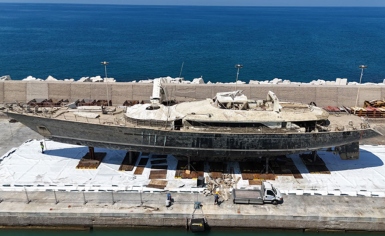
At 04:06 on 19 August 2024, the private sailing yacht Bayesian was at anchor 0.5 nautical miles south-east of Porticello, Italy. A violent downburst of hurricane-force winds knocked the vessel onto its starboard side. Unable to right itself, Bayesian flooded and sank in 50m of water, according to the Bayesian report and safety flyer.
Six guests and nine crew members escaped the vessel as it foundered. Six guests and one crew member died in the accident. None of the liferafts on board automatically inflated or released from the vessel, requiring the crew to do so manually. The crew organised the survivors in the water and assisted them into a liferaft. They were later rescued by a nearby vessel and then taken ashore.
The investigation found that, with no sails set, Bayesian’s windage and stability characteristics left it vulnerable to knockdown in severe winds. This vulnerability was affected by its loading condition, apparent wind angle and the position of the centreboard, but had not been identified in the originally approved stability information available to the crew.
Information contained in guidance provided to mariners did not provide sufficient detail of the impact of possible weather conditions to support decision-making. The weather forecast for the area, while predominantly correct, did not indicate the risk of downbursts from the thunderstorms predicted.
Following the accident the MAIB published an interim report and has prepared a paper to submit to the International Maritime Organization to highlight the investigation findings.
Recommendations have been made to the Red Ensign Group to undertake a study of the vulnerabilities identified in this report and amend the Red Ensign Group Yacht Code and associated guidance to account for its findings.
The Maritime and Coastguard Agency has been recommended to amend its training syllabus for yacht masters to include the risks from downbursts and severe wind gusts.
A recommendation has also been made to the UK Met Office to raise with the World Meteorological Organization the need to consider how low likelihood, high impact weather hazards should be represented in its data services.
Lastly a recommendation has been made to the UK Hydrographic Office to develop and update guidance on the risks of such extreme weather in its publications.
Chief Inspector of Marine Accidents, Rob Loder, said:
“Our thoughts remain with the families and loved ones of the seven who lost their lives, and with all those affected by the loss of Bayesian.
This accident developed with extraordinary speed. In just 14 minutes, calm conditions had given way to winds of at least 68 knots, which in less than 15 seconds pushed the yacht onto its side. Fifteen survivors escaped from the yacht and recovered to a liferaft that had been launched by a crew member.
Our investigation found that Bayesian had a vulnerability to high winds that was not recognised, because the yacht had never been assessed at anchor with its sails down. The extreme winds that night were also not explicitly forecast, so the crew had no warning of the risk.
MAIB has published a safety flyer for the industry and a report which makes recommendations covering vessel design standards, crew training and how rare but severe weather is represented in forecasts. I urge everyone with a part to play, including regulators, training providers and weather services, to read our report and act on it, so that a tragedy like this is not repeated.”
Download the full report:
Download the safety flyer for the fishing industry: