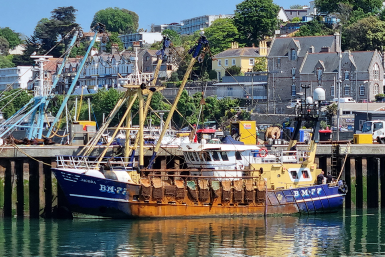
The UK Marine Accident Investigation Branch (MAIB) has published its final report on an incident that left a deckhand seriously injured while working on scallop dredger Jacoba.
The MAIB also published a safety flyer with safety lessons and considerations to the fishing industry.
What happened
On 10 May 2025, a deckhand on the UK registered fishing vessel Jacoba was seriously injured while the vessel was dredging for scallops in the English Channel. The deckhand had been attempting to free a snagged dredge bag chain from the dredge teeth when recovering the dredges and was standing on the conveyor, positioned beneath the port side main beam. The mate then operated the winch from the wheelhouse and lowered the main beam, which struck the deckhand and crushed them against the tipping bar. The deckhand suffered multiple serious injuries and was evacuated to hospital by helicopter.
The investigation found that the accident happened because the main beam was lowered while a deckhand was positioned beneath suspended gear. The absence of documented procedures for dealing with snagged dredging gear and an incomplete understanding of the vessel’s risk assessment meant that the risks associated with this task were not fully appreciated. Unsafe working practices were therefore able to develop during routine operations.
Although some of Jacoba’s crew had previously served on commercial ships they had limited experience of fishing vessels. The absence of effective crew familiarisation combined with a lack of training specific to fishing vessels meant that the hazards of working on a scallop dredger were not fully understood. This increased reliance on informal working practices and created conditions for unsafe conduct during routine deck operations.
Safety issues
- The risk assessments did not adequately address the operation of scallop dredging gear, resulting in associated hazards being ineffectively mitigated and placing the crew at risk.
- The lack of effective crew familiarisation meant that hazards were not fully understood, increasing reliance on informal practices and creating conditions for unsafe conduct during routine operations.
- The requirement to ensure crew had completed mandatory safety training went unenforced and Jacoba continued to operate with uncertified crew. This reduced assurance that those on board had the required safety knowledge.
- Limited company oversight and reliance on informal on board practices meant that Jacoba did not have a structured safety management framework. The absence of a fishing safety management system reduced assurance that risks were being systematically identified, controlled and reviewed.
- The absence of regulator follow‑up or enforcement following an identified deficiency in crew training represented a missed opportunity to ensure all crew had completed essential safety training.
Recommendations
Jacoba’s owner has been recommended to expedite the implementation of a safety management system that aligns with the principles outlined in Maritime and Coastguard Agency guidance. The company has also been recommended to review its risk assessments for scallop dredging and to ensure crew have undertaken the required training.
Download the final report:
Read the safety flyer: MAIB safety flyer – Jacoba