The Francis Scott Key Bridge Baltimore accident: Now we know the cause
 You don’t need me to remind you of the catastrophic incident in March 2024, which resulted in the MV Dali totally destroying the Francis Scott Key Bridge in Baltimore, killing six highway workers in the process. It really is one of the most spectacular and tragic maritime accidents in recent times, witnessed around the world by millions. We have covered the story in more detail elsewhere in this news bulletin, but I wanted to add some additional, personal commentary.
Now we learn from a public meeting late last year, held by investigators, that a loose wire in the ship’s electrical system caused a breaker to unexpectedly open, which started a chain of events that led to two vessel blackouts and a loss of both propulsion and steering. Investigators found that wire-label banding prevented the wire from being fully inserted into a terminal block spring-clamp gate, causing an inadequate connection.
When I shared this information with some close friends in discussion, who have limited knowledge about what happens at sea, they were frankly incredulous that something such as this could cause such devastation, loss of life and a massive insurance pay out running into billions to rebuild the structure, and to say nothing of the lives needlessly lost. I share their sense of incredulity and disbelief! Please let this be another wake up call for the industry.
“Unaffordable” restoration works at iconic British attraction paused
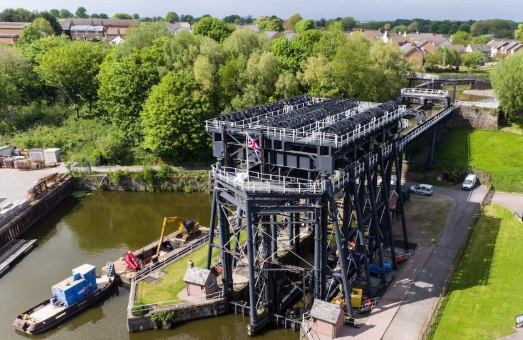 I have featured the story of the Anderton Boat Lift, which is located in the leafy countryside of Cheshire, UK, before. And I have been following the restoration project with interest for some considerable time. The lift, said to be the world’s first boat lift, was constructed in 1875 near Northwich by engineer Edwin Clark. It was designed to connect the Trent & Mersey Canal to the River Weaver Navigation, overcoming a 50ft height difference.
The structure has been closed since January 2025, when a lifting gate cable broke on the upper west canal side caisson during a routine test. This has made it impossible for boaters to use the facility and the structure is in need of extensive renovations. However, in a statement issued by the Canal & River Trust, it confirms that it will now be prioritising reopening the structure and getting it operational for boaters. This means the extended restoration project and renovations to the visitor centre are currently paused.
In a statement, the trust says: “The installation will happen over the winter of 2026/27 with one caisson being opened in time for the summer season in 2027, and the other caisson also opening as soon as possible after that.
“Although this seems a long time off, the works are complicated and time-consuming. They will see a new lifting mechanism installed on ten separate gates, replacing the current ropes, wires and pulleys. The new system will be robust, future-proof, safe to operate and safer to maintain.”
It seems to me that money is tight and a lack of cash may be the real reason why the programme has come to a temporary halt.
EMEC completes 3-in-1 tidal energy, hydrogen and battery demonstration
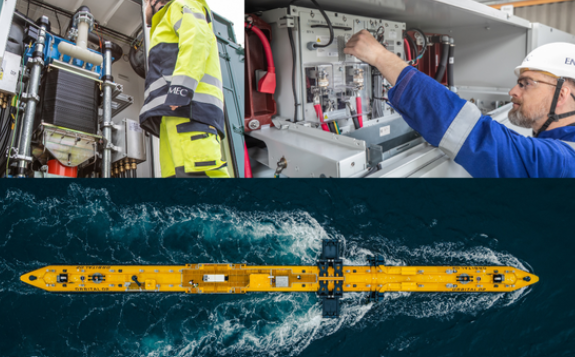
Innovation continues to flow from all areas of the world and here’s another first from a remote location off the northern coast of Scotland. I read that a world-first demonstration combining tidal power, battery storage and hydrogen production has been completed at the European Marine Energy Centre (EMEC) in Orkney, Scotland.
The project has been led by EMEC and the demonstration successfully integrated three technologies – Orbital Marine Power’s O2 tidal turbine, vanadium flow batteries supplied by Invinity Energy Systems, and an ITM Power 670 kW electrolyser, at EMEC’s onshore site on the island of Eday.
Multiple energy flow scenarios were trialled. During high generation periods, power from the O2 was used to charge the battery system, supply electricity directly to the electrolyser and export power to the grid. When tidal generation was low, the battery system discharged power to the electrolyser to keep the electrolyser operating. This approach effectively smoothed out the cyclical nature of tidal energy, enabling on-demand electricity to power the electrolyser for hydrogen production. In addition, battery power was used to support operations at EMEC’s onshore Caldale site.
This is the first time globally that tidal power, vanadium flow battery storage and hydrogen production technologies have been integrated into a single energy system. This approach could help overcome future grid constraints and open up new offtake opportunities, paving the way for more resilient, responsive renewable energy systems.
EU study supports mutual recognition of boating licences
 The EU Commission has published a study on the mutual recognition of boating licences, addressing longstanding concerns about fragmented requirements for recreational boating licences in Europe.
The European Boating Industry (EBI), which represents the recreational boating industry in Europe, is supporting the development of the study, and has been contributing expertise and participation across its network.
In a statement, EBI says it welcomes the recommendations and is urging policymakers to prioritise the issue by introducing EU‑wide measures for licence recognition. According to the organisation, such changes are important for enhancing the experience of Europe’s estimated 48m recreational boaters and strengthening the sector’s competitiveness.
The study’s findings highlight how the absence of mutual recognition affects boaters, charter operators, marinas and training organisations by creating practical and administrative challenges that limit mobility and slow the expansion of nautical tourism. It notes that increased nautical tourism benefits the wider boating sector by supporting companies and jobs. The study recommends adopting mandatory mutual recognition of the International Certificate of Competence (ICC) to simplify cross‑border boating, improve safety and reduce administrative complexity.
That’s all for this month.
Mike Schwarz