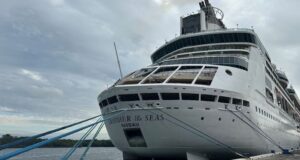
The Bahamas Maritime Authority has concluded an investigation after an electrical cadet died of probable mechanical (positional) asphyxia after trying to exit an access space on board a passenger ship.
On 21 January 2025, an electrical cadet on board Bahamas flagged passenger ship, Grandeur of the Seas, went into an access space to troubleshoot a level transmitter for a bilge water settling tank. He attempted to exit the space but lost his footing on a ladder he placed outside, and became stuck in a suffocating position.
His positioning gave the appearance he was still working as intended, but was later discovered to be unconscious by members of the engine room staff who removed him and placed him on the deck. After attempting resuscitation, he was declared deceased by the shipboard medical team.
Post-casualty tests of the atmosphere inside the access space confirmed the presence of Hydrogen Sulphide (H2S) gas.
Conclusions
An electrical cadet died as a result of probable mechanical (positional) asphyxia after entering an access space to troubleshoot a level transmitter for a bilge water settling tank. He was unaware that any hazards were present, having previously worked in the space under supervision, he believed the conditions would be the same.
The access space was not designed to accommodate continuous work by shipboard staff and the sensor had no technical reason to be located inside the space. The space was also not designated as enclosed, confined, or dangerous, thus there were no safety precautions in effect involving work inside the access space.
The transfer history in the Oil Record Book indicated that various sources of untreated water had been transferred into bilge water settling tank (M4) and contributed to favourable conditions for hydrogen sulphide gas formation. This was verified by lab analysis results showing high anaerobic plate counts throughout tanks within the system used for transferring.
The first stage sensor for the bilge water settling tank had been relocated outside at an unknown point in the vessels history, indicating a need to avoid potential hazards in entering the access space for troubleshooting the sensor. The second stage level transmitter was also relocated outside of the access space post-casualty, ensuring ease of access for any future maintenance required.
Lessons learned
Spaces containing equipment requiring maintenance should be designed to be easily accessible, safe and suitable for crew. The most effective risk control is elimination at the design stage.
The standard industry terms “enclosed” or “confined” space may not be sufficient to alert seafarers to potential hazards. Areas not normally occupied should be treated with the same caution as if entering a space that was previously “closed”.
Shipboard oily water management should not put people at risk. Tanks used to hold untreated contents from various sources need regular sample analysis to detect conditions that promote hydrogen sulphide generation.
Download the full report: BMA marine safety report – Grandeur of the Seas