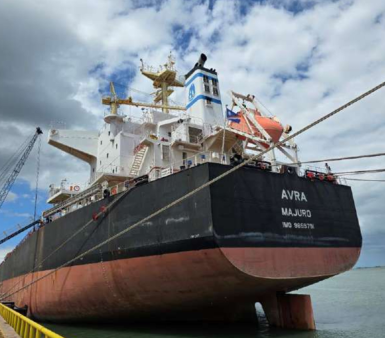
The bosun died on bulk carrier Avra was found collapsed and later pronounced deceased after he entered a space that was part of a fully loaded cargo hold, according to the Republic of the Marshall Islands Maritime Administrator.
What happened
On the morning of 25 July 2025, the geared five-hatch, bulk carrier Avra was berthed on the starboard side at MB5, Daesan Port, and was discharging the bulk cargo of wood pellets.
At 1015, wood pellets were being discharged from CH Nos. 1, 3, and 5, with the hatch covers in the open position. The hatch covers for CH Nos. 2 and 4, both fully loaded with wood pellets, remained closed.
The C/O, who was in the ship’s office, called the Bosun on the walkie talkie but did not receive a response. The C/O then instructed the 3/O to call the Bosun on his cabin telephone and checked with the duty ASD regarding the Bosun’s whereabouts. After receiving no answer from the Bosun’s cabin telephone, the 3/O made an announcement on the ship’s public address, but there was no reply from the Bosun. The duty ASD reported to the C/O that he had not seen the Bosun.
At about 1020, the C/O proceeded to the main deck to look for the Bosun. The C/O was walking forward on the port side of the main deck when he noticed the CH No. 4 aft access hatch cover was open. The C/O looked down through the open access hatch and saw the Bosun lying inside the CH No. 4 aft access hatch space.
The C/O immediately called for help on the walkie talkie. As the crew arrived, some carrying SCBAs, the C/O left to get a multi-gas detector. At 1033, the C/O returned to CH No. 4 aft access hatch space and conducted an atmosphere test. The atmosphere of the space was determined to contain 40 ppm of carbon monoxide and 16.7% oxygen.
The C/O assessed that the access space was narrow and decided that only the 3/O, who had already donned an SCBA, would enter to rescue the Bosun. The 3/O then climbed down the access ladder carrying a rescue rope. After reaching the bottom of the access ladder, the 3/O tied the rescue rope around the Bosun’s torso and signaled the crewmembers on deck to hoist the Bosun up through the access space. The Bosun was hoisted up and was placed on deck. The 3/O exited immediately after. The Bosun was unresponsive and crewmembers immediately began administering CPR.
At 1034, the Master called for shore medical emergency assistance through the agent. The shore medical emergency team arrived at 1100 and took over CPR from the crew. At 1120, the Bosun was stretchered off the ship by the shore medical emergency team and was transported in an ambulance to the local hospital.
At 1216, the Master was informed by the local agent that the Bosun did not respond to medical intervention and was deceased.
The investigation
The Republic of the Marshall Islands Maritime Administrator’s marine safety investigation determined that the Bosun had entered the CH No. 4 aft access hatch space to gain access to the CH No. 5 forward inspection platform to sweep off cargo residues on the platform without complying with the Company’s enclosed space entry procedures.
Causal factors that contributed to this very serious marine casualty included:
- the Bosun’s decision to enter the CH No. 4 aft access hatch space, an adjacent connected space to CH No. 4; and
- lack of oversight by the C/O of the Bosun’s movement and work activities during cargo operations in port due to the Bosun’s perceived level of experience.
Additional causal factors that may have contributed to this very serious marine casualty included:
- there were no requirements for the reporting of personnel entry into enclosed spaces where the spaces were identified as low risk (Appendix I – MLC Crew Manual); and
- poor and/or lack of warning signs or physical barriers to prevent unauthorized entry into the cargo holds access hatch spaces.
Lessons learned
The following lessons learned were identified:
- Entering a space that is part of a fully loaded cargo hold without authorization and without following established shipboard enclosed space entry procedures is extremely hazardous and should not be attempted.
- Physical barriers and warning signs are critical for preventing unauthorized access into an enclosed space.
- Compliance with established safety procedures is paramount and should always be prioritized to ensure personal safety.
Download the report: