Background & History
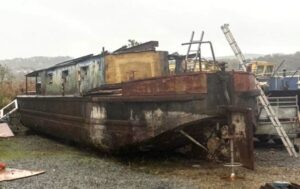
To introduce the vessel 43M. Heritage Boat 43M is from the Irish Grant canal system which was built in Ringsend boatyard by Vickers in 1927. The boat was built for the Grand Canal Company as a transport barge serving the Grand Canal, the River Shannon Navigation and the River Barrow Navigation.
The boat operated from the late 1920s until the late 1950s when the canal ceased trading. The boat had an unfortunate set of uses from 1959 onwards. The boat was cut down by 11” to open the hold up so it could be used as a small boat floating drydock. 43M was later converted to a pleasure boat but had many years neglect and dereliction in private ownership until it sank around 2009,
The boat was removed from the navigation by Waterways Ireland and sat until 2025 on the hard in a boatyard. Waterways Ireland offered the boat for tender, and Damien Buckley was the tender bid winner. And here this snapshot of our journey starts.
Introduction
Damien Buckley is a barge restoration enthusiast from the Ireland’s midlands, based in Co. Offaly. He and his family have restored a number of barges over the past 20 years and campaigned hard to be the restorers of 43M.
Damien first tried to purchase 43M privately in 2007/2008 but was unsuccessful and instead ended up restoring a different Irish Canal boat, 1B, which he subsequently sold during the economic downturn. Damien later purchased the two halves of Heritage Boat 44M, joined them back together, and successfully completed her restoration in 2022.
The Restoration
The restoration began in October 2025 with a full survey of the hull and an assessment of its weak points. This assessment showed some serious structural issues. The base plate of the boat was sitting up to 9” high in the centre of the boat and the bilges had cracked along each side – basically her back was broken!
This prompted a change in the original stabilising strategy which was to build “W” type trusses inside the hold to take the inward pressure of a crane to lift the boat. Instead of just trusses it was necessary to install 9” RSJs across the hull’s width just above the turn of the bilge. Once each RSJ was installed four 30T bottle jacks were used to push down on the bilge plate to bring the bottom back flat.
The addition of the RSJ across also held the sides square and allowed the bilge to return to its radius. Once the shape had returned, box section stand offs were welded to the RSJ and to the base plate, and the jacks were removed. The hull was back into shape, and the trusses could now be added. The addition of the RSJ allowed for the truss shape to be changed to a “V” type truss. A second cross support of 3” angle was added touching the underside of the deck in line. From this support a V shape structure was installed pushing moments of force around the structure when outward pressure would be in play from the crane straps.
43M was now stable and could be moved. No time was wasted and within hours of bracing she was successfully lifted and placed on a trombone trailer for transportation to Damien’s yard in Banagher Co. Offaly, Ireland. Once 43M arrived at its stand in the yard the work began. A teleporter was brought in to help lift off the old superstructure and wheelhouse. There wasn’t much left holding it.
The old wheelhouse floor was taken up to give access to the engine room and there we found a very old British Leyland 370 engine up to its manifold in water. We proceeded to pump the engine room out and remove the engine. The engine had been mounted on the old truck cross member from whatever vehicle had donated it and was barely bolted to the engine beds. The engine had been setup to cool directly from the boats old ballast tank, a brave move running water from the tank directly to the un-marinized engine. Despite 16 or so years of being submerged the engine turned straight over using a big spanner. This is something that gets a bit of attention further down the road to see if it will run. At the same time as all this strip back was going on the first of the build-up started.
Damien had hidden an old Ford D series short block in the back of his shed waiting for such a project to come along. The D Series, a straight 6 cylinder, came from British Army surplus and with a doner engine also stuck in another corner a recondition and rebuild starter. 43M was basically getting a new 1970s engine! A pause to assess what state the hull was in brought a few head scratches and deep drawings of breath, but on the project went. The original belief was that 43M had been cut down by 6” but in measuring her sister ships, she was low by just under 11”. The hull had holes in the bilges, the baseplate and the bow were paper thin underneath, and the ballast tank had rotted.
Some foresight had been used in getting ready for the boat’s restoration. There was an assumption that the bilge plate and bilges were beyond ordinary repair. A new bottom had been prefabricated in the workshop and was sitting on the boat’s stands ready for the arrival. When 43M was lifted into place it was placed onto new 8mm bilge plate and 6mm bilges. The new bottom was attached by drilling 18mm holes at 18” intervals along the old line of her ribs and impacting 16mm bolts through it before welding seams along the joint lines of the bottom section and then welding the bolt heads.
Tackling jobs one at a time, the decks were removed and all the issues were laid bare for all to see. The deck had only been stitched on and this caused major rot along the edge of the hull. The rot had to be cut back, and the sides of the boat brought square. The boat had sagged out by 4” along the deck line but with a number of chain blocks this was straightened. Once all this had been squared up the sides were extended using 6mm plate to match the ¼” plate on the original. There was around 0.2mm difference between them, so it worked well.
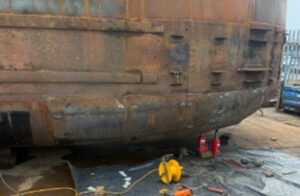
The bow and stern were a slightly more challenging story. The ballast tank in the stern had rotted at its bulkhead and along the waterline of the hull. The hull had been cut down in a banana shape and was a bit butchered. This made the rebuild in the area very much more difficult, dealing with squaring up the old sides along with replating and rebuilding the tank’s bulkhead. If the ballast tank was to be used as a cooling tank again it would need to be watertight and retreated.
And one by one the jobs continued. The bow was next. A very deep crease in the starboard side of the bow was evident in her from photos taken in the 1940s and 1950s. This damage had caused the inside supports to rot away over time and the ribs to rot. It wouldn’t be possible to remake the round shape of the bow with this damage, so it had to be repaired. The outer bumpers were removed to gain access and 2 x 4’ slices were cut along the metal to allow it to be pulled out. The inner rib and rivets were then removed, once the rib was out the metal could be pulled using the forklift and a bottle jack and finally the bow took shape again. After all this the rib was replaced and the cuts welded back up.
43M took up her original shape and dimensions again. The decks could be re-added, the old 8mm diamond plate had been carefully removed and was reusable. This was a big score as the diamond plate is difficult to get and is expensive. The bow and stern were decked out, and the side decks were on. 43M was now becoming a boat again. The wheelhouse floor was installed 9” below the deck to allow for bridge clearance and the design was taking shape.
The superstructure was built 30” off the deck. This was for no other reason than it looked good and was half of a 5’ x 10’ sheet. The cabin was roofed using rolled 2” box section overlayed with 4mm sheets. The front cuddy was pushed forward and the bulkhead moved to allow for maximum main cabin space and headroom during fit out.
From there, we went on to the wheelhouse, and it came together beautifully. The roof is 13ft long and 9’6” wide, a great space with 6’10” head height. A forward-facing window design was used to save the bother of installing a wiper and side access sliding doors were installed to save on cost. It’s much cheaper to build sliding doors out of spare box section than it is to have custom doors made at over £1,000 each.
The boat was now together. The hull was repaired, new superstructure and wheelhouse added, and we awaited the rebuilt engine back from the Ford specialist. Glass and windows were required. That took us onto the internet. Wesley Marine Windows has a great section on their site which lists cancelled or unused orders. Fortunately, there was a full set of superstructure thermal break windows that worked with the dimensions and layout. They were on a pallet and away in quick time, a major saving. The wheelhouse was simpler. The frames were built into the structure and double glazed units, locally sourced, were installed. The side doors would provide enough ventilation, so again a major saving.
From there we got on with those nice things that make the boat look good. Firstly paint. The boat was prepared, cleaned and primer applied. The topcoat was going on a day later. The whole boat was painted with three coats of zinc phosphate semi-gloss paint, locally manufactured, and a good proven coating on many other M boats.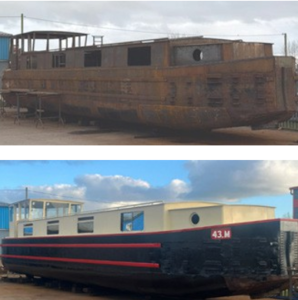
Keeping up the nice work, battens were fixed to the steelwork inside, and the boat got a good 2” coat of closed cell spray-foam from our local supplier, Pro Spray Foam. A
big step on for the project, it always takes shape when the spray foam goes in. The 17T of 4” concrete blocks that had been lifted in before the superstructure went on were then spread out between the boat’s ribs. This allowed for the floor support timbers to go in and the ¾” ply to make a floor. It is all down to finishes from this point. The first fix wiring was installed and the roof light in the saloon was put in place. The plumbing with the water tank were all put together.
This pace of fit out is blinding for a hobby project, but there’s a target event. We wanted to make the canal boat rally in Shannon Harbour, Co. Offaly. Heritage boats 44M and 45M are going to be there and to be able to capture these vessels in a set of photographs along with many of the other M’s that are still around would be incredible.
A pallet of marine plywood arrived. It is taken below deck for lining and partitioning. Three straight weeks and there was a very spacious boat emerging. This is more a team effort now that there’s an end in sight. Interest and help were coming from all angles. This was just in time. It had been an exhausting restoration and a tough winter!
The engine arrived back in the middle of all this. It was quickly squeezed through the door and into the engine room. There followed a week of alignment, wiring and piping. It is all well worth it. The vessel is new and runs like new. While that side of things was happening, a further two days went into sorting the steering and mounting a wheel.
A little bit of decoration to conclude, and she’s as ready as she’s going to be for a couple of summer events. The crane and truck are booked again, and it is off to the river for her first run in nearly 20 years. Another boat saved and, although beyond economical repair, she wasn’t beyond repair.
This is the Marine Notice that first attracted Damien to the sale and potential purchase of Heritage Barge 43M.
Marine Notice No. 93 of 2025 – All Navigations
Issued: 22 August 2025 Sale of Heritage Barge 43M
Waterways Ireland invites public tenders for the disposal of the former CIE canal barge 43M, built 1928, a vessel of considerable heritage value. The barge is currently stored on the hard at New Ross Boat Yard, Waterford Road, Raheen, New Ross, Co. Wexford, Y34 V967, Ireland.
Waterways Ireland’s preference is for the vessel to be restored in a way that recognises its heritage value. Accordingly, all tender submissions must include a plan outlining the proposed restoration of 43M which demonstrates how its heritage value will be preserved. In the absence of a suitable buyer, and restoration plan, Waterways Ireland reserves the right to dispose of 43M by way of scrappage.
Public Viewing. 43M may be viewed externally only between 11:00 hrs and 15:00 hrs on Saturday, 13 September 2025 at New Ross Boat Yard.
by Damien Buckley BEng.MIEI MSc.MCT