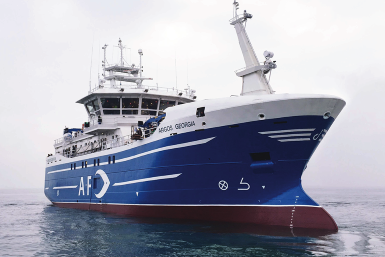
The line hauling hatch of fishing vessel Argos Georgia unexpectedly opened in heavy seas, which led to uncontrolled flooding and the vessel’s eventual sinking, killing 13 crewmembers, according to the final investigation report from the UK Marine Accident Investigation Branch (MAIB).
Chief Inspector of Marine Accidents, Rob Loder, said: “This was a tragic accident resulting in the loss of 13 lives. Fishing in the remotest and most hostile parts of our oceans requires strict adherence to the maintenance of a vessel’s watertight integrity. Should a problem arise a quick, clear and efficient emergency plan should be executed. Training and safety drills provide the best chance of survival in such extreme circumstances.”
What happened
At about 1900 on 22 July 2024, the St Helena registered longline fishing vessel Argos Georgia capsized and sank while on passage from Port Stanley, Falkland Islands to fishing grounds near South Georgia. Of the 27 people on board, 13 perished and 14 were recovered.
At about 1300, while approximately 190 nautical miles east of Port Stanley, Argos Georgia had experienced an uncontrolled ingress of water through the line hauling hatch. Water progressively flooded into the line hauler room then through the vessel via weathertight doors that had been left open, and the vessel took on a starboard list. A crew member raised the alarm via a colleague on a fishing vessel operating in the same region. This alarm was relayed to the authorities in the Falkland Islands and a rescue operation was initiated.
As the list of the vessel steadily increased, the crew mustered and donned their immersion suits. At about 1551, Argos Georgia lost propulsion and the vessel drifted in the heavy seas. By about 1600, with the list further increasing, the crew started abandoning ship into two liferafts. One of the liferafts became damaged during the abandonment. Argos Georgia foundered at about 1900.
By about 1130 on 23 July 2024, two of the responding vessels had recovered 14 survivors and nine deceased crew members. Four crew members remain missing, presumed dead.
Safety issues
- Cause of loss: The manual securing mechanism for the line hauling hatch had likely not been applied and the hatch could not be closed by the crew. This led to the vessel progressively flooding, loss of stability and foundering.
- Technical and operational failures: The hatch’s drive mechanism had an unidentified design weakness, while open weathertight doors, vulnerable electrical systems and inaccessible manual controls allowed flooding to spread.
- On board emergency response: The crew’s response was unstructured, and delays in declaring distress and abandoning ship reduced rescue time. Poor evacuation control, extreme conditions and liferaft damage increased cold water exposure and loss of life.
- Shoreside management deficiencies: The company lacked effective systems for controlling safety-critical risks and for assessing, escalating and responding to flooding, abandonment and distress emergencies in severe weather and remote waters.
Recommendations
The Maritime and Coastguard Agency is recommended to amend Merchant Shipping Notice 1873 (F) – The Code of Practice for the Construction and Safe Operation of Fishing Vessels of 24m Registered Length and Over – to include design requirements for shell door arrangements that, as a minimum, require automatic locking arrangements capable of securing doors in the closed position.
Argos Froyanes Limited is recommended to implement a documented safety management system across its fishing vessels.
The Falkland Islands Government, Directorate of Emergency Services and Islands Security is recommended to enhance the Falkland Islands maritime search and rescue communications capability so that direct and reliable contact can be established with vessels in distress within the Falkland Islands maritime search and rescue area of responsibility.
Read the full report: