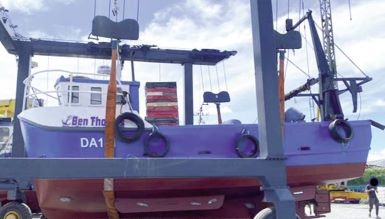
A crewmember died after the fishing vessel, Ben Thomas capsize and sank off the Irish coast.
A report into the incident, which took place two years ago, has been released by the Irish Marine Casualty Investigation Board (MCIB), concluding the investigation.
What happened
On the 12 December 2023, at approximately 05.00 hours the fishing vessel Ben Thomas departed Port Oriel, Clogherhead, Co. Louth with two crewmembers onboard. This was only the second day this vessel had been operated by this crew.
Fishing operations commenced close to Dunany Point, Co. Louth, which is approximately 4.5 nautical miles north of Port Oriel. The vessel operated a hydraulic dredge to catch razor clams, which is a species of mollusc. The Skipper helmed the vessel and operated the winch during cage deployment and recovery, while the other crewmember worked on deck at the stern gantry, opening the cage to release and process the catch.
Having completed a number of fishing operations that morning, the FV Ben Thomas capsized and sank prior to 08.00 hrs while recovering the dredge cage onboard. Both crewmembers were working on deck, and they entered the water at the same time. Neither was wearing a Personal Flotation Device (PFD)2. The Skipper donned a PFD he found floating close by and held onto other floating debris to remain afloat.
At approximately 08.30 hrs, a crewmember on the deck of another fishing vessel working close by heard someone calling for help. After a brief search the Skipper of the FV Ben Thomas was found and recovered onboard. The Skipper, who is likely to have been experiencing hypothermia, was brought ashore to Port Oriel and a waiting ambulance at 11.00 hrs. The search for the second Crewmember continued over the following two days. On the morning of the 14 December 2023, Naval Service divers recovered the Casualty’s body from the seabed. The vessel has not been recovered.
The cause of this vessel’s capsize and sinking is likely to have been the overturning effects of a heavily laden dredge cage as it was being recovered onboard. A contributory factor is likely to have been the vessel’s low level of residual stability at this stage of the fishing operations.
The loss of life of one crewmember, and the threat to the life of another crewmember, occurred because of a combination of the following factors:
- Inadequate safety systems for the operation of this vessel.
- The failure to wear PFDs.
- The failure of the liferaft to inflate.
- The failure of the Emergency Position Indicating Radio Beacon (EPIRB) to operate promptly.
- The omission of Personal Locator Beacons (PLBs).
- Cold water immersion.
Conclusions
The cause of the capsize and sinking of the FV Ben Thomas is likely to have been the overturning effects of a heavily laden dredge cage as it was being recovered onboard. A contributory factor is likely to have been the vessel’s low level of residual stability at this stage of the fishing operations.
The stability of the FV Ben Thomas was last evaluated by means of a rolling period test, carried out on the 25 June 2021 during the CoP survey. The CoP survey’s DoC indicates that the vessel complied with the CoP’s stability requirements. However:
- The details of any vessel modifications undertaken following the 2021 CoP survey could not be confirmed.
- The data recorded for the rolling test does not include details to show positive evidence of compliance with the CoP. The vessel was outside the dimensional parameters intended for the CoP’s stability formula, thereby requiring that “special care” should be applied in the circumstances. Despite this, the formula was used to determine this vessel’s stability parameters apparently without question, without evidence recorded in the test report of what special care was applied.
- The approach taken in the CoP to determining a vessel’s stability does not recognise that landing the catch is a condition that will produce the lowest values for a vessel’s stability parameters.
The vessel was fitted with a liferaft, attached with a HRU. It is not possible to determine the time at which the liferaft’s HRU operated, therefore its release of the liferaft canister may have been sometime after the vessel sank. When the capsized vessel came to rest on the seabed, the liferaft canister’s HRU is likely to have been at a depth of at least 1.5m. This may have been sufficient for activation of the HRU at its lower intended range, but not at a depth of 4m, that may have been needed for activation at its upper intended range. Therefore, operation of the liferaft’s HRU as intended may not have occurred until high water, later in the day when a depth of approximately 4m occurred.
Although the HRU operated and released the liferaft, the liferaft did not inflate as it floated free from the vessel. The vertical depth of water in which the vessel sank was insufficient to fully extend the liferaft painter, which was required in order to inflate the liferaft. The end of the liferaft’s painter had not been attached to the HRU’s weak link which would have remained attached to the vessel as required. Therefore, the required force could not be applied to the painter to pull it from the casing to inflate the liferaft. Had the vessel sunk in deeper water, the liferaft cannister would have been released, and the tests ashore prove that it would have inflated had it been secured to the HRU as required. The incorrect securing of the painter to a strong point other than the weak link element of the HRU, would have resulted in the inflated liferaft being dragged underwater rendering it unusable had the HRU not operated.
The vessel was fitted with an EPIRB attached with another HRU. The type and operational limits of this HRU could not be confirmed as it remains attached to the vessel, but a typical HRU intended for use with an EPIRB is designed to operate within a water depth of 1.5 to 4m, similar to the liferaft’s HRU. A distress signal from this EPIRB was not received by the emergency services promptly after the vessel’s sinking; the EPIRB was recovered on the day after this vessel’s sinking, and it was transmitting then.
The nature of this fishing vessel’s operations in relatively shallow water within 1 NM of the shore, increased the likelihood of either its liferaft or EPIRB, or both, not deploying promptly in the event of the vessel sinking.
Neither crewmember was carrying a PLB when this capsize occurred. There is no record that a PLB had been issued to any crewmember.
The crew of the capsized vessel spent approximately one hour in the water before another fishing boat operating nearby heard one crewmember calling out for help. Prompt activation of this vessel’s liferaft and EPIRB when the capsize occurred, and/or access to a PLB, would have significantly reduced the length of time the two casualties spent in the water.
The failure of the liferaft to inflate promptly, the failure of the EPIRB to release so as to activate promptly, and the omission of PLBs for the crew, were causal factors in this marine casualty.
The description provided by the first Casualty of spending approximately one hour in the cold water, temperature of 9°C, and being unable to communicate when recovered from the water, is consistent with the onset of hypothermia. While it is not known how long the deceased second Casualty survived in the water, this Casualty is likely to have experienced at least the short-term effects of cold-water immersion, which will have been compounded by the non-wearing of a PFD. Immersion in cold water was a causal factor in this marine casualty.
Less than three weeks prior to this marine casualty, the registered owner entered into an arrangement with a third party to operate this vessel. The Skipper of this vessel had only one day of fishing experience on this vessel prior to this marine casualty. The owner, the owner’s appointed operator, and the Skipper of this vessel missed many opportunities to apply standard safety management procedures to this vessel and crew. The result was a vessel that was not being operated safely, which led to the loss of the vessel, one fatality and one near fatality. Inadequate safety management was a causal factor in this marine casualty.
Read the full report: