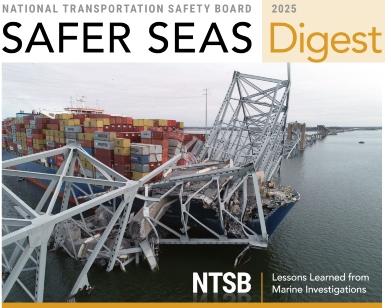
The National Transportation Safety Board (NTSB) has published Safer Seas Digest 2025, a collection of safety lessons drawn from the NTSB’s marine investigations completed in 2025.
The annual publication provides the marine community with a concise look at what happened, why it happened, and what can be done to prevent similar casualties in the future. The 2025 digest examines 49 investigations that looked at accidents including capsizings, collisions, contacts with fixed objects, fires, floodings, groundings, and machinery damage.
Among the investigations featured in Safer Seas Digest 2025 are the contact of the containership Dali with the Francis Scott Key Bridge and subsequent bridge collapse, the hull failure and implosion of the Titan submersible, and the fire aboard the roll-on/roll-off container vessel Grande Costa D’Avorio.
The NTSB encourages marine operators and other stakeholders to review the safety issues identified in the Safer Seas Digest 2025 and consider how the lessons from these investigations can be applied to their own operations. Applying these lessons before a casualty occurs can save lives, prevent injuries, and reduce property and environmental damage.
NTSB investigators noted some commonalities that all mariners and vessel operators should consider. These include the following:
- Performing maintenance effectively
- Effective voyage planning and management
- Detecting and containing vessel fires
- Assessing the condition of waterfront infrastructure
- Ensuring watertight integrity
- Accounting for bank effect
- Combating fatigue and distraction,
- Properly securing and monitoring lithium-ion batteries
- Mitigating the risks of a loss of electrical power
- Planning and training for emergencies
- Operating in strong currents or heavy-weather conditions, and
- Operating equipment and machinery systems as designed.
The NTSB’s Office of Marine Safety investigates major marine casualties upon the navigable waters of the U.S. and accidents involving U.S. flagged vessels worldwide. The investigations determine probable causes and lead to safety recommendations to prevent future casualties and improve maritime safety.
Download the Digest: