Community mural brings a splash of colour to Doncaster Lock
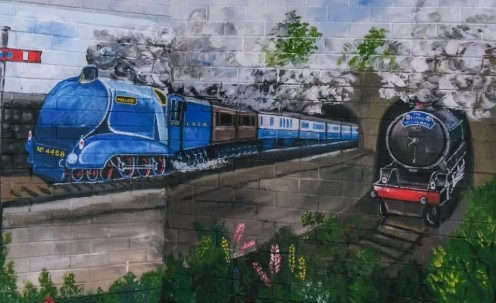
The UK canal network has provided me with inspiration once again, and not for the first time. Doncaster is a medium size city in the north of the UK. Volunteers have completed a vibrant mural at Doncaster Lock to celebrate the city’s heritage and encourage more boaters to experience this part of the waterway network.
Created by local artist Kate Rhodes, with assistance from volunteer lock keeper and ex-boater Jan Miller, the mural – measuring more than 10 metres long – was jointly unveiled by the Canal & River Trust and Doncaster Council.
Kate, who volunteered over several weeks to create it, said, “I really wanted to give something back to the area, and having been a boater for more than 20 years, I wanted to do something to celebrate the waterways, brighten up Doncaster Lock, and hopefully put it on the map.”
Glyn Jones, deputy mayor and cabinet member for the environment, housing and safer communities at City of Doncaster Council, said, “This tremendous piece of art is a fitting tribute to Doncaster’s storied history and its exciting present, capturing everything that makes it such a vibrant place.”
Well done Kate – great and inspiring work.
Legends of maritime heritage came together for the 2026 Auckland Wooden Boat Festival
 By the time you read this article, bad luck, the 2026 Auckland Wooden Boat Festival has been and gone last month. But I wanted to pick out and highlight the importance of this event. In the UK wooden boats are few and far between, as indeed are marine surveyors prepared to undertake surveys on these craft – equally rare.
But it is heart-warming to see that in some parts of the world, wood is still attractive as a material, and any event capable of persuading 10k visitors plus to visit is surely worthy of note.
More than 100 of New Zealand’s best examples of maritime history were on display at the Auckland Wooden Boat Festival. This year’s theme celebrated the story of timber – kauri in particular – and how its strength and resilience have lent themselves to the story of New Zealand’s classic boat fleet, believed to be the largest fleet of original boats still sailing in the world.
In partnership with the New Zealand Maritime Museum, the festival also featured a programme of short films, talks and seminars, offering insight to the stories, skills and innovation behind wooden boats.
Let the event’s co-director, Michelle Khan-Stevenson, have the final word. She said, “The Auckland Wooden Boat Festival is a living showcase of all things maritime that reflects the city’s story.”
Records are made to be broken
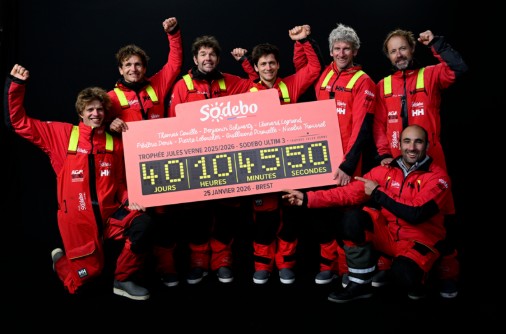 Thomas Coville and the crew of Sodebo Ultim 3 have set a new benchmark in offshore sailing, becoming the fastest team ever to sail non-stop around the world. The French skipper and his six-man crew completed their circumnavigation in just 40 days, 10 hours, 45 minutes and 50 seconds, ending a record that had survived for nine years and thirteen unsuccessful attempts.
The successful attempt followed several years of perseverance in the pursuit of the Jules Verne Trophy. The team had launched four record attempts over the past six years, including two aborted runs in 2024. Despite those setbacks, the same core crew chose to return for another challenge, determined to complete their shared journey. Despite completing the course faster than any crew before them, conditions proved far less favourable than those faced by their predecessor, IDEC Sport, which set the previous record. Rather than benefiting from a smooth weather pattern, Sodebo Ultim 3 was forced to adapt repeatedly to complex and unstable systems.
A large flotilla of boats and hundreds of spectators welcomed the team back to shore, where emotional reunions with family, friends, and Sodebo colleagues followed. Champagne corks were popped, and the celebrations began for Coville and his “magic seven” crewmates.
Scientists develop new tank-based method for growing red seaweed
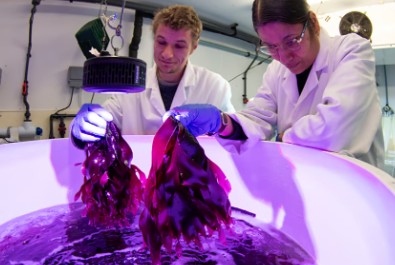 Dr Frederik De Boever and Dr Puja Kumari. Photo credit: Scottish Association for Marine Science
Well, here’s a quirky story for you, but one that would appear to have importance.
Do you ever wonder what other people do for a job? I do occasionally. But growing Palmaria palmata in tanks for a living is one that passed me by, I have to admit!
Yes, it seems that Dr Frederik De Boever and Dr Puja Kumari are growing Palmaria palmata, also known as dulse, in tanks at the Scottish Association for Marine Science’s facility in Oban.
Researchers at the Scottish Association for Marine Science (SAMS) said they have developed a successful tank-based method for growing the red seaweed variety Palmaria palmata, commonly known as dulse. This seaweed is consumed as a high-end food product. SAMS said it is 40 times more valuable per tonne than kelp and can be used in food, feed, dyes, cosmetics, and pharmaceuticals. However, the species is difficult to grow.
The cultivation method developed at SAMS has sought to overcome challenges in how Palmaria palmata grows. Researchers identified a bottleneck at the hatchery phase, as the species has a short reproductive window and the sexual maturity period of males and females is different, posing challenges for growers to control its life cycle.
The demand for red seaweed is increasing but this industry primarily relies on a few seaweed species, mainly cultivated in Asian countries, that are facing threats from increasing incidences of diseases.
More stories next month.
Mike Schwarz