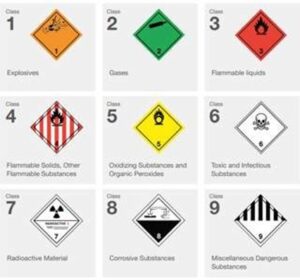
IIMS is indebted to TT Club and their team for producing an information and easy to read series of handy dangerous goods quick reference guides, which we are delighted to publish and share.
Dangerous goods quick reference guide – Class 1: Explosive substances and articles
Class 1 dangerous goods include explosive substances and articles that pose risks such as property damage, cargo damage, injury, environmental harm, insurance invalidation, and potential criminal prosecution.
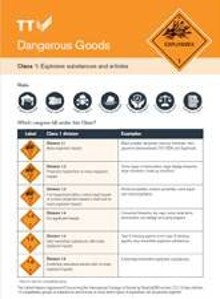 Explosives are divided into six divisions under ADR guidelines:
1.: Mass explosion hazard (e.g., TNT, dynamite, RDX).
2.: Projection hazard without mass explosion (e.g., large fireworks, munitions).
3.: Fire hazard with minor blast/projection hazard (e.g., rocket propellant).
4.: No significant hazard (e.g., consumer fireworks, airbags).
5.: Very insensitive substances with mass explosion hazard (e.g., blasting agents).
6.: Extremely insensitive articles with no mass explosion hazard.
Key Handling Guidelines:
-Packing: Use correct, protective, watertight packaging; avoid plastic that generates static or packaging that creates internal pressure.
-Storing: Store separately from incompatible items; avoid stairways/emergency exits; follow documented procedures.
-Transporting: Ensure security provisions, proper training, and compliance with CTU Code; never transport with reactive cargo or military equipment enabled.
Handling: Never throw, drop, or expose to adverse weather; maintain emergency response plans; communicate clearly across the supply chain.
Dangerous goods quick reference guide – Class 2: Gases
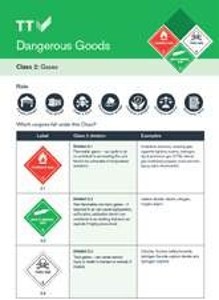 Gases are divided into three divisions:
1.: Flammable Gases: Ignite in air or contribute to fire; sensitive to temperature
changes. Examples: Acetylene, butane, propane, LPG, hydrogen, aerosols.
2.: Non-Flammable, Non-Toxic Gases: Can cause asphyxiation, oxidization, or explode under pressure. Examples: Carbon dioxide, helium, nitrogen, oxygen, argon.
3.: Toxic Gases: Harmful or fatal if inhaled. Examples: Chlorine, fluorine, methyl bromide, hydrogen fluoride, sulphur dioxide.
Key Handling Guidelines:
-Packing: Use tanks/cylinders per manufacturer’s instructions; never use
damaged or overfilled containers; do not repackage without expert advice.
-Storing: Store in well-ventilated, temperature-controlled areas; keep away from heat sources; use leak detectors; inspect regularly; train staff in emergency response.
-Transporting: Ensure ventilation during transport; secure tanks/cylinders tightly; avoid ignition sources near flammable gases; have a security plan for high-consequence cargo; comply with CTU Code.
Handling:
Never throw, drop, or drag cargo; maintain emergency response plans; communicate clearly across the supply chain.
Dangerous goods quick reference guide – Class 3: Flammable liquids
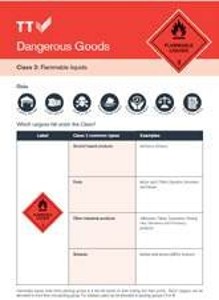 Class 3 dangerous goods include flammable liquids that pose risks such as property damage, cargo damage, injury, environmental harm, insurance invalidation, and potential criminal prosecution.
Common Types & Examples:
Alcohol-based products: Methanol, Ethanol. Fuels: Petrol, Gasoline, Kerosene, Diesel.
Industrial products: Adhesives, Paints, Turpentine, Printing inks, Varnishes, Perfumery products.
Solvents: Methyl ethyl ketone (MEK), Acetone.
Flammable liquids are grouped into Packing Groups I, II, III based on boiling and
flash points. Some cargoes (e.g., paint) can fall into multiple groups.
Key Handling Guidelines:
-Packing: Use only approved tanks/packaging; avoid damaged or contaminated containers; never overfill; keep spill management equipment nearby; control ignition sources.
-Storing: Store in well-ventilated, temperature-controlled areas; away from heat and ignition sources; close to ground; inspect regularly; train staff in emergency response; alert DG competent person if issues arise.
-Transporting: Segregate from other cargoes; follow manufacturer’s instructions; secure containers; comply with CTU Code; avoid ignition sources; obtain permissions for public/built-up areas.
Handling:
Never expose to extreme temperatures; never throw, drop, or drag cargo; maintain emergency response plans; communicate clearly across the supply chain.
Dangerous goods quick reference – Class 4: Flammable substances
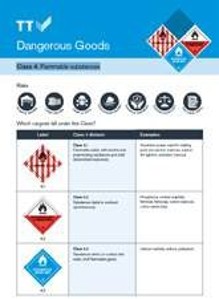 Class 4 dangerous goods include flammable solids and substances that can ignite spontaneously or emit flammable gases when in contact with water. These pose risks such as property damage, cargo damage, injury, environmental harm, insurance invalidation, and potential criminal prosecution.
Classification & Examples:
1.: Flammable Solids: Self-reactive, polymerising substances, and solid desensitised explosives. Examples: Aluminium powder, matches, sulphur, fire lighters, activated charcoal.
2.: Spontaneously Combustible Substances: Liable to ignite without external ignition. Examples: Phosphorus, sodium sulphide, fishmeal, carbon, oily cotton waste.
3.: Dangerous When Wet: Emit flammable gases when in contact with water.
Examples: Calcium carbide, sodium, potassium.
Key Handling Guidelines:
-Packing: Use only approved packaging; airtight for 4.2, watertight for 4.3; never repackage without expert advice.
-Storing: Store in well-ventilated, temperature-controlled areas; away from heat, ignition sources, and (for 4.3) water; inspect regularly; train staff in emergency response; alert DG competent person if issues arise.
-Transporting: Keep risk assessments updated; secure cargo; use temperature- controlled units for self-reactive substances; comply with CTU Code; never allow ignition sources near cargo.
Handling:
Never expose to extreme temperatures; never throw, drop, or drag cargo; maintain emergency response plans; communicate clearly across the supply chain.
Dangerous goods – quick reference guide – Class 5: Oxidising substances and organic peroxides
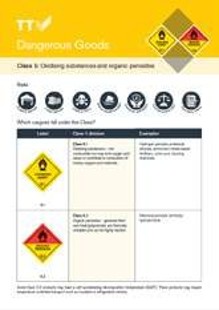 Class 5 dangerous goods include oxidising substances and organic peroxides that can intensify combustion or react dangerously. They pose risks such as property damage, cargo damage, injury, environmental harm, insurance invalidation, and potential criminal prosecution.
Classification & Examples:
1.: Oxidising Substances: Not combustible but emit oxygen, increasing fire risk. Examples: Hydrogen peroxide, potassium chlorate, ammonium nitrate fertilisers, pool cleaning chemicals.
2.: Organic Peroxides: Thermally unstable, generate heat, and can polymerise.
Examples: Dibenzoyl peroxide, tert-butyl hydroperoxide.
Some Class 5.2 products have a Self-Accelerating Decomposition Temperature (SADT) and may require temperature-controlled transport (e.g., insulated or refrigerated vehicles).
Key Handling Guidelines:
-Packing: Use only approved packaging; never repackage without expert advice; avoid damaged containers.
-Storing: Store in well-ventilated, temperature-controlled areas; away from heat, ignition sources, and incompatible cargo (e.g., Class 1 explosives, Class 3 flammable liquids, Class 8 corrosives); inspect regularly; train staff in emergency response.
-Transporting: Keep risk assessments updated; segregate from reactive cargo; secure loads; comply with CTU Code; never
allow ignition sources near cargo; have a security plan for high-consequence loads.
Handling:
Never expose to temperature deviations; never throw, drop, or drag cargo; maintain emergency response plans; communicate clearly across the supply chain.
Dangerous goods quick reference guide – Class 6: Toxic substances and infectious substances
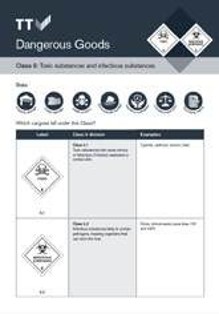 Class 6 dangerous goods include substances that are toxic or infectious, posing severe risks such as property damage, cargo damage, injury, environmental harm, insurance invalidation, and potential criminal prosecution.
Classification & Examples:
1.: Toxic Substances: Cause serious or fatal injury if inhaled, swallowed, or in contact with skin. Examples: Cyanide, cadmium, arsenic, lead.
2.: Infectious Substances: Contain pathogens that can harm the host.
Examples: Ebola, clinical waste, Lassa fever, HIV/AIDS.
Key Handling Guidelines:
-Packing: Use only approved packaging; secure cargo to prevent movement; never repackage without expert advice; avoid damaged containers.
-Storing: Use secure facilities; keep away from heat, ignition sources, and incompatible cargo; inspect regularly; train staff in emergency response; alert DG competent person if issues arise.
-Transporting: Ensure proper segregation; avoid ignition sources for cargo with subsidiary flammable hazards; comply with CTU Code; obtain permissions for public/built-up areas; secure cargo during transport.
Handling:
Never expose to extreme temperatures; never throw, drop, or drag cargo; maintain emergency response plans; communicate clearly across the supply chain.
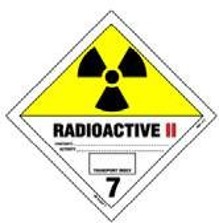 Dangerous goods quick reference guide – Class 7: Radioactive Material
Definition:
Materials containing radionuclides where activity concentration and total activity exceed specified thresholds.
Classification:
No divisions or packing groups exist; instead, they are categorized into three categories based on maximum radiation dose exposure.
Key Handling Guidelines:
-Packing: Adhere to manufacturer instructions; never use damaged or overfilled containers.
-Storing/Transporting: Ensure proper ventilation, security, and regular inspection.
-Compliance: Follow the latest IMDG Code amendments (e.g., Amendment 42-24, effective 1 January 2026).
Dangerous goods quick reference guide – Class 8: Corrosive substances
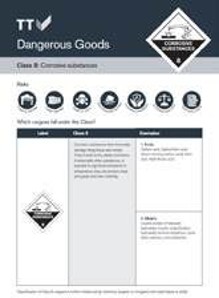
 Class 8 dangerous goods include corrosive substances that chemically damage living tissue and metals. They can react violently, produce heat and gases when mixed with other substances or exposed to temperature deviations. Risks include property damage, cargo damage, injury, environmental harm, insurance invalidation, and potential criminal prosecution.
Examples:
Acids: Sulfuric acid, Hydrochloric acid, Oleum (fuming sulfuric acid), Nitric acid, Hydrofluoric acid.
Alkalis/Bases: Caustic potash (Potassium hydroxide), Caustic soda (Sodium hydroxide), Ammonia anhydrous, some drain cleaners, some bleaches.
Classification is influenced by chemistry (organic/inorganic) and state (liquid/solid).
Key Handling Guidelines:
-Packing: Use only approved containers; never use damaged or overfilled packaging; clean containers before refilling; keep spill management equipment nearby; choose packaging material carefully.
-Storing: Store in well-ventilated, temperature-controlled areas; away from heat, ignition sources, and incompatible cargo; close to ground; inspect regularly; train staff in emergency response; alert DG competent person if issues arise.
-Transporting: Keep risk assessments updated; secure cargo; comply with CTU Code; never assume segregation rules are the same for all modes; avoid exposure to moisture and temperature deviations.
Handling:
Never throw, drop, or drag cargo; maintain emergency response plans; communicate clearly across the supply chain.
Dangerous goods quick reference guide – Class 9: Miscellaneous dangerous substances and articles
 Class 9 is a catch-all category for dangerous goods that do not fit into other classes but still pose significant risks, including environmental hazards, marine pollutants, or substances requiring elevated temperature transport. Some may act as catalysts or accelerants for fire or explosion, requiring additional risk management.
Examples:
- Internal combustion engines
- Self-inflating life rafts
- Vehicles
- Asbestos
- Elevated temperature substances (e.g, Bitumen)
- Polymeric beads
- PCBs
- Lithium Batteries
Key Handling Guidelines:
-Packing: Use only approved packaging; select packaging carefully due to the wide variety of substances; avoid damaged containers.
-Storing: Store in well-ventilated, temperature-controlled areas; away from ignition sources, heat, and incompatible cargo; inspect regularly; train staff in emergency response; alert DG competent person if issues arise.
-Transporting: Keep risk assessments updated; secure cargo; comply with CTU Code; never allow ignition sources near cargo that could accelerate fire or explosion; remove lithium batteries showing blistering, bulging, or heat to quarantine for checks.
Handling:
Never expose cargo to extreme temperatures; never throw, drop, or drag cargo; maintain emergency response plans; communicate clearly across the supply chain.