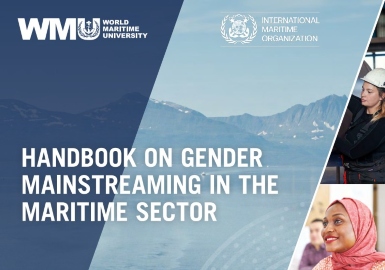
The World Maritime University and the International Maritime Organization have jointly published a new handbook focused on integrating gender perspectives into the maritime sector.
The handbook, titled the Handbook on Gender Mainstreaming in the Maritime Sector, was released on 18 May to coincide with the International Day for Women in Maritime, according to the IMO. The document was written by WMU Professor Momoko Kitada, who this year received the IMO Gender Equality Award. According to the source, this publication is the first of its kind and aims to address persistent gender inequality in the global maritime industry.
The handbook notes that women represent only one percent of the world’s seafaring workforce and hold just 19 percent of ministerial positions responsible for maritime affairs. It was launched during an event held at IMO headquarters in London, marking the 2026 International Day for Women in Maritime.
The publication provides practical guidance for maritime administrations, shipping companies, ports, shipyards, and maritime education institutions. It covers how to integrate gender considerations into policies, recruitment, training, workplace safety, and leadership development. The handbook also includes tools tailored for maritime organizations to conduct gender analysis, develop gender equality action plans, and carry out monitoring and evaluation.
Presenting the handbook, Professor Kitada stated that gender mainstreaming is an effective strategy, process, and methodology that benefits everyone. She noted that leadership is required to implement it, and that individuals at any role or level within an organization can exercise gender mainstreaming in both large and small capacities.
In the foreword, IMO Secretary-General Arsenio Dominguez wrote that the industry must move beyond rhetoric and toward measurable action. He described a more diverse maritime workforce as more competent, safer, and more sustainable. Dominguez called gender mainstreaming a strategic tool to bridge the gap, stating it is not a secondary objective or a women’s issue, but a globally recognized methodology for scrutinizing every policy, regulation, and operational practice through a gender lens.
WMU President Maximo Q. Mejia, Jr. stated in the preface that the handbook was designed as a roadmap to definitive change, helping organizations implement practical measures to create more equitable workplaces. He noted that WMU itself achieved gender parity in its Malmo MSc intake for 2025 after decades of targeted efforts to increase opportunities for women in maritime education.
Download the handbook: