
The use of lithium-ion batteries in the maritime sector is increasing. Many see battery energy storage as the most suitable decarbonisation solution for the small craft, and pleasure sector – the road to trouble is paved with many good intentions. This is debatable, however, with the supply of sustainable fuels such as HVO that can be used in diesel engines without any conversion of the engine; but battery technologies will certainly have a role to play in a low emission future.
In this race to lower emissions, the safety challenges of lithium-ion batteries are poorly understood, or even completely ignored. Leading edge safety research and testing of lithium-ion batteries and emerging battery chemistries are revealing a huge amount of new detail about the complexity of battery failure, and about the nature of the hazards that will create new risks from marine application of these high energy batteries.
There is commonly a long lead time between research findings and the updating of industry safety regulations. As a result, regulations regarding the testing, and installation of lithium-ion batteries in the marine sector are inconsistent, or confused at best, these gaps in the knowledge of what safe installation or best practice is, in comparison to what safety testing is showing, is allowing unintentionally unsafe installation designs to enter into use in the marine industry. This poses serious safety risks for the public, for marinas, harbours, marine surveyors, ports and waterways authorities, and real concerns for insurance companies, P&I clubs and flag state authorities. This confusion and conflict is further increased by classification bodies and flag state authorities seeking to plug these knowledge gaps in the International Electrotechnical Commission (IEC) and ISO core standards with guidelines which miss important details, and neither of which fully understand the complexity of the safety challenges either. Catastrophic battery failures are rare but high impact when they do occur! So far, only good fortune has prevented serious injuries or something far worse in the marine sector.
The safety challenges are complex, and we have already covered the nature of these (see the March 25 edition of The Report magazine and the Maritime Professional Council’s ‘Lithium-ion battery fires: What we know so far’ guide), so I will not go into huge details again. However, here is a brief reminder of the key elements of lithium- ion battery failures.
- Failure is not a fire, it’s heat! No active fire is required for failure (thermal runaway) to be present.
- All the existing chemistries we use – including the new ones – can experience failure, but different chemistries will express this failure in differing ways, giving varying primary hazards
- Currently there is no full resolution to failure, other than the ability to slow reactions down, buying time and possibly limiting propagation of the failure.
The safety challenges stem from the high energy density of these battery chemistries. As the energy density increases so do the hazards from any failure. It’s the same energy density that makes these new battery technologies so useful but also makes them so hazardous should a failure occur.
So what standards are currently on the menu?
Cell, module or battery and system level test standards
- IEC 62619:2023: Secondary cells or batteries containing alkaline or other non-acid electrolyte – safety requirements for secondary lithium cells and batteries, for use in industrial use.
- IEC 62620:2023: Secondary cells or batteries containing alkaline or other non-acid electrolyte – secondary lithium cells and batteries for use in industrial application.
- UL 1973: Batteries for use in stationary and motive power applications.
- IEC 62133-2:2017: Design and electrical construction standards for lithium batteries tested in IEC 62619:2023 and IEC 62619:2023.
- UL 9450A:2019 – Test methods for evaluating thermal runaway fire propagation in battery energy storage systems.
- IEC 62984:2020 – Safety requirements for high temperature secondary cells and batteries in battery energy storage systems (Up to 1500VDC)
- IEC 63056:2020 – Safety requirements for secondary lithium cells and batteries in battery energy storage systems (Up to 1500VDC).
Marine installation guidance documents:
- ISO 26325:2021 Small craft lithium- ion batteries.
- MGN 550: Electrical installations. Guidance for safe design, installation and operation of lithium-ion batteries.
- ABS (American Bureau of Shipping): guidance on the Use of Lithium- Ion Batteries in the Marine and Offshore Industries
- Lloyd’s Register: Battery Installations -– Key hazards to consider and Lloyd’s Register approach to approvals (second edition Jan 2016).
- RINA Type Approvals.
- BV (Bureau Veritas): Type approvals.
- DNV (Det Norske Veritas) Type approvals.
It can be seen from the above list of regulations that the number of available options are huge. This gives a very wide range of ideas of what “safe” looks like, depending on the flag state, or classification society requirements a ship system is designed to and the core IEC, UL or ISO standards referenced.
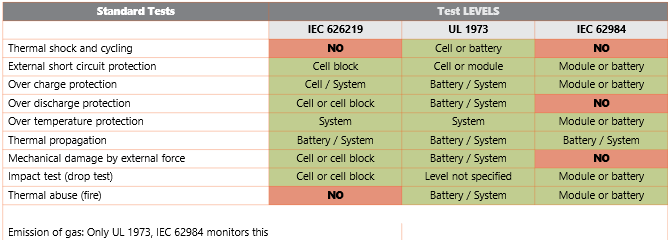
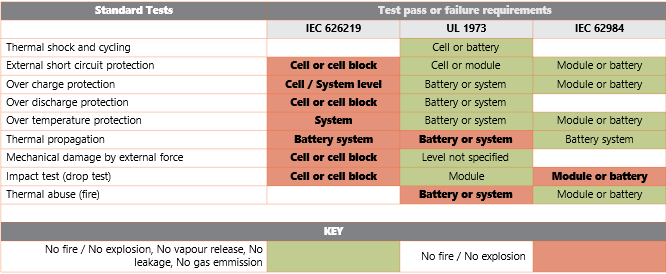
The main testing standards commonly referred to in marine guidelines are IEC 62619:2023, IEC 62620:2022, and IEC 62133-2:2017, plus the occasional referral to UL 1973, IEC 62984 referenced by some class or flag state authorities. The types of test used are common to all these standards, however, the test requirements and pass or fail conditions can vary widely between them. See figure 2.
For example, under IEC 62619:2023 a test pass requires no active fire/ flames from, or explosion of the cell under test in all the listed tests. Venting of gases is seen as good, as this relieves pressure in the cell or module. In fact, cells are designed to vent gases or vapour, but the venting of gases is not monitored or seen as a failure mode under any of the IEC 62619 standard tests, and can go on as long as it likes, or until ignition occurs, which would only then be seen as a failure.
The requirements in UL 1973 and IEC 62984 are more detailed. The majority of tests require no flammable gas emissions and no toxic vapour release among other requirements to pass, so UL 1973 does regard venting of gases or vapour as a failure mode, and explosive volume is monitored and must be below gases LEL to pass under some of the UL 1973 tests at battery and module level, but not all. However the rate of gas release is seemingly not measured at all, which would be valuable information to have when designing a ventilation management system for a marine battery installation.
There are additional variations. The “thermal abuse test” for example, has widely different temperatures and exposure periods for the test. IEC 62619:2023 test heats cells or cell blocks to 80C for 3 hours and waits for temperature fall afterwards, while UL 1973:2022 tests at battery or cell or battery module level by heating to 130C for 30mins and observes the battery for 24hours post heating period.
The variation in test requirements means the tests under the currently framed standards don’t consistently reflect the nature of battery failure, or monitor the hazards that are going to cause risks in a marine installation; the release of toxic and flammable gases that occur long before flames, and create the risk of Vapour Cloud Explosion (VCE) in the confined spaces within a ship or small craft.
So, what are possible solutions might there be?
First of all, we need a complete review of the current standards and guidelines in the current menu. This is what the IMarEST MESIG is aiming to do with regard to what independent safety testing is telling us about failure, and what hazards a failure is likely to cause in a marine installation on various types of vessels. Any new standard would likely be created as a IEEE standard to apply at an international level.
Requirements under IEC 8846 for intrinsically safe electrical devices in battery spaces might seem to be a solution, but that will not include a failing battery module within that space. Good ventilation management seems more helpful, but the battery testing in standards needs to allow this to be calculated for by measurement of vapour release and volumes over time. This can only really be achieved by creating a standalone clear single marine lithium-ion battery test and installation standard that will clearly tell the battery suppliers what safety performance we want for marine batteries, rather than the battery manufactures telling us in the marine industry what we are going to get. However, an IEEE standard could still contain elements from the exiting standards available. This has been done for other industry standards, such as SAEs and IEC 61982 for EVs and CAA and ICOA requirements for aviation with reference to IEC 60952 for example.
A single standard could cover all vessel types and applications of lithium-ion batteries aboard. This would mean safety systems would be common between ships, allowing a common training system for crews, surveyors, emergency response, and safety management systems like ISM. This would also make third party maintenance easier and safer, even after an Original Equipment Manufacturer (OEM) has gone out of business; a problem that has caused battery failure after repairs by a third party to keep a system operational. A single standard would mean that classification societies, insurance companies, and P&I clubs would have clear minimum rules that they can require ship yards, vessel builders and owners to follow, and they would not need to try and plug gaps in a way that further confuses the understanding of what is safest, or best practice. It would also help the establishment of formal training courses like the UK MCA Advanced engineering course AEPC 1 and 2 rather than isolated islands of understanding leading to widely varying training on what safe system is.
Another issue raised by IIMS surveyors to be addressed in a marine lithium battery standard is the design of BMS systems and access to battery system information, giving an agreed safety related set of data using a common protocol, such as NEMA or CAN bus networks, thus allowing anyone with a compatible device to down load data from a BMS unit locally, without referral to a OEM system supplier. The upcoming EU battery passport requirements might help in the drafting of this. This would require a review of the existing IEC 62620 which covers battery management systems and electrical specifications, but again there is no reason why a new single IEEE standard could not include a clearly specified set of data requirements.
A clear set of goals is needed that tells the industry how to use lithium-ion and high energy density batteries appropriately and ensure they are treated with a respect for what they really are. The safety challenges are going to increase as the energy density of batteries increase with All Solid State types and Sodium Ion chemistries, which might not really be part of the lithium-ion family, because they have lithium metal anodes making them lithium metal batteries with sulphide based electrolytes like SPL. These chemistry changes also mean that water based agents are not going to be a good choice for fire suppression or cooling. A single marine standard would be easier for a coordinating group to keep up to date as battery technologies are developing rapidly.
With all this, lithium-ion and other new battery chemistries have much to offer the marine world. We should not be scared of them, but we should be aware of the safety challenges they can present and equip regulations to address the hazards of a failure. Fire service professionals, battery safety researchers, the BSS, IIMS, IMarEST, leading scientists and many others I have contact with are already highlighting these potential problems and are discussing solutions and trying to increase public and industry awareness. But from responses, or the lack of them at various maritime industry events mainly in the pleasure sector, I am worried. The concern I have is that marine business leaders, and local authorities are not understanding the safety challenges that current and future battery chemistries present and are underestimating the hazards and risks from a battery failure occurring aboard a vessel in a UK harbour, marina or in coastal waters.

Referenced documents
EU JRC technical report: Overview of battery safety tests in standards for stationary battery energy storage systems
Authors: H Idlebrand S, Eddarir A , Lebedava N
Published 2024
By Marcus Jones Jones AMIMarEST, DipMarSur(IND) www.lsemarine.com