Sauna culture comes to the Connecticut coast
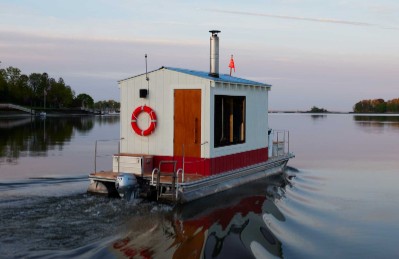 This is not the first time that floating sauna stories have come to my attention, so clearly, you can see I am fascinated by this concept. It is just, well, so whacky!
As we all know, sauna bathing is a centuries-old tradition in Scandinavia that’s closely tied to the outdoor lifestyle. Peter Boldt, an architectural designer based in Cos Cob, Connecticut, was first introduced to sauna culture when he lived in Sweden. Years later, during the pandemic, Boldt and his wife were looking for a project they could work on at home. She had grown up sailing, and they both enjoyed spending time on the water. Drawing on Boldt’s architectural background, they created the sauna float, a vessel that rides on a reclaimed pontoon boat hull.
The shed on the boat, which houses the sauna and a small changing room, is a relatively basic structure. Boldt says that it’s similar in scale to an accessory dwelling on a residential property.
Aesthetically, Boldt drew inspiration from the shapes and materials used in other small waterfront structures along the Connecticut coast, including boat sheds and lobster shacks.
Powered by a 20-hp Honda outboard, the sauna float easily navigates the coves, inlets and harbours around northwestern Long Island Sound. Boldt and his family use the vessel year-round.
Use of fitness app may have revealed French aircraft carrier’s location

At first glance, this seems a bonkers story, and you would be right, it is! For sure, it’s a modern-day challenge, but it is not unique, apparently. Read on. I wanted to share it because it shows how interconnected our world has become and how, on the face of it, such an innocent activity could have potentially catastrophic implications.
French news outlet Le Monde has reported that a sailor’s use of a popular fitness app may have inadvertently revealed the location of a French warship currently deployed overseas. The individual, whom Le Monde said was a French Navy officer, reportedly used the fitness app Strava to register a run lasting 35 minutes while he was on board the nuclear-powered aircraft carrier Charles de Gaulle.
The officer’s use of the app via his smartwatch generated a map that showed the carrier’s location at the time, which Le Monde said was approximately 100 kilometres off Turkey and northwest of Cyprus. This is not the first time that the use of the fitness app may have accidentally revealed the location of a French Navy warship while at sea.
So be careful. You never know who might be watching or tracking you on your daily jog!
As AI unfolds, you were not trained for this …
 This ‘what caught my eye’ story is a much longer one than usual, but an important one in my opinion. The original feature-length article was written by Nina Young FCA, who runs a surveyor’s forum on LinkedIn, which is where she first published it.
I have shamelessly lightly edited her original text that was targeted at building surveyors, but so much of what she has written applies equally to the marine surveying profession. So, with humble apologies to Nina, here we go.
Nina writes: “Over the past few years, I have had hundreds of conversations with surveyors about AI. Some surveyors are already deep in. They are using AI daily, testing tools, building prompts, rethinking how they write reports and manage data. Others have not opened an AI tool once. Some are angry about it. Some are dismissive. Many are frightened but will not say so publicly. Some have decided it is a fad or hype. Some have decided it will destroy the profession. Some are looking forward to retirement. Some are pretending it does not exist with their head in the sand. Some are fearful of younger generations.
When the internet arrived, we saw exactly the same spectrum. The sceptics. The early adopters. The ones who said it would never replace the high street, the phone call, the face-to-face meeting. And they were right, for a while. Until they were not. But this is different.
The internet gave us a new way to access information. AI is not doing that. AI is generating intelligence. It is reasoning. It is producing work that, until very recently, required years of training, professional qualifications, and ongoing CPD to deliver. That is an identity shift.
Think about what it means to be a professional. You studied. You trained. You sat exams. You committed to ongoing learning. You earned the right to charge a premium for what you know. Your knowledge, your judgement, your professional expertise. That is your value proposition. That is what clients pay for.
Nobody asked for this. Nobody got a vote. The most transformative technology most of us will experience in our working lives arrived without permission and it is not slowing down for anyone. Now, for the first time, much of that knowledge is accessible through a free tool. Or a tool that costs less than a monthly phone contract.
The replacement of professional judgement. I am not saying AI replaces professional judgement. It does not. But the knowledge layer, the thing that made you the expert in the room, is no longer exclusively yours.
Many of the people already using AI are doing so “quietly”. It saves them time. It makes them faster. But they are not passing that on. They are not lowering their fees. Many are just doing more, and they are not telling clients. Because the moment you admit AI helped you produce that report in two hours instead of six, the client asks why they are still paying for six. That contradiction will not hold long-term.
I believe the professional model itself will change. Charging by the hour only works when your time is scarce, and your knowledge is hard to access. When neither of those things is true, the value shifts to the outcome you deliver, not the hours you spend delivering it. Law and accountancy will feel this first. Surveying will not be far behind. And pricing will change.
We know website traffic across almost every professional services sector is falling as more and more turn to the AI tools rather than Google. We know AI search is answering questions that used to drive phone calls and emails.
For surveyors, there is some protection. Much of what you do is physical. You attend the site. You inspect. You measure. You report. You observe things a language model cannot see from behind a screen. Those roles are not disappearing any time soon.
But the advisory layer. The report writing. The interpretation. The recommendation. That is where the ground is shifting.
And this is where the fear lives. Because the fear is not really about technology. It is about relevance. It is about spending decades building expertise and watching something replicate the output in seconds. It is about wondering whether the next generation of clients will still see the value in your qualifications when they can get a plausible answer for free.
I do not think the answer is to panic. I do not think the answer is to ignore it.
“And I certainly do not think the answer is to pretend you are above it. Some will. And in five years, they will wonder why the phone stopped ringing.” The answer is to get honest and work on conveying what makes you valuable beyond knowledge alone.
You cannot outsource professional responsibility to AI. Those things matter. They matter enormously. But they only matter if you can articulate them. And they only hold value if clients understand why they should still come to you instead of asking an AI chatbot.
That is the work now. Not learning every AI tool. Not ignoring the whole thing. Not raging against it. The work is understanding what AI changes about your profession and being clear, to yourself and to your clients, about what it does not.
The surveying profession is in transition. That is not comfortable. And I understand why some surveyors want nothing to do with AI. They built their careers on a model that worked. It is not easy to watch that model get questioned. But the surveyors who will thrive are not necessarily the most tech-savvy. They are the ones who are willing to sit with the discomfort, be honest about what is changing, and do the thinking that matters.
I know some of you reading this will think I am overstating it. That is fine. I would rather say it now and be proven wrong in two years than say nothing and watch people get caught out. And some of you will not have seen any of this in your day-to-day work yet. AI has not knocked on your door. Your clients have not mentioned it. Your workflow has not changed. That does not mean it is not happening. It means it has not reached you yet.”
With thanks to Nina Young FCA.
The Florida Plywood Regatta
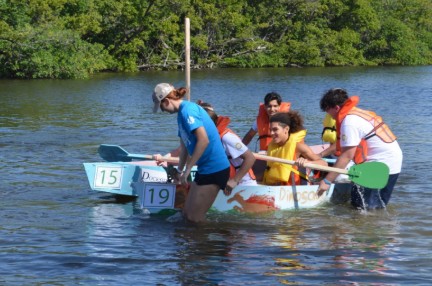 The wonderfully named Plywood Regatta set me off on a search to find out more. The event name just begged questions for my inquisitive mind, and I needed to find answers! By the time you read this story, the 2026 event (the 29th iteration) will have just taken place at the end of April.
It seems that the Plywood Regatta was established in 1996 by the Marine Industries Association of South Florida. The event honours the craft of boat building and the excitement of recreational boating in an effort to continue ‘building boats’ future today!’ Now that is a concept I totally support.
Teams of middle school, high school, and marine technical school students attempt to build seaworthy vessels in one day, using simple hand tools and only the supplied materials of plywood, 3M 5200 fast-cure caulk, and zip ties. Once the boats are built, the students paint, decorate, and name their boats. On day two of the event, participants compete in a fun-filled and friendly rivalry as they line up their boats to test them in the water and race each other in a series of heats to determine an event champion.
All Plywood Regatta proceeds benefit South Florida’s marine industry education programs and the Plywood Regatta Scholarship Fund. The aim of these programs is to encourage marine education and develop students’ interest in the marine industry.
Great initiative and one I am delighted to share with you.
I’ll be back with more curios for you next month.
Mike Schwarz