Seventh European International Submarine Races concludes with new record
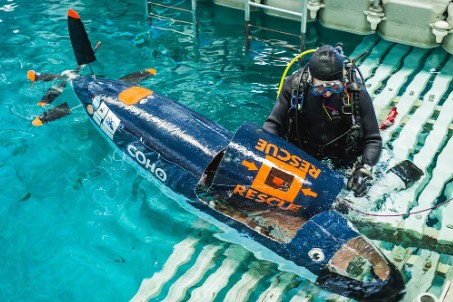
What a joyous and quirky story this is. An event dedicated to human-powered submarines. This should be an Olympic sport!
The 2026 European International Submarine Races took place at QinetiQ’s Ocean Basin in Gosport, UK, with five days of competition between university teams from around the world. Defending champions Team OMER, from École de Technologie Supérieure (ETS) in Montréal, retained their title, winning the Hill Trophy and recording the fastest run of the competition at 6.36 knots.
Teams raced their human-powered submarines over a 200-metre course at a depth of up to six metres, each run combining a timing-gate sprint, a 180-degree turn and a progressively harder slalom. The demanding course tested hydrodynamic efficiency, manoeuvrability, propulsion performance and pilot endurance.
Each of the participating submarines is human-powered and fully designed and built by a team of university students. The submarines are able to operate safely at depths of three to six metres, where they float neutrally buoyant. The submarines were built to be fully flooded, and the pilots breathe air through scuba systems, hence the requirement for pilots who are also qualified divers. Each submarine’s pilot straps their feet into a set of pedals and drives a propeller or other propulsion system using muscle power alone. Steering is achieved with joysticks and mechanical or mechatronic control systems driving rudders and dive planes.
Now, who on earth would invent such a crazy event? Well, I have the answer for you! The Sir Bob Hill. He was a Vice Admiral of the Royal Navy and one of the founders. The Sir Robert Hill Trophy is awarded in his honour.
What price nuclear propulsion for superyachts?
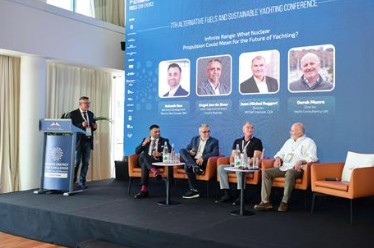 When I think about nuclear reactors, I imagine large-scale, sinister production plants dotted about the country in remote landscapes and, slightly menacingly, hidden from view. But discussion at a recent industry event means this technology can potentially be transferred to propel boats.
The panel session at the recent 2026 Monaco Energy Boat Challenge explored the prospects for nuclear power in superyachts, with Lloyd’s Register (LR) contributing technical insight to the debate on one of the sector’s most ambitious emerging technologies. The session examined in detail how advances in small modular reactor technologies, combined with changing expectations around sustainability, energy security and operational autonomy, are prompting renewed interest in nuclear propulsion across the maritime sector.
While nuclear-powered yachts remain a long-term proposition, panellists agreed that the conversation is no longer theoretical. Rapid developments in maritime nuclear technologies, combined with increasing pressure to decarbonize shipping and yachting, are encouraging designers, owners, regulators and classification societies to consider how such vessels could be safely designed, operated and regulated in the future.
Jan de Boer, representing LR, commented, “The yachting sector has always been at the forefront of innovation. While significant regulatory and societal challenges remain, it is important that the industry begins the conversation now.
“Classification societies have a key role to play in establishing the safety frameworks, risk assessments and assurance processes that will be required should nuclear propulsion become a viable option for superyachts.”
It’s a whole, brave new world looming!
UK IWA celebrates 80th anniversary
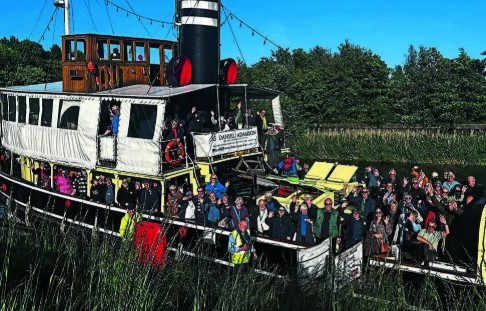 The UK based Inland Waterways Association (IWA) marked its 80th anniversary with a special cruise aboard the historic SS Daniel Adamson. Sadly, I was not one of the invited guests on this occasion!
The event celebrated eight decades of the IWA’s work to protect, restore and promote inland waterways, while highlighting the potential of the River Weaver and challenges affecting its future.
It combines industrial heritage, important wildlife habitats and reliable cruising conditions, yet remains underused. The IWA believes the navigation deserves greater recognition but says issues such as limited dredging, infrastructure concerns and restricted access through Marsh Lock continue to hold it back.
IWA chair Mike Wills said, “Over the last 80 years, the IWA has helped secure the future of waterways around the country. The River Weaver is one of the finest examples of what our waterways can offer, combining industrial heritage, outstanding wildlife and excellent cruising conditions. However, its potential is being held back by avoidable infrastructure issues, most notably the prolonged closure of the Anderton Boat Lift. We want to see this remarkable navigation fully connected, accessible and able to realise the benefits it can bring to local communities, boaters and visitors.”
My hearty congratulations to the IWA and their team for reaching this milestone.
Unusual new ferry service from Fécamp to Shoreham
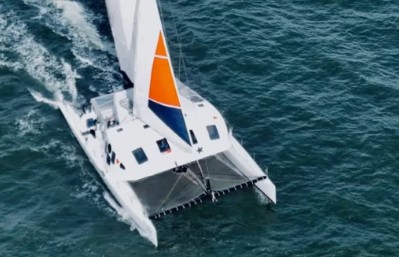
SailLink is launching a pilot project offering trips between Shoreham Port in the UK and Fécamp, a French commune in Normandy, this month. With an ambitious plan, they aim to prove that regular, wind-powered crossings can become a practical alternative to traditional ferries.
Each crossing will take around 8 hours and will be limited to just 12 passengers. The crossings will take place aboard Mer Agitée, a high-performance racing catamaran captained by Michel Desjoyeaux, who will personally skipper each journey. Mr Desjoyeaux is a well-known name in the yachting world and is the only sailor in history to have won the Vendée Globe round-the-world sailing race twice.
As stated, the new ferry service is a pilot project running through September 2026 only. Prices for the pilot start at £220 for a one-way ticket, with return journeys priced at £440.
So, what do you think? Just a publicity stunt, or is this project viable and does it have legs?
More stories for you next month.
Mike Schwarz