 Recently, I attended the annual Certifying Authority BCC meeting at the UK Maritime & Coastguard Agency’s (MCA) in Southampton, which drew about 40 attendees. All the UK Certifying Authorities and the Recognised Organisations were represented and present. We were joined by senior and key MCA personnel and others from the Jersey and Cayman Islands registries. For the large part, it was business as usual as the regulator announced new initiatives, interpretations and to give a general news update on a series of policies and ongoing work behind the scenes.
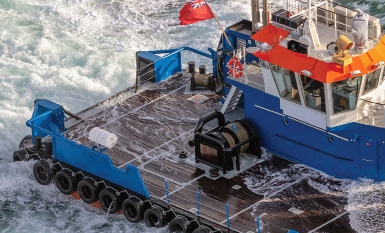
But mid-way through the meeting, a comment was made by the Code Lead in his presentation about the Workboat Edition 3 Code in relation to a recently circulated urgent MCA press release. I could not let this go unchallenged. The Code, which was first introduced in December 2023, becomes mandatory in December 2026, meaning all under 24 metre workboats must be compliant with the new regulations to continue operating. Apparently, a number of vessel owners/operators have yet to transition to meet the new Code requirements – hence why the press release was issued. I directly asked two of the Certifying Authorities present, who are responsible for a large number of workboats between them, just how serious the issue was. Both responded by saying that somewhere in the order of 80% have yet to do what is required to meet the requirements of the code. Yes, a staggering 80%, and there are only eight months left to the deadline.
It already seems clear that Certifying Authorities do not have the surveyor capacity and administrative manpower to get all vessel owners/operators where they need to be to meet the deadline. So, the message to surveyors who look after commercially coded workboats and vessel owners/operators is act now – and even if you do, it may already be almost too late!
All of this presents a conundrum for the MCA. On the face of it, there is no grace period and no extension possible at this time. But if that renders hundreds of commercial vessels suspended and unable to operate, the results could be catastrophic. Let’s see what develops.
This scenario leads me to a related matter going forward, which needs mentioning and thinking about now. The MCA’s Sport or Pleasure Vessel Code, launched in December 2025, also has a three-year ‘window of opportunity’ for under 24 metre vessels to meet the new regulations by December 2028. But unlike the workboat fleet, the number of sport and pleasure vessels is considerably bigger. So, the best advice is plan now and get ahead of the curve or prepare for the likely similar consequences further down the track!
Rarely is IIMS invited to make a competitive pitch for a commercial contract, but it happened recently. The Royal National Lifeboat Institution (RNLI) fleet is to be coded for the first time in its 200-year history. As a consequence, IIMS was invited to submit a bid for the 5-year contract. The timeline was short, and I believe our bid was of the highest order, not only commercially viable, but also meeting the stringent technical requirements that were asked for as part of the submission. I’d like to publicly recognise the significant work carried out by Fraser Noble, our Certifying Authority Chair, who went above and beyond with his time and document preparation to assist me. Sadly, on this occasion, we were not chosen, and I understand the contract has been awarded to another organisation.
Let me talk numbers with you for a moment. Numbers and statistics reveal lots. They can be used to explain the success of an activity, or conversely, the severity of a crisis, perhaps. Where would we be without numbers? So, I was particularly interested to read a report about the number of global port state control inspections conducted in 2025 and the resulting deficiencies and detentions. I am not quite sure what number I was expecting to see, but I was shocked!
The report revealed that in 2025, Port State Control (PSC) inspections showed a rising trend, with approximately 75,168 inspections conducted worldwide, leading to 177,741 deficiencies in total and 2,569 detentions. I have no historical data to compare these figures against, but the volume of deficiencies seems vast. Anyone not related to or invested in the maritime industry would surely be shocked and concerned at these statistics. So, what are the most common offending issues?
It seems the main issues have not altered; they just keep being repeated.
• Fire safety systems (SOLAS II-2) are a big one and accounted for 17% of all deficiencies. Inspections found faulty alarms, inoperative fire pumps and missing maintenance records.
• Life-saving appliances (SOLAS III) – 10% of findings. Typical deficiencies included damaged lifeboats, expired pyrotechnics and untested launching systems.
• And that old chestnut, the ISM Code implementation (SOLAS IX), which revealed recurring non-conformities in drills, SMS execution, and crew familiarisation.
On that sombre note, and before I leave you, I would like to send my personal congratulations to IIMS President, Capt. Ruchin Dayal, who was recently recognised for his contribution to maritime excellence when he was presented with a special award at the 63rd National Maritime Day Celebration. See elsewhere in this bulletin for more details.
I bid you farewell until next month.
Survey well.
Mike Schwarz
Chief Executive Officer