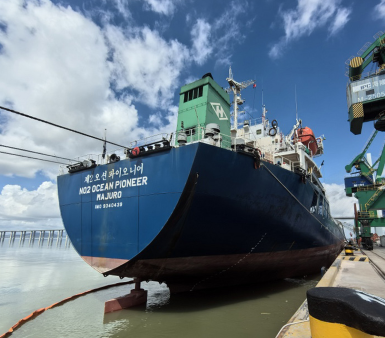
The Republic of the Marshall Islands Maritime Administrator has released an investigation report into the death of a Chief Officer (C/O) aboard a tanker last year.
What happened
On the morning of 25 August 2025, the C/O on board the Republic of the Marshall Islands-registered oil/chemical tanker No.2 Ocean Pioneer was entering Nos. 1–3 port/starboard cargo tanks to inspect them after they had been washed and gas freed following the carriage of benzene as cargo.
Deck ratings then entered the cargo tanks to rinse them with de-ionized water after they had been inspected by the C/O. The C/O had reportedly tested the atmosphere inside these cargo tanks earlier that morning and had determined they were safe for entry. Neither the C/O nor the other crewmembers were wearing a personal gas detector while entering the cargo tanks.
Approximately five minutes after the C/O entered the ship’s No. 3 port cargo tank, crewmembers who were on deck heard a noise and, after looking through the tank dome, saw the C/O lying on the tank top inside of the cargo tank. They immediately called for help and then began bringing rescue equipment to the tank dome.
After arriving at the tank dome, the ship’s Master put on a BA set and entered the cargo tank to assist the C/O, who was unconscious and breathing weakly. The Master took the mask of his BA set off and held it over the C/O’s face. The Master then alternated between holding the mask on the C/O’s face and using it himself until he exited the cargo tank when two other crewmembers arrived on scene with a rescue harness. After putting on another BA set, the Master re-entered the cargo tank carrying an EEBD that he put on the C/O. The C/O was then hoisted out of the cargo tank.
Once the C/O was on deck, crewmembers started to administer CPR after determining that he did not have a pulse and was not breathing. There were no visible injuries consistent with a fall from height. Despite all efforts to revive the C/O, it was subsequently determined that he was deceased.
Investigation
The marine safety investigation conducted by the Republic of the Marshall Islands Maritime Administrator determined that the gas freeing operation that had been conducted on 24–25 August 2025 was not effective, the atmosphere inside the cargo tanks had not been properly tested, and the C/O was not wearing a personal gas detector as required by the Company’s procedures.
The Administrator’s marine safety investigation also identified evidence of an ineffective safety culture both at the Company level and on board the ship. Some examples include ineffective management oversight by the Company and by the ship’s Master and the Master having acted contrary to his overall responsibility for ensuring the safety of the ship and all crewmembers by entering No. 3 port cargo tank to assist the C/O. Other examples include that enclosed space rescue drills were likely conducted as pre-scripted exercises rather than conducted to ensure that crewmembers were prepared to respond to an actual emergency and that the crewmembers’ records of work and rest hours were not accurately maintained.
Lessons learned
The below lessons learned were identified:
- The atmosphere inside an enclosed space must be properly tested to determine if it is safe for entry.
- Gas detection equipment must be used in accordance with the manufacturer’s instructions.
- Enclosed spaces should never be entered for any reason without completely implementing established shipboard procedures.
- A positive safety culture both on shore and on board a ship is essential and requires that both shore-based and sea-based staff place safety above all else.
- Enclosed space rescue drills should be conducted as if it was an actual emergency, not as pre-scripted exercises.
- Deviations from established procedures increase the risk of accidents.
Read the full report: