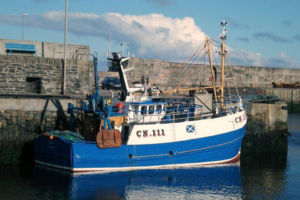
Four crewmembers had to be rescued after uncontrolled flooding on prawn trawler Freedom II caused the vessel to founder and later sink off the Scottish coast.
The MAIB received 230 reports of flooding of fishing vessels between 2013 and 2022, of which 78 (34%) resulted in the loss of the vessel. The data indicates flooding remains a significant safety issue.
What happened
At 1535 on 21 February 2024, the 15.94m prawn trawler Freedom II foundered and sank to the east of the Garvellach Islands in the Firth of Lorn off the west coast of Scotland. Freedom II had suffered an uncontrolled flood into the engine room. The crew were initially alerted to the flood by the activation of the bilge alarms but did not isolate any sea cocks as they believed that the flood was due to a failed stern seal. The flood, likely caused by the failure of a seawater pipe, overwhelmed the available bilge pumps and passed into the fish hold.
The skipper and a deckhand tried to deal with the flood while Freedom II was taken under tow by an RNLI lifeboat. The tow was abandoned when it became apparent that the vessel was sinking, and the skipper and the deckhand swam clear of the vessel as it foundered; they were recovered from the water by the lifeboat’s crew.
Safety issues
- The vessel foundered due to a progressive flood into the engine room.
- The exact source of the flood could not be identified. The most likely cause was a vibration-induced fracture of the seawater suction pipe for the deck wash pump.
- The rate of flooding overwhelmed the operational bilge pumps and additional pumps either failed or could not be used due to power supply issues. The salvage pump from the lifeboat was not used.
- The skipper was proactive in ensuring that the crew were safe and managed to raise the alarm in an area of poor signal coverage.
Lessons
- Flooding is preventable, but if it occurs can be controlled in most cases. If discovered early, leaking pipes can be isolated and the flooding controlled by pumping out the affected space. Flooding can be rapid, and late discovery leaves no time to treat the cause. An efficient bilge alarm can be critical in providing early warning of flooding.
- If in doubt as to the source of a flood, closing down the seawater system might contain the f loodwater and help to identify the source.
- On board Freedom II the crew initially checked all the compartments around the vessel; however, it was only later in the emergency that the fish hold was found to be almost fully f looded. Regular checks for progressive flooding can help inform effective decision-making throughout each stage of the emergency.
- Regular checks and function tests of bilge alarms and pumps, together with regular examinations of vessel hulls and pipework will assist in preventing potential leaks or failures occurring.
- Being prepared for an emergency, and knowing what to do when it occurs, is vital for the safety of all on board: know your vessel systems; test your emergency pumps and drill for emergencies.
Download the report:
Download the safety flyer: