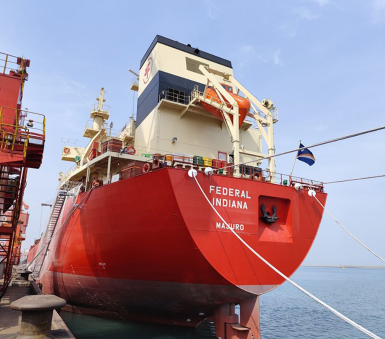
A trainee seafarer dies on board Federal Indiana after being found unconscious near the entrance of an access space on board the bulk carrier, which was transporting scrap metal, according to a report released by the Republic of the Marshall Islands Maritime Administrator.
The trainee seafarer had served on board Federal Indiana for only 4.9 months before the incident that killed them.
What happened
On the morning of 19 February 2025, Federal Indiana was underway in the Mediterranean Sea, laden with scrap metal divided over the six cargo holds on board. The Company had assessed scrap metal as an oxygen depleting cargo that could emit toxic gases.
Each cargo hold was accessible by means of two booby hatches located on the main deck: one located at the forward end and one at the aft end. The booby hatches were locked during the voyage.
The forward booby hatch for CH No. 1 was located inside a small space under the forecastle deck. The space was naturally ventilated and was accessible through a weathertight door from the cross deck between the forecastle and CH No. 1. Empty pallets and drums with chemicals were stored inside this space. Based on the definitions contained in IMO Resolution A.1050(27), applicable at the time of the incident, the space was assessed as neither an enclosed space nor an adjacent connected space, owing to the previously mentioned presence of natural ventilation.
Around 0815 hours, after the daily planning and Toolbox Talk for the activities on deck, the Bosun and the DTS started to open the four booby hatches of CH Nos. 1 and 2 for inspection of the toggle pins and packings of the booby hatch covers by the C/O. Around 0830, the Bosun and the DTS opened the forward booby hatch cover for CH No. 1 and an additional two of the four booby hatches before the Bosun was called away. Before he left, the Bosun instructed the DTS to open the forward booby hatch of CH No. 2 and then join the ASD1.
When the Bosun later passed by the entrance of the CH No. 1 Access Space, he found the DTS collapsed near the entrance of the space. The Bosun then alerted the other crewmembers who were working on deck and informed the OOW on the Bridge through his handheld radio.
The ASD3 and the Fitter were the first crewmembers who arrived at the CH No. 1 Access Space. The Fitter reported a strange smell and felt uncomfortable breathing, so he went to the ship’s side for some fresh air. The ASD3 entered CH No. 1 Access Space to help the DTS, but experienced shortness of breath and felt unwell. He managed to get out of the space by his own effort. The ASD1 observed that the ASD3 was unable to get air and realized that compressed air was necessary to safely enter the space. Ultimately, the DTS was rescued out of the space by crewmembers using SCBAs.
The ASD3 recovered after medical oxygen was administered for approximately 20 minutes. The DTS was unconscious, not breathing, and without a pulse. CPR was initiated, shoreside medical advice was consulted, and the Master deviated the ship to the port of Skikda, People’s Democratic Republic of Algeria for medical evacuation of the DTS by helicopter.
At 1250, the DTS was declared deceased when he arrived at the hospital.
Investigation
The Administrator conducted a marine safety investigation and determined that the CH No. 1 Access Space was not identified as a connected space on board Federal Indiana, consistent with IMO Resolution A.1050(27) applicable at the time of the incident. As this resolution did not define connected spaces in the context of naturally ventilated arrangements, no preventive entry measures were implemented.
Lessons learned
The following lessons learned were identified.
- Connected spaces should always be treated as enclosed spaces. Hazardous atmospheres in enclosed spaces can migrate to adjacent and connected spaces when the barrier between both spaces is no longer intact. Natural ventilation of a connected space might be insufficient and should not be relied upon.
- Entering a connected space without following established shipboard enclosed space entry and rescue procedures is extremely hazardous and should not be attempted.
- Enclosed space rescue procedures must be properly practiced and drills conducted as if they were a real emergency.
Download the full report: