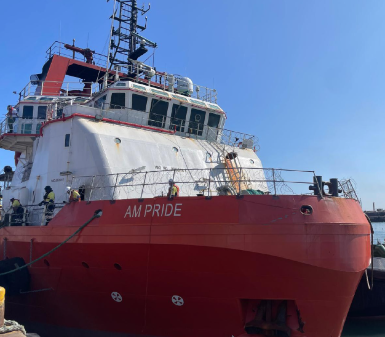
An investigation launched by the Republic of the Marshall Islands Maritime Administrator into an accommodation fire on board an AHTS vessel has been closed. The Administration published a report on the incident, which forced the ship’s crew to evacuate by helicopter.
What happened
On the morning of 12 September 2024, the fire alarm on board the Republic of the Marshall Islands-registered AHTS vessel AM Pride activated. The vessel was engaged in helicopter stand-by duty, approximately 1.5 NM away from the FA Platform south of Mossel Bay, Republic of South Africa. AM Pride was managed by V.Ships Offshore (Asia) PTE LTD and had recently undergone a change of 80% of its crew.
At 1000, the fire panel located on the vessel’s Navigation Bridge indicated an activated alarm in three zones inside the Accommodation and an activated alarm in the Bow Thruster Room. Upon verification, black smoke was observed in the Main Deck Alleyway inside the Accommodation, but no flames were visible. A PA was made by the Master and, subsequently, the crew mustered on the forecastle deck. Many doors inside the Accommodation, including fire doors, were open and the ventilation was operating in full recirculation mode when the fire broke out. These conditions facilitated the smoke rapidly spreading through the entire Accommodation and complicated the determination of the source of the fire and subsequent firefighting activities.
Around 1100, it was observed that crewmembers had not succeeded in locating the exact source of the fire or in controlling the fire. Subsequently, the Master decided to lock down the Accommodation and Engine Room and to shut down the main engines. Arrangements were made for the evacuation of the vessel by helicopter.
Between 1350 and 1540, while waiting for evacuation, crewmembers continued firefighting activities and assessed the fire to be under control, however it could not be established if the fire had been extinguished. At 1540, a helicopter rendezvoused with AM Pride and commenced evacuating crewmembers.
At 1600, all crewmembers were safely evacuated and the vessel was abandoned.
On 13 September 2024, an emergency towing vessel arrived and a salvage team boarded AM Pride. After it was confirmed that the fire had in fact been extinguished, AM Pride was towed to Cape Town, South Africa where it arrived on 21 September 2024.
Upon arrival, the observed fire damage was primarily located on the main deck level inside the Accommodation and in the cabin above the Recreation Room. The most severe damage was observed inside the Recreation Room. Smoke damage was observed throughout the entire Accommodation and the Navigation Bridge.
Investigation
A fire expert determined that the fire most probably occurred by a tracking defect inside the sockets mounted on the portside bulkhead of the Recreation Room. The Administrator’s investigation determined that the crew’s limited familiarization with the vessel, the recent 80% crew change, and the compromised fire integrity by means of open doors on board resulted in the abandonment of the vessel.
Lessons learned
The following lessons learned were identified:
- When a room is used for a purpose other than that for which it was originally designed, its suitability should be verified, and the room should be arranged for the new use to ensure that goods or equipment can be stowed in a safe and secure way. A risk assessment, as part of a management of change process, could help to determine if any original installations needed to be adapted or decommissioned for the new purpose of the room.
- Immediate smoke containment by early shutdown of the ventilation and strict fire door control avoid the rapid spreading of fire and smoke in case of fire on board, and will facilitate in locating the source of the fire.
- Fire doors not fitted with self-closing devices should not be maintained open by use of rope, wedges, or any other means, and should always remain closed when not in use.
- Self-closing devices should be tested regularly to ensure that they are operating properly.
- An 80% crew change requires additional attention related to the familiarization with safety equipment and critical safety duties in emergency situations.
- Fire and safety equipment on board that is in excess of the minimum required on the vessel’s Fire and Safety Plan should be included in shipboard contingency plans, monthly and weekly inspections, and incorporated within crewmember familiarization checklists.
Download the full report: