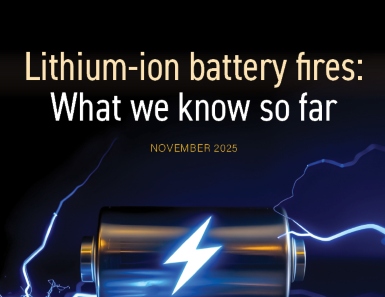
Lithium-ion battery fires: What we know so far is a new publication published on behalf of the members of the Maritime Professional Council of the UK. That said, it is aimed at an international audience. The publication has been co-authored by Frances Birkett and Mike Schwarz of IIMS.
Preventing the next lithium fire at sea: A data-driven blueprint for safer transportation
With new data and technological innovation, the maritime industry must re-evaluate cargo handling protocols and develop more resilient fire mitigation strategies to address growing risks at sea, argues Alicia Lee, Chief Operating Officer at GSBN. On a summer morning in June 2025, a carrier vessel called the Morning Midas caught fire in the middle of the Pacific Ocean. The entire crew on board had to abandon ship to escape flames. The Morning Midas, along with the electric vehicles it was carrying that started the blaze, now rests at the bottom of the ocean. Continue reading “Preventing the next lithium fire at sea: A data-driven blueprint for safer transportation”
Managing the growing risk of Lithium-ion battery fires
The global energy transition has led to an acceleration of new and innovative technologies designed to support decarbonization efforts across the global supply chain. The maritime industry plays a fundamental part in this effort, not simply by addressing its own impact on global CO2 emissions, but also by facilitating the availability and transportation of new and innovative technologies that are designed to mitigate carbon emissions. But not all of this is safe as their is a growing risk of Lithium-ion battery fires.
For instance, the shipping industry is playing a critical role in accelerating the green automotive market, particularly the global transportation of electric vehicles (EVs) and large battery hybrids. According to Statista, the EV market is projected to grow by nearly 10% each year and account for over 17 million vehicles by 2028. However, this development also brings with it significant safety implications that don’t just impact the vessel, but also the health and wellbeing of crew members onboard – specifically in relation to the significant increase in fire risks presented by the lithium-ion (Li-ion) batteries used in EVs. Continue reading “Managing the growing risk of Lithium-ion battery fires”
Carrying electric vehicles and lithium-ion batteries at sea and the fire risks
In its Shipping and Safety Review 2023, Allianz Global Corporate & Specialty reported that the second top cause of loss of vessels in 2022 was fire or explosion. There were 209 ship fires reported during 2022, the highest in a decade and 17% more than in 2021. Of those fires, 13 occurred on car carriers. Fire was also reportedly the most expensive cause of marine insurance claims furthering the point that electric vehicles and lithium-ion batteries at sea at potent fire risks. Continue reading “Carrying electric vehicles and lithium-ion batteries at sea and the fire risks”
Lithium-ion batteries: a growing risk for yacht fires?
Increased usage of lithium-ion batteries aboard yachts and superyachts presents significant risk for the maritime industry and it is compounded by the rapid evolution of technology with which regulatory oversight struggles to keep apace. But now we must ask: Are Lithium-ion batteries a growing risk for yacht fires?
On 9 January 2025, a fire broke out on board the m/y Naisca IV while moored near Marseille. Initial indications are that the fire, which ultimately destroyed the Naisca IV and caused damage to two neighbouring yachts, originated from a lithium-ion battery. While efforts were made to mitigate environmental harm, the extent of the loss remains uncertain. Continue reading “Lithium-ion batteries: a growing risk for yacht fires?”
LiBs batteries are increasingly used in the marine industry. Their advantages are many: compact and cheap, with higher energy density, they can help to cut down sharply on fossil fuel use. Problems are rare, but when things go wrong the results have a high impact and take up emergency resources for a considerable time which has spawned the phrase: Lithium batteries don’t commit suicide. They’re murdered. Continue reading “Lithium batteries don’t commit suicide. They’re murdered”
Capt Rahul Khanna, pictured, indicated insurers have seen large losses from lithium-ion batteries
Electrification of the global economy continues to bear risks for the shipping industry and supply chains, according to Allianz Commercial’s latest Safety and Shipping Review.
Electrification of the global economy is driving huge demand for lithium-ion batteries, from electric cars and e-bikes to industrial scale battery storage systems. The global battery market is forecast to reach US$322bn by 2030, more than double its value in 2024, driven by growing demand for electric vehicles and battery storage systems required to support the transition to renewable energy. Continue reading “Electrification continues to bear risks for the shipping industry”
An expert’s guide to lithium-ion battery fire prevention
Mark shares some essential lithium-ion battery safety advice and guidance to give a better understanding of the risks associated with this technology. Giving his expert’s guide to lithium-ion battery fire prevention.
Lithium-ion battery powered devices don’t pose an increased risk if devices are maintained in good working condition and people follow some basic rules. From a fire service perspective, the vast majority of lithium-ion battery fires we’ve seen have been caused by human error.
Many of these simple rules that should be followed are almost all related to battery charging. Ensure that the charger you use to charge your particular device is the specific charger that’s recommended by the manufacturer. If you buy a quality product from a reputable retailer, you can be confident that the correct charger will be supplied with that product. However, if you buy a discount replacement charger online you need to be very aware where that product is coming from. Continue reading “An expert’s guide to lithium-ion battery fire prevention”
In its “Fate, Behaviour, Potential Damage & Liabilities Arising from a Shipping Incident Involving a Li-ion Battery Powered Vessel” report, at least half of existing vessels with Li-ion batteries utilise the technology as part of a hybrid system paired with a traditional combustion engine using conventional fuels (or possibly biofuels). Continue reading “Consequences of incidents involving Li-ion battery powered vessels”
The international transportation industry has been looking carefully at the hazards inherent in transporting lithium- ion (Li-ion) batteries and goods powered by them. As has been highlighted recently in the industry press, while Li-ion battery fires are not a common occurrence, their consequences can be devastating.
Shipping lithium-ion cells in containers guidance published by CINS
The International Safe Containerised Cargo Organisation (CINS) has published safety guidance on shipping lithium-ion cells in containers. Lithium-ion cells are the primary elements of a battery and can exist in various forms. Commonly used in portable electronics and electric vehicles, their defining characteristic is the ability to accumulate, store and release electrical energy through the movement of lithium ions between a positive and a negative electrode.