“Fore”: Floating golf target system enhances on-water golf experience
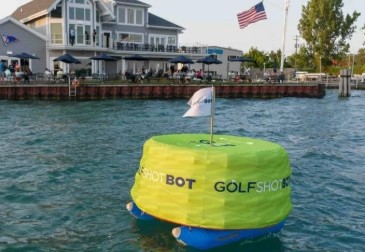 Oh, the ingenuity of it all. Whatever next? On-water golf, it seems!
RoboBuoy, the marine robotics company behind the MarkSetBot autonomous sailing mark system, is seeing increasing adoption of its GolfShotBot floating golf target. This ingenious floating, self-propelled golf target system is increasingly being deployed across major international golf championships, including the U.S. Open, Ryder Cup and Senior PGA Championship.
The system can be virtually anchored in place or programmed to move, allowing operators to create dynamic golf experiences on the water. When paired with biodegradable golf balls, it enables safe deployment in environmentally sensitive locations. GolfShotBot utilises GPS spot-lock technology to hold station without physical anchors, even in strong winds or currents. Controlled via a mobile application, the system can be virtually anchored or programmed to follow dynamic routes, allowing waterfront venues, luxury resorts and event operators to establish pop-up driving ranges.
The company is now targeting yacht clubs, waterfront resorts, marinas and private owners, positioning GolfShotBot as a premium amenity for events, hospitality and guest experiences. Across multiple activations, the product has been paired with Zero Ball, a biodegradable golf ball created by Splash City Golf.
And once you have had your fill of on-water golf, just head to the nineteenth hole for refreshments!
Australian national survey highlights critical marine workforce shortages
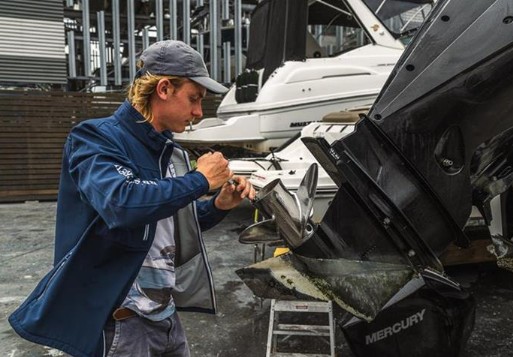
The results of this significant survey will not come as a surprise to many. The depressing reality is that skills shortages across all sectors of the marine sector are apparent and being felt. What’s harder is to know how to practically combat the issue and reverse the trend. For several years, I have been aware of a shortage of professional marine surveyors. As the older generation starts to retire and pass away, there is a void emerging. IIMS will do what it can to train new marine surveyors, but the routes into the profession are not as clear-cut as they used to be, and it requires ‘thinking outside the box’ to address the problem.
Here’s the story and an overview of the findings of the Boating Industry Association’s survey.
More than 90 per cent of Australia’s marine industry is deeply concerned about a critical lack of skilled labour, according to the latest data released by the BIA. The 2026 BIA National Jobs & Skills Survey has laid bare the immediate and long-term workforce challenges facing the recreational boating sector nationwide, revealing that severe shortages are actively impacting the operational capacities and financial performance of marine businesses.
The findings come at a vital time for a sector that is a major powerhouse of the Australian economy. The marine industry generates an annual national turnover exceeding $10.2 billion and employs approximately 35,000 people across more than 2,000 businesses—spanning designers, manufacturers, retailers, marinas and trades.
According to BIA CEO Andrew Fielding, the results highlight an urgent need for targeted investment in workforce development, education and vocational training. He said, “The 2026 National Jobs & Skills Survey confirms workforce shortages are no longer just an administrative headache – they are a direct threat to industry prosperity,” Mr Fielding said. “When nine out of ten businesses tell us they are worried about skilled labour and apprentice pipelines, it is a clear call to action.”
Did you miss Jono Ridler’s historic and epic Swim4TheOcean?

Shamefully, I have to admit this extraordinary feat of endeavour passed me by, but I have no idea why. It is an astonishing story and one I am delighted to share with you. When Jono Ridler completed the longest unassisted staged swim in history on 4 April, millions of people around the world didn’t just hear about it – they watched it happen in real time (apart from me you understand)!
Behind that experience was PredictWind, whose live tracking and marine forecasting powered the Swim4TheOcean campaign from the first stroke to the last. Swim4TheOcean saw Ridler swim 1,367km (approx. 850 miles) down the east coast of New Zealand’s North Island over 90 days, without a wetsuit. The mission, developed in partnership with marine conservation foundation Live Ocean, carried a clear call to end bottom trawling on New Zealand’s seamounts.
The swim generated remarkable numbers:
– 1,426,500 strokes, the equivalent of 27,340 lengths of an Olympic pool
– 468 hours 23 minutes spent in the water across 90 days
– 4.48 million Live Ocean page views and almost 300,000 unique visitors
– 73,647 signatures on the call to end bottom trawling
Hats off to Jono for an amazing adventure and for setting a record that I am certain may never be bettered!
Free to a good home – one heritage boat
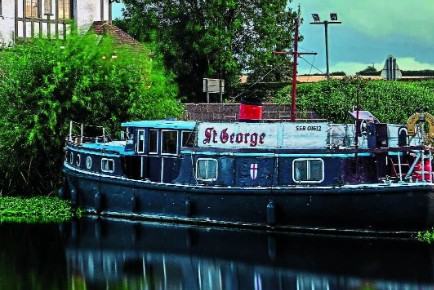
There is no such thing as a free lunch; you don’t need me to tell you that. But what about a free boat? Well, you are in luck, it seems. You could have a free boat!
A last-ditch plea has been issued to save St George, a once elegant 1935 passenger vessel, now lying in poor condition at Willow Moorings, Kegworth in the UK. The 58ft craft, whose long career has spanned pleasure cruising, wartime service and a starring role in the 2012 Diamond Jubilee Pageant, is being offered free to a good home as its owner can no longer care for her. The vessel’s construction is typical of the period: a carvel-built hull with oak frames and pine planking, later ferro-sheathed in 1983. It carries a ketch rig with gaff sails and is powered by a 1969 Ford 4D engine.
National Historic Ships UK describes the vessel as a large project, but one with real potential for a committed restorer. A boat lift is available just four miles from its mooring, easing the logistics for any prospective new custodian.
If you are keen to take on such a project, make contact with National Historic Ships UK to express your interest by email at info@nationalhistoricships.org.uk.
Survey well
More next month.
Mike Schwarz