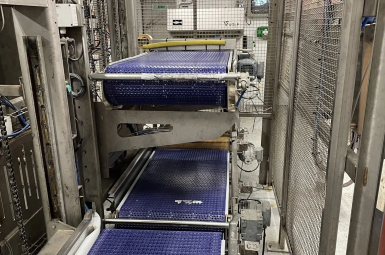
The Norwegian Maritime Authority (NMA) has received reports of serious crushing accidents involving fish packaging machines in factories on board vessels.
An incident in which a person was caught in an automated palletising prompted the NMA to share an article highlighting the dangers involved. In the particular incident a vital safety barrier had been removed.
Removed safety barriers
Palletising machines are equipped with safety barriers designed to ensure they stop if personnel enter the restricted area surrounding the machine. One of the barriers is a safety fence around the machine, with doors that must remain closed during operation.
When one of the doors is opened, the machine’s operating voltage is intended to be automatically disconnected.
In the incident on which this article is based, involving a palletising machine on board a vessel, two doors had been removed. This was justified on the grounds that the doors caused frequent stoppages during periods of good fishing and high activity in the factory.
The doors were fitted with sensors that functioned as safety devices. As a result, the operator was able to enter – and climb on to – the machine while it was still energised. The operator’s movements activated sensors, which in turn activated the palletising machine while the person was inside it.
Risk assessment
The risk assessment for the incident referred to stated that the area was secured with safety barriers and that entry into the area would cause the packaging machine to stop. This assessment, however, was based on the assumption that the doors were installed. Consequently, the risk assessment did not reflect how the work was actually carried out by the employees.
An updated risk assessment must reflect the actual risk. In this incident, it did not do so, as the doors were not in place.
It is essential that those involved in the operation participate in the development of procedures, which must be relevant and realistic to follow. Otherwise, procedures may be bypassed, which can have serious consequenses for employees who are not familiar with the specific safefty conditions associated with the operation in question.
If certain tasks are caried out safely but outside the established procedure, it is important that the procedure is updated accordingly and made known to everyone.
Corrective measures
The NMA recommends that the entire industry establish a practice of always assessing corrective measures when safety barriers are modified or removed.
This includes:
- a comprehensive review and risk identification for both normal operation and operational deviations
- approval from the manufacturer or supplier when changes are made to barrier and safety functions
- ensuring that procedures or routines are in place for the isolation of machinery and equipment before work is permitted to commence
- technical safety devices must not be removed or disabled
- removal of safety barriers requires compensating measures to ensure an equivalent level of safety
- ensuring that the crew receive correct and sufficient training and familiarisation, both for normal operation and in case of operational disturbances. This must form part of the vessel’s safety management system.
Read the article: NMA – Serious crushing injuries in packaging machinery