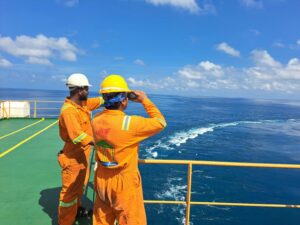
On 2 May 2019, a twistlock fitted to one of the bottom corner fittings of a container fell out of the fitting while the container was being restowed aboard the container vessel MOL Bravo, in the port of Manzanillo, Mexico. The twistlock landed on the second officer who was on deck, struck his safety helmet and caused fatal injuries.
The investigation report by the Marine Department of Hong Kong noted the following:
– The second officer failed to follow the company safety procedures to stay away from the hazardous zone underneath the container while it was being restowed by a gantry crane.
-Although the second officer should not have been standing under a container being loaded onto the vessel, the safety helmet was required to protect him from the falling twistlock. The helmet did not provide adequate protection for this hazard. For those unfamiliar, a twistlock is a steel device inserted into the bottom corner fittings of containers, designed to lock containers in a vertical stack.
This article is not concerned with the competence of vessel officers examining twistlocks or of pin men who attach twistlocks to the bottom corner fittings of containers. Their work involves recognising defective twistlocks and corner fittings. Once detected, pin men are expected to reject defective twistlocks and ensure containers with defective corner fittings are not loaded onto the vessel.
The urgent need for safety helmets
Instead, this article deals with the urgent need for safety helmets used by crew and stevedores involved in container vessel operations to be fit for purpose. This requires safety helmets to be redesigned so they can protect the wearer from the energy and force of a falling twistlock — hereinafter referred to as a redesigned safety helmet. Such a safety helmet would provide protection even in cases where human error occurs.
The second officer’s safety helmet could not protect him against the falling twistlock because it was not designed to withstand the impact energy and force involved.
Safety standard of the safety helmet
The safety helmet was manufactured to European Standard EN 397, which is designed to protect the wearer from falling objects. In accordance with the standard, the chinstrap releases at 150 to 250 newtons of impact force, and the helmet absorbs 50–80 joules of energy.
In the accident, the twistlock weighed approximately 5.2 kg and fell from a height of 9.5 metres. The estimated impact energy and force on the second officer could have reached 500 joules and 5,000 newtons respectively. This demonstrates that the falling twistlock produced forces far beyond the helmet’s protection range.
Because the helmet was designed to EN 397, it was not fit for this particular hazard. The report did not make recommendations regarding awareness of the limitations of EN 397 helmets or the development of helmets specifically designed for container vessel operations.
While the report did not make these recommendations, safety measures are generally expected to include informing personnel about the limitations of standard helmets and encouraging the adoption of purpose-designed helmets. This involves multiple stakeholders, including container vessel owners and crew; stevedoring companies and their employees; safety regulators; maritime unions; insurers; and other entities involved in container vessel operations.
The continued use of helmets that do not match the risks on container decks exposes personnel to potential injuries. Employers have ongoing obligations under work health and safety legislation to assess hazards and implement risk control measures. For example, Section 27 of the Work Health and Safety Act 2011 (NSW) places duties on officers of a business or undertaking to ensure safety obligations are met. Similar federal provisions apply.
It is well recognised that stevedoring companies and shipowners often have differing objectives. However, the absence of any industry-wide move toward purpose-designed head protection for twistlock hazards highlights a shared gap in addressing safety risks.
Safety alerts and further examples
One such example is a safety alert issued by the International Container Handling Co-ordinating Association (ICHCA) on 7 May 2025, whose membership includes stevedoring companies and shipowners.
In 2023, a team leader at a member terminal was struck by a falling twistlock.
It is likely that the head protection he was wearing saved his life. However, the trauma was severe, as can be seen in the images in this safety alert. The injured worker agreed to the images being shared to help raise awareness of this risk.
The investigation concluded the twistlock dislodged from a five-high fitting, striking the vessel team leader. The twistlock became dislodged because the twistlock locator pin failed while loading into a blind cell on deck.
Although the report does not mention whether the stevedore was in a safe location on deck when struck, it must be noted that few locations on a vessel’s deck — stacked with containers and while loading containers — provide adequate protection from a twistlock ricocheting off containers during its fall.
The injured stevedore deserves credit for agreeing to the images of his injuries being shared, as a means of raising awareness of helmets being unfit for purpose and the need for redesigned helmets.
A redesigned safety helmet may include materials such as Kevlar. Its cost would be secondary to the obligations of stevedoring companies and shipowners to eliminate risks to the safety of their personnel. A redesigned helmet would also enable these entities to give meaning to mottos such as, “Come home safe, that’s all I ask” and “Make sure you get home safe to your family.”
Despite twistlocks being responsible for causing an officer’s death and a stevedore’s serious injuries, shipowners and stevedoring companies have not yet moved to demand redesigned helmets.
Officers of stevedoring companies and shipowners, responsible for the safety of their personnel, ought to consider their obligations under work health and safety legislation in Australia. Section 27 of the Work Health and Safety Act 2011 (NSW) enables an officer to be found guilty of an offence under the Act, whether or not the employer has been convicted or found guilty of an offence relating to that duty. Corresponding federal legislation is in similar terms.
It is well recognised that stevedoring companies and shipowners rarely see eye to eye. Their goals are often diametrically opposed. However, the lack of any industry-wide move toward purpose-designed head protection for twistlock hazards highlights a shared gap in protecting personnel on container vessel decks.
A final thought
The continued reliance on helmets that do not match the energy of falling twistlocks demonstrates the need for ongoing discussion and development in industry safety
standards. Awareness of these risks and consideration of improved equipment would support the safety of those working on container vessel decks and terminals.
Written by Capt. Glenn Mathias