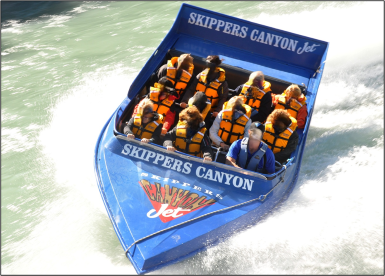
The Transport Accident Investigation Commission (TAIC) has released a report into an incident where several passengers were injured after a jet boat crashed into a canyon wall last year.
What happened
On 25 February 2025, commercial jet boat Discovery 2 was operating in Skippers Canyon, on the Shotover River, with 11 passengers on board.
Shortly after commencing the return leg of the journey, and as the boat completed a right-hand turn, its engine suddenly cut out. The driver immediately reset the ignition, but the engine would not start, so the boat had no propulsion and no thrust to provide steering control.
As a result, the boat continued across the river, where it made heavy contact with the canyon wall. The boat’s speed upon impact was estimated to have been between 30 and 35 kilometres per hour.
The sudden stop caused the passengers to be thrown forward and resulted in one passenger fracturing their wrist and several passengers suffering deep cuts and bruising. Two adults and two children from the same family were evacuated by helicopter.
Some of the passengers reported significant psychological trauma following the accident.
Why it happened
The driver lost control because the engine suddenly shut down, leaving the boat with no thrust and therefore no steering capability.
Tests ruled out contamination of the fuel and the lubricating oil as contributing to the accident. Relevant properties were consistent with their grade specifications.
It is virtually certain that the engine shut down because part of the engine’s wiring harness had chafed against a casting of the engine. The chafing exposed a wire and eventually caused a short circuit when it contacted part of the engine. This resulted in the loss of the 5-volt reference voltage shared by the critical engine sensors, and the engine shut down.
The padding requirements, prescribed in the Maritime Rules for commercial jet boats, did not include enough detail to form a measurable standard for passenger protection. Padding of the seats and surrounds of Discovery 2 did not adequately protect the passengers from injury during a sudden stop.
Passengers were not informed of, and therefore were uncertain about, what was an appropriate brace position for an emergency on board a jet boat. It is likely that some passengers suffered worse injuries due to this uncertainty.
Lessons learned
Operators conducting thrill-type trips should inform passengers of the risks involved so that the passengers know when things are going wrong, and how best to aid themselves.
Single-engine jet boats are vulnerable to loss of control, because once the engine fails, a jet boat has no steering.
Safety solutions are unique to each operator. Preventive maintenance and survivability measures are critical when redundancy is not a viable option.
Read the full report: