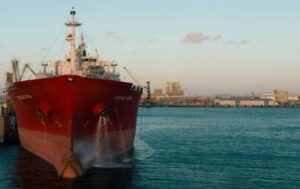
ABS shares guidance on ladders and stairways as a means of escape from engine rooms

ABS shares guidance on ladders and stairways as a means of escape from engine rooms. Source: ABS

Following Port State Control findings on the design and installation of heat shielding ladders forming an escape route from machinery spaces, ABS has provided guidance on on ladders and stairways as a means of escape from engine rooms.

In a letter to industry, ABS has said PSC inspectors may issue a deficiency against 07120, Means of Escape, when there exists a gap in the heat shielding between the ladder and the deck it serves. Continue reading “ABS shares guidance on ladders and stairways as a means of escape from engine rooms”

Preventing the next lithium fire at sea: A data-driven blueprint for safer transportation

Preventing the next lithium fire at sea: A data-driven blueprint for safer transportation

With new data and technological innovation, the maritime industry must re-evaluate cargo handling protocols and develop more resilient fire mitigation strategies to address growing risks at sea, argues Alicia Lee, Chief Operating Officer at GSBN. On a summer morning in June 2025, a carrier vessel called the Morning Midas caught fire in the middle of the Pacific Ocean. The entire crew on board had to abandon ship to escape flames. The Morning Midas, along with the electric vehicles it was carrying that started the blaze, now rests at the bottom of the ocean. Continue reading “Preventing the next lithium fire at sea: A data-driven blueprint for safer transportation”

NTSB alerts land-based firefighters to risks of vessel fires

A fire boat directing water onto the Grande Costa D’Avorio at a port
A fire boat directing water onto the Grande Costa D’Avorio. Source: NTSB

The U.S. National Transportation Safety Board (NTSB) has issued a safety alert urging greater awareness and training for land-based firefighters who may be called to fight fires aboard vessels in local ports.

The safety alert follows several NTSB investigations into deaths and injuries to firefighters.

The NTSB found land-based firefighters often lack the necessary training and familiarity with vessel layouts and fire protection systems to effectively fight in-port vessel fires. They also may be unaware of how to use the structural fire protection built into most commercial vessels.

Continue reading “NTSB alerts land-based firefighters to risks of vessel fires”

IUMI best practice for safely transporting EVs

IUMI best practice and recommendations for safely transporting EVs

IUMI has released an update to its best practice and recommendations for safely transporting EVs.
In 2023, IUMI published a set of best practice and recommendations for the safe carriage of electric vehicles. This was part of its ongoing support of loss prevention guidance to the global marine insurance and shipping sectors.
In September 2025, IUMI issued an updated version titled “Risk mitigation for the safe ocean and short-sea carriage of electric vehicles”. Continue reading “IUMI best practice for safely transporting EVs”

Global Shipping Business Network report argues that dangerous goods reshape the fires at sea landscape

Dangerous goods reshape the fires at sea landscape is the theme of the Global Shipping Business Network report

The Global Shipping Business Network report focuses on the risk mitigation of the transportation of lithium-powered products in the maritime industry, which finds itself under increasing pressure to safely transport larger volumes of dangerous goods, which have reshape the fires at sea landscape.

According to the Global Shipping Business Network report “Fires at Sea, A New Landscape – Risk Mitigation Strategies for Safe Transport” dangerous goods (DG) given their potential consequences, have received significant attention in conversations surrounding cargo handling. Continue reading “Global Shipping Business Network report argues that dangerous goods reshape the fires at sea landscape”

Tokyo MOU on maintenance and rigging of pilot transfer arrangements

Defective pilot ladder. Source: Tokyo MOU

Tokyo MOU has reinforced an awareness of the potential risks associated with the improper maintenance and rigging of pilot transfer arrangements. Therefore they released a guidance on maintenance and rigging of pilot transfer.

Tokyo MOU has reported that recent reports and Port State Control (PSC) inspections have highlighted recurring issues related to pilot ladders and hoist/pilot transfer arrangements, the improper rigging of pilot transfer arrangements. Continue reading “Tokyo MOU on maintenance and rigging of pilot transfer arrangements”

AMSA on using exhaust gas cleaning systems (EGCS)

 AMSA has provided guidance on using exhaust gas cleaning systems (EGCS) in Australian waters.
AMSA has provided guidance on using exhaust gas cleaning systems (EGCS) in Australian waters.

The Australian Maritime Safety Authority (AMSA) has released guidance on how to use an exhaust gas cleaning system (EGCS) to meet the fuel sulphur limit of 0.50% m/m, as required under MARPOL Annex VI and Australian law. This what AMSA has to say on exhaust gas cleaning systems.
Marine notice 2025/04 provides guidance on using an exhaust gas cleaning system (EGCS) to support compliance with the sulphur limit of 0.50 mass per cent concentration (m/m) in fuel oil.
The sulphur limit is required by the International Convention for the Prevention of Pollution from Ships (MARPOL) Annex VI and Australia’s domestic law. Continue reading “AMSA on using exhaust gas cleaning systems (EGCS)”

Liberia launches CIC on compliance with marine notices

Liberia launches CIC on compliance with marine notices

The Liberia Maritime Authority has launches a CIC on compliance with marine notices.
The purpose of the CIC is to determine the level of compliance of all involved parties with the requirements of the Liberian marine notices, especially those related to safety compliance.

Vessel operators and Designated Persons Ashore (DPA) should ensure that:

  • Relevant documents are available onboard and ready for inspection by Liberian inspectors
  • Evidence of communication is preserved and available upon request
  • Crew is aware of Liberian requirements and ready to demonstrate compliance

Continue reading “Liberia launches CIC on compliance with marine notices”

Understanding effective risk assesments

Understanding effective risk assesments

The growing scale and complexity of marine transportation necessitate a proactive and multi-faceted approach to risk management. While professional expertise, experience, and regulatory frameworks provide valuable advantages, they cannot anticipate all potential risks which is why Understanding effective risk assesments is important.

A review of incidents often finds that opportunities were missed to identify and mitigate the risks. As with any process, risk assessments may be ineffective and unlikely to contribute to safety if they are missing the point, are not understood, or seen merely as a ‘tick box exercise’. Risk assessments should ideally occur on many levels, both as a formal, documented process and as a dynamic, ‘on the job’ activity. Continue reading “Understanding effective risk assesments”

How a Navy doctor revolutionized high-speed boat safety

How a Navy doctor revolutionized high-speed boat safety Photo Credit: Ullman Dynamics

For years, operators of high-speed boats have silently endured the physical toll of their profession. Repeated slamming impacts from rough seas caused serious injuries, many of them life-altering. However, one Navy doctor saw these challenges not as an unavoidable consequence but as a problem that could be solved. His solution? A seat that would change the course of high-speed boat safety. This article is about how a Navy doctor revolutionized high-speed boat safety. Continue reading “How a Navy doctor revolutionized high-speed boat safety”

Container ship fires on the rise again?

Container ship fires on the rise again?

After a seemingly ‘benign’ period, we have seen several serious container ship fires lately, including a large one leading to tragic loss of life. Congested ports in Asia and increasing traffic of large container ships around Africa are also a cause for concern. Which begs the question: are container ship fires on the rise again?

Cargo-related fires on board container ships have long been a hot topic in the industry – and rightly so: In 2023, we saw on average one container cargo fire every 9 days, according to statistics from Cargo Incident Notification System (CINS). This is an increase compared with 2020, when the number was approximately one container fire every two weeks. Continue reading “Container ship fires on the rise again?”

Asphyxiation in cargo hold due to oxygen depletion

Asphyxiation in cargo hold due to oxygen depletion

Britannia P&I Club has published a case study focusing on an incident onboard a bulk carrier nearing the completion of loading corn cargo, which caused the asphyxiation in the cargo hold of two fumigation contractors, one of whom died.

On 3 December 2021, a 33,000 GT bulk carrier arrived in Chennai, India, to load 53,000 tonnes of yellow corn. Fumigation contractors boarded to install ducting for fumigating the cargo. Loading began that day but was intermittently halted due to rain. By 15 December 2021, cargo hold four was loaded and its hatches and accessways were sealed. Loading continued in other holds as weather allowed. Continue reading “Asphyxiation in cargo hold due to oxygen depletion”

Instagram Posts from the IIMS @iimsmarine

Privacy Overview

This website uses cookies so that we can provide you with the best user experience possible. Cookie information is stored in your browser and performs functions such as recognising you when you return to our website and helping our team to understand which sections of the website you find most interesting and useful.

Strictly Necessary Cookies

Strictly Necessary Cookie should be enabled at all times so that we can save your preferences for cookie settings.

Show details Hide details
Performance & Marketing Cookies

This website uses Google Analytics to collect anonymous information such as the number of visitors to the site, and the most popular pages. This also helps us optimise our marketing campaigns. User data sent to Google Analytics may be used for ad personalization and measurement of our ad campaigns. Keeping this cookie enabled helps us to improve our website.

Show details Hide details