Matagorda Pilot Transfer painting by Joey Blazek
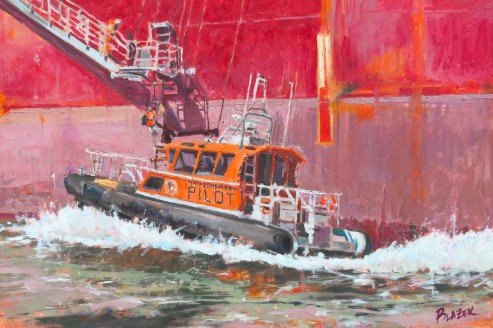 Of course, the sea, ships and boats have inspired artists for centuries – as well as me, although my artistic skills are not at the level of Joey Blazek! The original work of art (pictured right), entitled Matagorda Pilot Transfer, was painted by US artist Joey Blazek and measures 30 by 48 inches. It depicts a dramatic scene of a pilot transfer underway, and his expressive style of painting really caught my eye.
His paintings focus primarily on the US coastal South, including the Gulf Coast’s wildlife and industrial, maritime and agricultural landscapes. “I started doing pilot boat paintings just because I was drawn to that,” he says. “I wasn’t really thinking anybody would find them interesting, but I just wanted to do them.”
Many of Blazek’s original pieces are based on reference photos he took in Sabine Pass and other areas with heavy marine traffic. Pilots noticed these pieces at festivals, and eventually, Blazek met a pilot who offered to send him images to paint. This painting is based on one of those photographs.
If you are interested in seeing more of Joey’s work, click here.
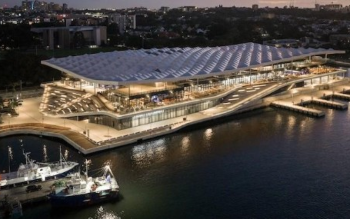
New Sydney fish market opens as a landmark destination
Over the years, I have visited many fish markets around the world, some more memorable than others – perhaps Bergen in Norway being one of the finest examples. They always fascinate me. But reading news about the superb new fish market, just opened in Sydney made me stop and think. Such a beautiful structure, but will it smell like a traditional fish market?
Here’s the story! Signalling a transformative moment for Blackwattle Bay and the redevelopment of Sydney’s harbour foreshore, the new Sydney Fish Market demonstrates how thoughtfully designed contemporary market space can create a landmark urban destination. By prioritising waterfront access and public amenity, the project reimagines one of Sydney’s most important civic assets for generations to come.
The publicly accessible market hall level will accommodate 12,200 sqm of fishmongers, restaurants, cafés and speciality vendors, creating the atmosphere of a lively, intimate marketplace. The design carefully separates various circulation flows, enabling the daily operations of a working fish market to safely coexist with public visitors. Expansive, glazed facades create strong visual connections to the harbour, ensuring an authentic open-air market feel. Within precisely controlled climate zones, bespoke equipment supporting live seafood, sorting the daily catch and producing up to 70 tonnes of ice per day is visible to the public as they move through the retail market, offering rare insight into the complex logistics that keep the market operating from pre-dawn hours.
Masts of historic Glasgow tall ship removed for restoration
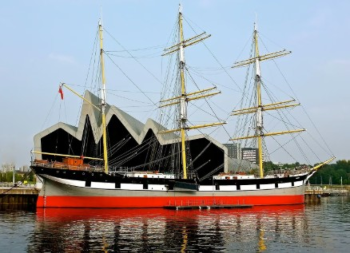
You may know of my keen interest and enthusiasm for the restoration of heritage vessels from past articles. So, I was delighted to see from my news feeds that in the port city of Glasgow, Scotland, the masts of an historic ship that serves as a reminder of a proud shipping past have been removed for the first time in 30 years.
For decades, the masts of the tall ship Glenlee have been a familiar sight on River Clyde where she serves as a floating museum sitting alongside Glasgow’s Riverside Museum. Over the coming few months, the masts will be conspicuously absent following their removal as part of efforts to conserve the historic ship.
The Tall Ship Glenlee Trust, an independent charity that owns Glenlee, said the removal of the masts forms the second phase of the ship’s restoration project that is being funded by a $2.4 million grant from the National Heritage Memorial Fund.
Built 130 years ago by Anderson Rodger in the Bay Yard at Port Glasgow, the steel-hulled ship that was designed to carry cargo across the world today stands as an iconic representation of Glasgow’s proud shipping past. Though refurbishments were carried out over the intervening years, Glenlee is now undergoing its deepest restoration project in over three decades. Following their removal, two of the ship’s three masts have been transported to a workshop where a detailed analysis of their strength and condition will be performed.
4,000 tonnes of invasive weed cleared from the UK canal network
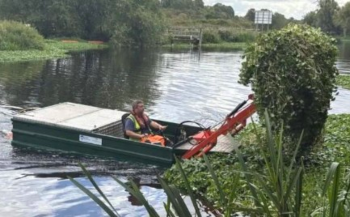 It is not the first time I have visited this topic, but it has drawn me back again. I remember smiling to myself a few years back when new job titles first appeared, drone pilots being one of them. Now we must add invasive aquatic weed cutter and remover to the list, and judging by this story, career prospects look good!
Last year, nearly 4,000 tonnes of invasive aquatic weed were removed from Britain’s canals and waterways by a single contractor. It highlights the growing impact of climate change on one of the UK’s oldest and most important infrastructure networks and underlines the need for urgent action.
The scale of the problem has been highlighted by marine and waterways engineering specialist The Rothen Group, which warns that unmanaged vegetation poses serious risks not only to the appearance of waterways, but also to flood prevention, navigation safety, biodiversity and community wellbeing. The work was carried out using specialist weed-cutting boats equipped with tugs and hoppers, alongside crane hoppers for tackling larger floating mats, allowing weed to be safely removed and placed on the bank.
The Rothen Group has warned that the threat posed by non-native aquatic vegetation is increasing. Invasive species out-compete native plants for light, water, nutrients and habitat, while also reducing oxygen levels in the water, which harms fish and other wildlife. Without intervention, this imbalance can severely damage canal ecosystems.
That’s it for this month.
Mike Schwarz