IACS publishes new Unified Requirement on ammonia release mitigation systems
IACS, the International Association of Classification Societies, has released a new Unified Requirement (UR H2) establishing a comprehensive safety framework for ammonia release mitigation systems (ARMS) on ammonia-fuelled ships.
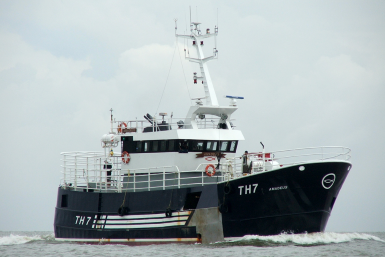
Stern trawler Opportune sank in 2024 due to “rapid and uncontrollable engine room flood” said the Marine Accident Investigation Branch (MAIB) in a final report.
The skipper’s decision-making skills and the crew’s training meant all of Opportune’s eight crew were rescued uninjured from the vessel’s liferafts by coastguard helicopters. Unfortunately, the vessel was not recovered.
Alongside the investigation report, the MAIB released a safety flyer to the fishing industry highlighting that on average, over seven fishing vessels are lost every year due to flooding. It also urged fishing vessel owners to have a maintenance plan for their vessel’s seawater pipework to ensure that it is routinely inspected and, if necessary, tested. The saltwater environment is very corrosive, and hot dipped galvanised pipework has a limited life, so replacement should be expected over a 20-year vessel operational life. Continue reading “Uncontrollable engine room flood sank trawler Opportune, says MAIB”
Britannia P&I has released updated guidance notes for condition surveys Forms on IG Ships.
Now available for both surveyors and masters, the revised documents have been developed to provide clearer direction on completing the International Group’s ship condition survey report forms, supporting more consistent reporting standards across the fleet. Continue reading “Britannia P&I updates guidance notes for condition surveys”
Bureau Veritas has shared a summary on the twelfth session of IMO Sub-Committee on Ship Design and Construction (SDC 12), which was held earlier this year.
SDC 12 agreed on:
– draft amendments to the 2011 ESP Code, with a view to approval in principle by MSC 111, formal approval by MSC 113 and adoption by MSC 114, as appropriate;
– draft guidelines on the use of Remote Inspection Techniques (RIT) with a view to adoption by MSC 111, in conjunction with the adoption of the draft amendments to the 2011 ESP Code to allow the use of RIT in ESP Code surveys; Continue reading “Bureau Veritas summary of IMO SDC 12”
The Bahamas Maritime Authority has concluded an investigation after an electrical cadet died of probable mechanical (positional) asphyxia after trying to exit an access space on board a passenger ship.
On 21 January 2025, an electrical cadet on board Bahamas flagged passenger ship, Grandeur of the Seas, went into an access space to troubleshoot a level transmitter for a bilge water settling tank. He attempted to exit the space but lost his footing on a ladder he placed outside, and became stuck in a suffocating position. Continue reading “Electrical cadet died of asphyxia, BMA investigation concludes”
Consortium advances design of new medium-sized uncrewed support vessels
A UK-led consortium has secured government backing to develop a new class of medium-sized uncrewed support vessels (USVs), marking a significant step forward in maritime innovation.
The Swedish Club has shared a case study in which grain beneath a leaking cargo hold hatch was damaged after a vessel encountered severe weather conditions.
In late November, a geared bulk carrier was loading grain at a U.S. West Coast port, with Asia as the discharge destination. Prior to commencement of loading, the cargo holds were inspected and passed by a surveyor in accordance with current USDA/FDA standards. The vessel’s crew had also prepared the cargo holds and hatch covers in line with ISM requirements and industry guidelines, which included cleaning the hatch coaming channels and hose testing of the hatch covers. No signs of water ingress were detected during the pre-loading inspection. Continue reading “The Swedish Club shares case study on leaking cargo hold hatch”
Pictured: Left to right: Nick Tomkinson, GNSP; Simon Williams, Rolls Royce; Blair Jamieson, Babcock; Mark Tipping, Lloyd’s Register; Kirsti Massie, Stephenson Harwood; and Mike Salthouse, NorthStandard
The UK is taking a decisive step towards leading the global race to decarbonise shipping with the launch of the Maritime Nuclear Consortium and its plans for a nuclear-powered fleet.
Britannia P&I Club safe handling of heavy steel plates
Britannia P&I Club has highlighted a case in which a crewmember was seriously injured after steel plates crushed him and encourages the safe handling of heavy steel plates.
Biofuel reduces black carbon emissions by 81% says Cleanship experts. Credit: Danish Technological Institute
New Danish data, collected during real-world sailing, documents significant climate benefits from biofuel for the shipping industry as biofuel reduces black carbon emissions.
Soot particles – also known as black carbon – are among the most harmful emissions from shipping, both for the climate, where they contribute to global warming and melting of Arctic ice, and for public health through poor air quality.