News

Warning sent out on counterfeit GMDSS batteries

Warning sent out on counterfeit GMDSS batteries

The Norwegian Maritime Authority has sent out a warning following a significant increase in the marketing, sale and installation of counterfeit batteries for Jotron GMDSS products in recent years.

Affected products include Emergency Position Indicating Radio Beacons (EPIRB), radar and AIS-SART devices, as well as handheld GMDSS emergency VHF radios. Continue reading “Warning sent out on counterfeit GMDSS batteries”

DNV shares insights into post-fire ship hull structure and material assessment

DNV shares insights into post-fire ship hull structure and material assessment

Fire incidents on ships rank among the most frequent accidents, and in recent years, fire incidents have specially increased among container and ro-ro cargo/passenger ships.

And DNV has supported many cases of post-fire structural and material assessments.

The incidents have ranged from isolated small-scale fires in cargo holds to major fires damaging the complete ship. Continue reading “DNV shares insights into post-fire ship hull structure and material assessment”

IACS publishes recommendation for onboard lifting appliances

IACS publishes recommendation for onboard lifting appliances

IACS, the membership organisation for the world’s leading classification societies, has published a recommendation to improve safety standards for lifting appliances, in line with SOLAS regulations covering both new and existing lifting appliances.

Lifting appliances play a vital role in cargo handling and ship operations, yet their limited structural redundancy has long posed safety risks for crews and vessels. To address these hazards, the International Maritime Organization (IMO) Continue reading “IACS publishes recommendation for onboard lifting appliances”

O-ring failure caused $5.5M engine room fire on bulk carrier, says NTSB

Left photo is of lower module of the oil fittings block showing overlap between the lower and upper module fuel ports. Right photo is the upper module of oil fittings block and fuel flow meter showing the pinched O-ring as indicated.
Source: Lemissoler Shipmanagement

A failed O-ring seal on a bulk carrier’s composite boiler unit led caused a fire costing more than $5 million dollars in damage, said an investigation report by the National Transportation Safety Board (NTSB).

On January 4, 2025, at about 2323, bulk cargo vessel Lem Verbena was docked at the Alabama State Docks on the Mobile River in Mobile, Alabama, with 19 crewmembers on board when a fire started in the engine room. Continue reading “O-ring failure caused $5.5M engine room fire on bulk carrier, says NTSB”

Brookes Bell on engineering analysis when the answer isn’t clear

Brookes Bell on engineering analysis when the answer isn’t clear

Engineering claims rarely begin with a complete picture, says Brookes Bell. More often, they start with partial evidence, damaged components, and an initial explanation of what may have gone wrong. In practice, those early assumptions are not always reliable.

For Andrew Kingshott, recognising and managing this uncertainty is a fundamental part of the investigation process. Continue reading “Brookes Bell on engineering analysis when the answer isn’t clear”

CHIRP Annual Digest 2025-2026 published

The CHIRP Annual Digest 2025-2026 is based on over 300 reports received

CHIRP Annual Digest 2025-2026 reveals that the organisation received 330 reports concerning safety, welfare, and compliance issues across all sectors, including commercial shipping, superyachts, fishing, pilotage, offshore installations, ports, search and rescue units, recreational vessels, and the “shadow fleet”.

Whilst praising those who had contributed, Adam Parnell, CHIRP’s Director Maritime said, “Speaking up is not always easy, but your reports have prevented harm, corrected unsafe practices and improved working conditions for many others.” Continue reading “CHIRP Annual Digest 2025-2026 published”

Best practices to avoid complications of mass flow meters

Best practices to avoid complications of mass flow meters

NorthStandard P&I Club has provided essential information about the potential vulnerabilities and limitations of mass flow meters (MFMs) in bunkering operations, providing key tips for operators to avoid any complications.

As explained by Alvin Forster, Senior Loss Prevention Executive – Americas & UK, NorthStandard, although mass flow meters are designed to improve accuracy and reduce disputes, they are not immune to manipulation. Documented cases in Singapore showed the use of strong magnets placed on sensors to distort readings, resulting in inflated recorded deliveries and significant financial fraud. Continue reading “Best practices to avoid complications of mass flow meters”

Ensure the SMS adequately addresses electrical hazards

Ensure the SMS adequately addresses electrical hazards

The Liberia Maritime Authority has issued a circular to reinforce mandatory safety requirements and operational controls related to electrical hazards onboard vessels, with particular emphasis on the use, handling, relocation, and isolation of portable electrical equipment.

A number of very serious marine casualties involving fatal electrocution demonstrate that routine shipboard activities can present significant electrical risks when energized equipment is handled without adequate isolation, inspection, Continue reading “Ensure the SMS adequately addresses electrical hazards”

2010 HNS Convention moves closer to entry into force

Four states set to ratify the HNS Convention

Four States deposited their instruments of ratification of the International Convention on Liability and Compensation for Damage in Connection with the Carriage of Hazardous and Noxious Substances by Sea, 2010 (2010 HNS Convention), bringing the treaty’s entry into force a step closer.

As announced, Belgium, Germany, the Kingdom of the Netherlands, and Sweden have deposited their instruments of ratification to the 2010 HNS Convention, marking an important step toward its entry into force. The Convention seeks to Continue reading “2010 HNS Convention moves closer to entry into force”

Key risks in the carriage of baled Refuse Derived Fuel

Key risks in the carriage of baled Refuse Derived Fuel

Recent cases have highlighted growing safety and operational concerns linked to the carriage of baled Refuse Derived Fuel, as increasing trade volumes continue to expose its variable—and at times hazardous—behaviour at sea, the Swedish Club has warned.

Refuse Derived Fuel is produced from mixed municipal and commercial waste after sorting and removal of non‑combustible materials. The remaining fraction can contain a significant biodegradable component and often varies considerably in composition. Continue reading “Key risks in the carriage of baled Refuse Derived Fuel”

MCA update on MGN 708(M) Guidance on the merchant shipping ISM regulations

The UK MCA has released an amendment to MGN 708(M), which sets out guidance and instructions regarding International Safety Management and the application of the Merchant Shipping International Safety Management Regulations 2026.

This notice replaces the 2014 ISM regulations and assimilated regulations 336/2006 in implementing the ISM code in UK law.

It also addresses certain gaps which arose in the previous legislation as a result of the UK leaving the EU, Continue reading “MCA update on MGN 708(M) Guidance on the merchant shipping ISM regulations”

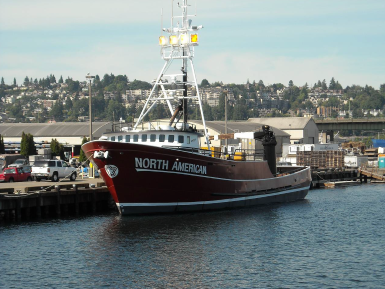
Fishing trawler Freedom II sank following engine room flooding

Fishing trawler Freedom II sank following engine room flooding. Image caption: Image courtesy of MarineTraffic

Four crewmembers had to be rescued after uncontrolled flooding on prawn trawler Freedom II caused the vessel to founder and later sink off the Scottish coast.

The MAIB received 230 reports of flooding of fishing vessels between 2013 and 2022, of which 78 (34%) resulted in the loss of the vessel. The data indicates flooding remains a significant safety issue. Continue reading “Fishing trawler Freedom II sank following engine room flooding”

Instagram Posts from the IIMS @iimsmarine

Privacy Overview

This website uses cookies so that we can provide you with the best user experience possible. Cookie information is stored in your browser and performs functions such as recognising you when you return to our website and helping our team to understand which sections of the website you find most interesting and useful.

Strictly Necessary Cookies

Strictly Necessary Cookie should be enabled at all times so that we can save your preferences for cookie settings.

Show details Hide details
Performance & Marketing Cookies

This website uses Google Analytics to collect anonymous information such as the number of visitors to the site, and the most popular pages. This also helps us optimise our marketing campaigns. User data sent to Google Analytics may be used for ad personalization and measurement of our ad campaigns. Keeping this cookie enabled helps us to improve our website.

Show details Hide details