News

Key considerations for the carriage of cement

Key considerations for the carriage of cement. Photo credit: Britannia P&I Club

The volume of seaborne cement trade continues to grow, with the most recent annual figure estimated to be over 145 million tonnes, however, the carriage of cement on conventional bulk carriers presents significant operational challenges, Britannia P&I Club explains.

According to Britannia P&I Club, bulk cement is typically carried on dedicated cement carriers or standard bulk carriers. On dedicated carriers, cement is loaded from shore silos through a pneumatic system and discharged via a closed self-unloading system, where compressed air fluidizes the cargo and a vacuum pipeline transfers it to shore—effectively minimizing dust and preventing hardening. In comparison, loading cement on conventional bulk carriers, whether in bulk or in bags, remains a much more challenging operation. Continue reading “Key considerations for the carriage of cement”

Update on MGN 675 (M+F) guidance for control and management of ships’ ballast water and sediments regulations

Update on MGN 675 (M+F) guidance for control and management of ships’ ballast water and sediments regulations

The UK Maritime & Coastguard Agency has published an update to MGN 675 (M+F) Amendment 2 The merchant shipping (control and management of ships’ ballast water and sediments) regulations 2022.

This notice provides important information on the UK’s implementation of the international convention for the control and management of ships’ ballast water and sediments 2004, which aims to address the spread of invasive non-native species by ballast water and sediments. Continue reading “Update on MGN 675 (M+F) guidance for control and management of ships’ ballast water and sediments regulations”

Study raises alarm on marine fiberglass pollution

Study raises alarm on marine fiberglass pollution

Simon Fraser University researchers have uncovered concerning fibreglass contamination in a key estuary on Vancouver Island, raising concerns about how an as-yet overlooked contaminant could affect aquatic birds, marine life and coastal communities that rely on shellfish and seafood.

A new SFU study found fibreglass particles buried in the sediment and biofilm layers of the Cowichan Estuary, a 400-hectare intertidal ecosystem used by the Cowichan Tribes First Nations for generations. The areas is an internationally designated important bird area and used for harvesting clams, geoducks, crabs, waterfowl, cod roe, urchins and salmon. Continue reading “Study raises alarm on marine fiberglass pollution”

A comparative study of underwater radiated noise from electric and conventional boats

A comparative study of underwater radiated noise from electric and conventional boats

A new, peer-reviewed study conducted by University College London’s Department of Mechanical Engineering in collaboration with RAD, a UK-based electric marine propulsion company, examined underwater radiated noise across a range of operating speeds, comparing electric and conventional boats. Their aim? To discover if electric boats really are quieter.

The study, titled ‘A comparative study of underwater radiated noise from electric and conventional boats’, is published in the Journal of the Acoustical Society of America (JASA). It was conducted by UCL’s Department of Mechanical Engineering in collaboration with RAD, a UK-based electric marine propulsion company. Continue reading “A comparative study of underwater radiated noise from electric and conventional boats”

New DNV AI tool RuleAgent makes navigating maritime rules easier

RuleAgent an AI-powered tool helps maritime professionals access DNV’s rules and standards faster and with greater clarity

DNV has launched RuleAgent, an AI-powered tool that helps maritime professionals access DNV’s rules and standards faster and with greater clarity. Designed to reduce the time customers spend navigating regulatory material, it enables users to ask natural‑language questions and receive targeted results. Fully connected to DNV’s rules and standards database, this new tool provides complete traceability to DNV’s official sources.

Maritime regulations are continuously evolving. Navigating the more than 30,000 pages of DNV’s rules across multiple documents, chapters, and editions can be complex and time-consuming. By presenting content in real time, RuleAgent enables users to identify the relevant rule paragraphs quickly, reducing the time spent searching across multiple documents. Continue reading “New DNV AI tool RuleAgent makes navigating maritime rules easier”

Safety guidelines for wind-assisted ships issued by MTF

Safety guidelines for wind-assisted ships issued by MTF

The Maritime Technologies Forum (MTF) has published new safety guidelines to support the safe operation of wind-assisted ships, those using wind-assisted propulsion systems, as the shipping industry increasingly adopts technologies aimed at reducing fuel use and emissions.

The guidelines provide recommendations for developing and implementing safety management systems tailored to vessels equipped with wind-assisted propulsion systems (WAPS), including rotor sails, suction sails and wing sails. Continue reading “Safety guidelines for wind-assisted ships issued by MTF”

Lithium-ion Battery Fires: What We Know So Far – edition 2 published

Edition 2 of the lithium-ion battery fires: What we know so far guide has been published

In edition 2 of the “Lithium-ion Battery Fires: What We Know So Far”, the Maritime Professional Council of the UK (MPC) warns of the rising risks and dangers of lithium-ion battery fires to ships, boats and their crews.

The maritime industry faces increasing incidents and fires due to lithium-ion technology, particularly with the growing use of electric vehicles (EVs) and a myriad of devices powered by these batteries. Lithium-ion batteries have a high energy density, making them efficient but also prone to catastrophic failures if mishandled. Continue reading “Lithium-ion Battery Fires: What We Know So Far – edition 2 published”

IACS 2025 Annual Review published

IACS 2025 Annual Review published

The IACS 2025 Annual Review explores the work of IACS and its classification society Members during 2025 in leading the development of technical requirements and guidance to support global shipping.

The report identifies many areas of progress, including IACS’s ongoing role in supporting industry decarbonisation objectives and the IMO’s efforts to balance its environmental ambitions with safety. Through it’s Safe Decarbonisation Panel, IACS is supporting progress in respect of a number of alternative fuels, whilst remaining neutral on any preferred option. This includes the development of Resolutions on the safe use of alternative fuels which underpin IMO regulations, or the classification rules of each IACS Member. Continue reading “IACS 2025 Annual Review published”

Transport Malta publishes report into explosion aboard container ship CMA CGM Shanghai

Transport Malta publishes report into explosion onboard container ship CMA CGM Shanghai

Transport Malta has released a simplified final report into a starting air explosion during berthing operations aboard CMA CGM Shanghai in Singapore.

What happened

CMA CGM Shanghai arrived just outside its designated discharge port of Singapore in the early hours of 15 March 2025, completing an 11-day voyage from Karachi, Pakistan.

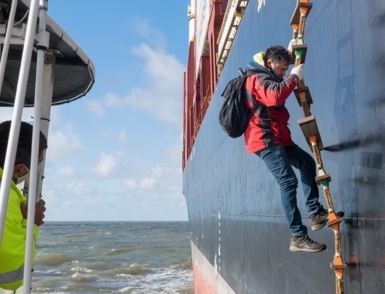
The vessel was expected to remain outside port limits for approximately 50 minutes. During this time, the crew prepared the pilot ladder and completed arrangements for the pilot, who boarded the vessel at 0612 local time. Continue reading “Transport Malta publishes report into explosion aboard container ship CMA CGM Shanghai”

Tokyo MOU shares preliminary results of CIC on Ballast Water Management

The Tokyo MOU has released the preliminary results of a Concentrated Inspection Campaign (CIC) it held which focused on aspects of the Ballast Water Management Convention (BWM) 2004.

The campaign was carried out from 1 September 2025 to 30 November 2025, jointly with the Paris MoU.

Over the course of the CIC period, involving all types of ships, a total of 9,244 inspections were carried out. Of these inspections, 6,930 (74.96%) inspections were performed using the CIC questionnaire and a ship was subjected to only one CIC inspection during the campaign period. During the period, 184 ships where CIC was carried out were detained in total (2.66% detention rate). Of which, 30 detentions were the result of inspections with CIC questionnaires, which were detained as a direct result of the CIC concerning deficiencies, reflecting a CIC topic related detention rate of 0.43%. Continue reading “Tokyo MOU shares preliminary results of CIC on Ballast Water Management”

IMPA warns of risks of deregulation in maritime pilotage

The International Maritime Pilots’ Association (IMPA) has sent out a warning of the consequences of deregulation and competition in maritime pilotage.

Maritime pilotage is a public, not commercial, service that exists for safety of navigation — protecting people, the environment and trade. IMPA said some jurisdictions are tempted by the idea that deregulation and competition deliver a better service at a lower cost. This is a mistake, and the evidence agrees. Continue reading “IMPA warns of risks of deregulation in maritime pilotage”

Seafarer died after being struck by steel plate says Marshall Islands

Seafarer died after being struck by steel plate says Marshall Islands

An Able Seaman died instantly after steel plates fell and struck him while on board Shaman Wisdom, said a safety investigation report by the Republic of the Marshall Islands Maritime Administrator.

What happened

On 5 June 2024, at 0800, the Bosun on board Shaman Wisdom instructed the ASD1 and ASD2 to select a suitable steel plate in the Forecastle Store to construct a step for one of the deck stairs. Both the ASD1 and ASD2 were wearing the standard PPE to work on deck, including a safety helmet, coveralls, and safety shoes. Continue reading “Seafarer died after being struck by steel plate says Marshall Islands”

Instagram Posts from the IIMS @iimsmarine

Privacy Overview

This website uses cookies so that we can provide you with the best user experience possible. Cookie information is stored in your browser and performs functions such as recognising you when you return to our website and helping our team to understand which sections of the website you find most interesting and useful.

Strictly Necessary Cookies

Strictly Necessary Cookie should be enabled at all times so that we can save your preferences for cookie settings.

Show details Hide details
Performance & Marketing Cookies

This website uses Google Analytics to collect anonymous information such as the number of visitors to the site, and the most popular pages. This also helps us optimise our marketing campaigns. User data sent to Google Analytics may be used for ad personalization and measurement of our ad campaigns. Keeping this cookie enabled helps us to improve our website.

Show details Hide details