Biofuel reduces black carbon emissions by 81% says Cleanship experts. Credit: Danish Technological Institute
New Danish data, collected during real-world sailing, documents significant climate benefits from biofuel for the shipping industry as biofuel reduces black carbon emissions.
Soot particles – also known as black carbon – are among the most harmful emissions from shipping, both for the climate, where they contribute to global warming and melting of Arctic ice, and for public health through poor air quality.
Owners and operators of beam and scallop trawlers have been urged to inspect their vessels’ quick-release arrangements after a deckhand was fatally injured by chain failure on the Honeybourne III in 2023.
IACS updates safety requirements for ammonia-fuelled engines
The International Association of Classification Societies (IACS) has announced a landmark revision to its Unified Requirement UR M78, introducing comprehensive safety requirements for marine engines fuelled by ammonia.
The newly published Rev.4 of UR M78 expands its scope to include ammonia as an approved fuel for reciprocating internal combustion engines. This development reflects IACS’s commitment to enabling innovative propulsion technologies while maintaining the highest safety standards.
LNG-fueled vessels lead alternative-fueled newbuild market
The latest annual data from DNV’s Alternative Fuels Insight (AFI) platform showed that within the container segment, alternative fuels dominated, with the fuel mix by tonnage approximately 58 percent LNG, 36 percent conventional fuels, and 6 percent methanol.
In a first of its kind, the Directorate General of Shipping (DGS) has developed a comprehensive Safety Video Series to improve safety awareness across the maritime workforce.
The DGS has observed recurring safety lapses and incidents attributable to deficiencies in safety awareness by shipping companies, seafarers and trainees as evidenced by casualty investigations conducted by the Directorate. Continue reading “India DGS launches Safety Video Series”
Canal & River Trust has published its Vital Connector for Nature and People report, in which it explores the wellbeing benefits of the UK canal network
The Vital Connector for Nature and People report has highlighted how the UK’s historic canal network — the nation’s longest and most connected corridor of freshwater habitat — is one of Britain’s most important yet under-recognised assets for nature recovery, public wellbeing and community connection.
The Vital Connector for Nature and People report, published by the Canal & River Trust and supported by environmental leaders including Dr Tony Juniper CBE, chair of Natural England, shows how canals can play a unique role in tackling three converging national challenges: biodiversity loss, declining connection with nature, and widening health and wellbeing inequalities. Continue reading “Canal & River Trust Vital Connector for Nature and People report published”
Performance of extinguishing agents against lithium-ion battery fire
This study presents a systematic evaluation of extinguishing agents against lithium-ion Battery Energy Storage Systems (BESS), specifically examining thermal runaway propagation in small domestic system (8 kWh). Five distinct suppression methods were evaluated: water mist, encapsulator agent (water mist with proprietary encapsulator), carbonate agent (water mist with ammonium bicarbonate), mixed agent (containing boron compounds and surfactants), and liquid nitrogen.
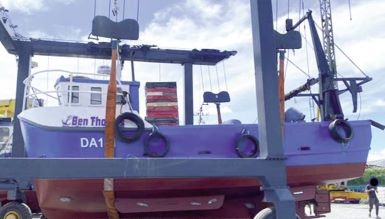
FV Ben Thomas (image supplied by the vessel’s owner). Source: MCIB
A crewmember died after the fishing vessel, Ben Thomas capsize and sank off the Irish coast.
A report into the incident, which took place two years ago, has been released by the Irish Marine Casualty Investigation Board (MCIB), concluding the investigation.
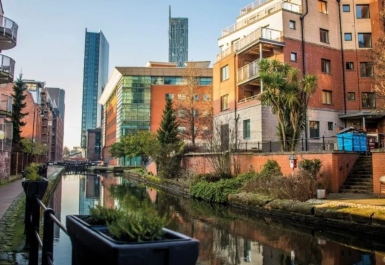
For my first two stories this month, I turned to the UK inland waterways, always a source of inspiration. The first story is shocking as you are about to find out.
Just before the Christmas holidays, a severe breach occurred on the Llangollen Canal near New Mills Lift Bridge, Whitchurch, with devastating consequences for several boaters. Footage of this extraordinary event shot around the UK news channels as it made the headlines. Continue reading “What caught my eye: February 2026”
The MITAGS campus will host the IIMS Baltimore Conference 2026 on 30-31 January
A belated welcome to 2026 and a Happy New Year to you and your family. In a turbulent world, may it be a good and prosperous one for you.
IIMS celebrates its 35th anniversary later this year. That’s something to be proud of, and as an Institute we have come a long way in a little over a third of a century. I was curious to research and discover what a 35th wedding anniversary is known as. To my surprise and delight, I discovered it is referred to as a coral anniversary! The nautical connotations made it seem very appropriate indeed. Continue reading “CEO blog: January 2026”
There is a slew of new and revised documentation released by the UK Maritime & Coastguard Agency (MCA) covering the period of December 2025 to January 2026.
Published on 12 December 2025
MSN 1908 (M+F) Amendment 2 – The merchant shipping (control and management of ships’ ballast water and sediments) regulation 2022. This MSN provides the technical requirements of the obligations contained in the merchant shipping (control and management of ships’ ballast water and sediments) regulations 2022 (SI 2022/737). Continue reading “New documentation from the MCA”




 For my first two stories this month, I turned to the UK inland waterways, always a source of inspiration. The first story is shocking as you are about to find out.